Why AI Is Becoming Mandatory for Brokerages in 2026
The competitive dynamics in US residential real estate have shifted decisively. AI adoption in real estate has accelerated rapidly — brokerages and individual agents are integrating AI tools across CRM automation, content generation, and lead follow-up sequencing at a pace that has reshaped competitive expectations.
The benchmark that matters most: a Harvard Business Review study analyzing 2,241 US companies found firms that contacted leads within one hour were 7x more likely to qualify them than those who waited longer. In competitive markets like Texas, Florida, and California — where multiple agents often pursue the same lead simultaneously — that window closes faster than most brokerages acknowledge. The majority still respond in hours, not minutes.
Commission compression compounds the pressure. Buyer-side structures have faced renegotiation following NAR settlement changes effective in 2024, reducing guaranteed buy-side income for many teams. Lead acquisition costs have risen 35–50% across major portals since 2022. Agencies that relied on volume to absorb operational inefficiency are now confronting those margins directly. In 2026, AI adoption is not a technology decision — it is a margin protection decision.
AI-driven automation is delivering similar ROI across other industries as well. For example, e-commerce businesses using AI for cart recovery, personalization, and support automation are reporting significant revenue lift — see our detailed breakdown in AI Tools for E-commerce Store Owners (2026).
- Industry shift: AI adoption across brokerages and individual agents has accelerated sharply — CRM automation, lead follow-up, and content generation are now standard workflow components.
- Acquisition cost pressure: Lead acquisition costs have risen 35–50% across major portals since 2022, per industry benchmarks.
Where Real Estate Agencies Lose Commission
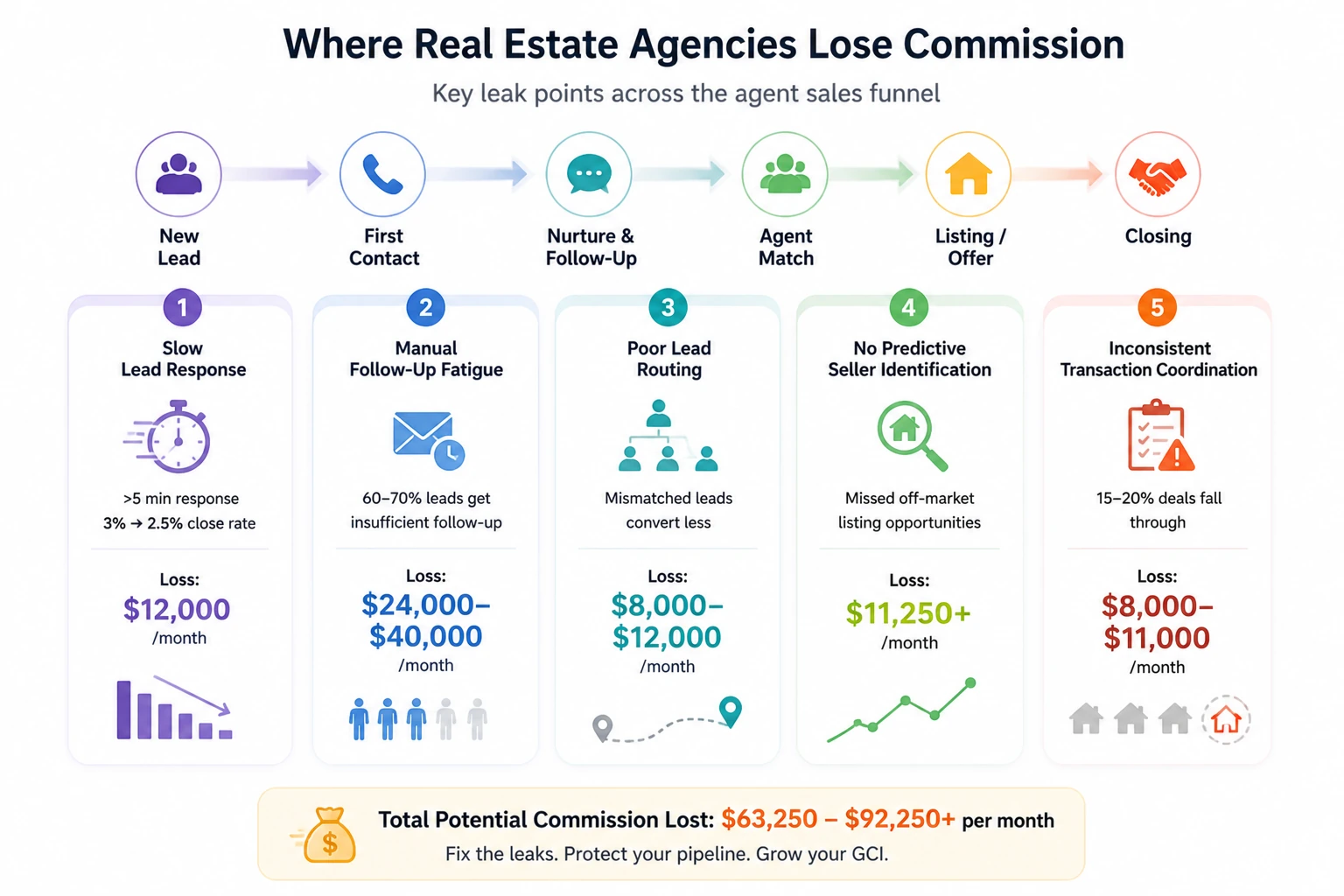
Key stages in the real estate sales funnel where agencies lose commission due to slow response, poor follow-up, misrouted leads, and transaction failures.
Benchmarks below reflect publicly reported industry data from NAR, Zillow, MIT, and InsideSales.com. Individual results vary by lead source quality, market conditions, and agent execution.
1. Slow Lead Response A brokerage receiving 100 leads per month at a 3% close rate generates 3 closings at $8,000 average commission — $24,000 per month in GCI. MIT and InsideSales.com research across more than 15,000 US leads found calling within 5 minutes makes contact 100 times more likely than calling at 30 minutes. A 0.5% close rate drop from chronic slow response removes 1.5 closings per month — $12,000 monthly, $144,000 annually. In teams managing 100–300 inbound leads per month, this pattern is consistent and measurable. AI delivering a qualified response in under 2 minutes is a six-figure annual revenue protection mechanism.
2. Manual Follow-Up Fatigue Zillow and Realtor.com data indicates the average home buyer requires 8–12 touchpoints before committing to an agent. In practice, CRM activity logs across mid-sized brokerages show follow-up completion dropping sharply after day seven — most agents make 2–3 attempts and move on. On a 10-agent team handling 200 leads per month, 60–70% of leads receive fewer touches than conversion requires: 3–5 potential closings dying monthly in the nurture gap. At $8,000 per closing, that is $24,000–40,000 per month in commission leakage traceable to manual follow-up limits.
3. Poor Lead Routing in Teams Lead assignment based on rotation or manual triage rarely optimizes for agent-lead fit. A high-intent buyer matched to a listing specialist, or a luxury inquiry routed to a volume generalist, measurably reduces conversion. A less obvious friction: agents receiving mismatched leads respond more slowly, compounding the response-time problem. One misrouted closing per month costs $8,000–12,000 in commission plus the opportunity cost of a misdirected interaction.
4. No Predictive Seller Identification The highest-margin lead is the off-market listing opportunity — a potential seller identified before publicly signaling intent. Without predictive tools, agencies wait for sellers to self-select through portals, entering a competitive market at the same moment as every other brokerage. One additional listing per month at 2.5% commission on a $450,000 sale represents $11,250 in gross commission invisible to non-predictive operations.
5. Inconsistent Transaction Coordination Industry data places contract fall-through rates at 15–20% of pending transactions nationally. Missed inspection deadlines, delayed lender documents, and unresolved contingency communications drive a significant share of those failures. For an agency managing 10 pending transactions, a 10% fall-through reduction through AI-assisted deadline monitoring preserves approximately one closing per month: $8,000–11,000 in commission that would otherwise revert to zero.
Speed-to-lead is the single highest-ROI problem to solve first. A sub-2-minute AI response operating 24 hours a day protects the commission leak that every other tool assumes you've already fixed. Deploy CRM and AI qualification before any other investment.
Commission Math: What AI Can Realistically Add
Actual results depend on lead quality, market conditions, and operational discipline. The scenarios below use conservative assumptions drawn from documented industry conversion benchmarks and are intended as planning models, not guarantees.
Why Small Percentage Improvements Compound at Scale
A 1% close rate improvement sounds marginal. At 200 leads per month, it means 8 closings instead of 6 — two additional transactions at $11,250 average commission, or $22,500 per month and $270,000 annually. That leverage ratio between a modest operational improvement and its annualized commission impact is why close rate sensitivity deserves more analytical attention from most brokers than it currently receives.
Scenario 1: Solo Agent ($10M Annual Volume)
Baseline: 20 leads/month, 3.0% close rate, $417K avg sale price, 2.5% gross commission = $312,500 annual GCI.
- 1% close rate lift (3.0% to 4.0%) from AI-assisted nurture: 20 leads × 12 months × 4.0% = 9.6 closings vs 7.2 baseline → +2.4 closings × $10,425 = +$25,020/year
- 25% appointment rate increase from sub-5-minute response (grounded in HBR speed-to-lead data): 0.5 additional closing/month = +$62,550/year gross
Conservative annual lift: $25,000–62,000 | Solo AI stack: $1,800–3,600/year | Estimated net gain: $23,000–58,000
Scenario 2: 10-Agent Team
Baseline: 200 leads/month, 3.0% close rate, $450K avg home price, 2.5% commission split.
- 1% close rate lift (3.0% to 4.0%): 8 closings/month vs 6 baseline → +2 × $11,250 = +$22,500/month, +$270,000/year gross
- Routing improvement reducing mismatch by 30%: +0.5 closing/month = +$67,500/year
- 15–20% appointment rate lift from sub-2-minute AI response: +2 closings/month across team = +$22,500/month
Conservative annual lift: $200,000–300,000 | AI stack: $6,000–14,400/year | Estimated net gain: $190,000–290,000
Commission Math Summary
| Metric | Formula / Assumption | Baseline | With AI (Conservative) | Annual Delta |
|---|---|---|---|---|
| Solo: Closings/year | 20 leads × 12 mo × CVR | 7.2 (3.0%) | 9.6 (4.0%) | +$25,000 GCI |
| Solo: AI stack cost | Monthly cost × 12 | — | $150–300/mo | −$1,800–3,600/yr |
| Solo: Net lift (est.) | GCI delta minus stack cost | — | Conservative | +$23,000–58,000/yr |
| Team: Closings/month | 200 leads × CVR | 6 (3.0%) | 8 (4.0%) | +$22,500/mo GCI |
| Team: AI stack cost | Monthly cost × 12 | — | $700–1,200/mo | −$6,000–14,400/yr |
| Team: Net lift (est.) | GCI delta minus stack cost | — | Conservative | +$190,000–290,000/yr |
→ Want exact numbers for your agency? Use the AI ROI Calculator to model your specific closing rate improvement and annual commission lift.
Core AI Stack for Real Estate Agencies
Tool recommendations reflect publicly documented pricing as of 2026, covering starter through mid-tier plans. Specific tools are named for clarity, not as endorsements. Actual cost depends on team size and feature requirements.
CRM and Lead Management
Follow Up Boss ($69–1,000/month based on team size) is the category standard for growth-oriented teams — strong pipeline visibility, smart list management, and native integrations with Zillow, Realtor.com, and Facebook Lead Ads. Every lead enters a defined follow-up action plan immediately upon capture. A consistent operational finding: brokerages that enforce CRM action plan completion as a managed metric see substantially better AI outcomes than those treating CRM use as optional.
Propertybase ($79–249/month) suits established brokerages prioritizing compliance documentation and audit trails, built on Salesforce with transaction management integrated.
For a full breakdown of AI CRM platforms across all business types, see the Best AI CRM Software for Small Businesses (2026 Guide).
AI Lead Qualification and Routing
Structurely ($499–999/month for teams) is the category leader for AI-powered qualification via SMS and email, engaging leads within an average of 90 seconds of capture, qualifying intent, and routing hot leads with appointment booking included. Rechat (typically $200–500/month) provides brokerage-level routing logic by geography, price range, and workload.
A consistent operational pattern: after-hours leads arriving between 6 PM and 9 AM show the greatest contact rate improvement from AI qualification, as they face the longest delays under manual protocols — often 12 hours or more.
AI Chat and Website Conversion
Ylopo ($500–1,500/month) combines AI chat, remarketing, and lead nurture in a real-estate-native platform — its RAIYA AI handles after-hours inquiries, qualifies by search behavior, and books appointments before agent involvement. Aiva Labs ($300–700/month) offers standalone conversational AI for brokerages wanting chat-only coverage without Ylopo's full suite.
Both address the same gap: high-intent inquiries arrive after hours, and next-morning responses frequently cost the relationship.
Predictive Seller and Valuation AI
SmartZip ($500–1,500/month for targeted farming areas) identifies homeowners most likely to list within 6–12 months, aggregating equity position, life event signals, and market timing. Documented conservative lift: 20–40% higher listing conversion in targeted areas versus untargeted outreach — based on published case data, not guaranteed outcomes.
HouseCanary ($50–500/month) provides AI-powered valuations at a documented median error rate of approximately 2.8%, used for rapid CMAs and pre-listing pricing strategy. Together, they can shift listing acquisition from reactive to structurally proactive.
Real estate teams that implement AI in a phased sequence...consistently achieve stronger sustained efficiency gains than those attempting full-stack deployment simultaneously without a measurement baseline.
Solo Agent vs Team vs Brokerage Stack
Solo Stack ($150–300/Month)
Follow Up Boss individual plan ($69/month) + an AI chat tool ($79–149/month) + Calendly ($12/month). Total: $160–230/month. The sole priority: consistent sub-5-minute lead response, 24 hours a day. Add routing or predictive tools only after this baseline is reliably operational.
Small Team Stack ($500–1,200/Month)
Follow Up Boss team plan ($500–750/month) + Structurely ($499–599/month). At 5–15 agents, misrouting and follow-up inconsistency are the primary commission leaks — this combination addresses both. Total: $700–1,200/month. Allow 60–90 days before evaluating full ROI, as behavioral data and agent adoption take time to stabilize.
Brokerage Stack ($2,000+/Month)
Propertybase or Salesforce-based CRM ($1,500–3,000/month) for compliance and transaction management, plus Ylopo ($1,000–1,500/month), SmartZip ($800–1,200/month), and HouseCanary. Full range: $3,000–6,000/month. One additional closing per month at $11,250 recovers 20–50% of the monthly stack cost.
AI Stack Cost vs Commission Lift
| Stack Level | Monthly AI Cost | Add. Closings/Mo (Conservative) | Monthly Commission Lift | Net Monthly Gain |
|---|---|---|---|---|
| Solo Agent | $150–300 | +0.2 avg (2.4/yr) | ~$2,085/mo avg | +$1,785–1,935 |
| Small Team (5–10) | $700–1,200 | +1–2 | $11,250–22,500 | +$10,050–21,800 |
| Brokerage (20+) | $3,000–6,000 | +3–5 | $33,750–56,250 | +$27,750–53,250 |
Break-even on an $800/month team stack: one additional closing at $8,000–11,250 commission covers the full cost. A 0.5% close rate improvement on 200 leads per month achieves this — a conservative target within 60–90 days of properly deployed AI qualification, assuming consistent agent adoption.
→ Calculate your exact stack cost: Use the SaaS Pricing Calculator to model your total monthly AI spend by team size and tool combination.
When AI Tools Are NOT Worth It
-
Under 5 leads per month: No qualification or routing AI generates meaningful ROI at this volume. Invest in lead generation first.
-
No CRM discipline: AI augments a functioning system. Leads tracked in spreadsheets or personal contacts produce disorganized AI outputs. Fix the foundation before layering automation.
-
No follow-up culture: If agents do not execute existing CRM action plans consistently, an AI layer does not solve a behavioral problem. Adoption discipline must precede tool investment.
-
Budget instability: AI stacks carry fixed monthly costs. Variable GCI without a committed operating budget causes on-off tool cycling that destroys AI learning continuity.
-
No defined team structure: Routing AI requires explicit agent roles, territory definitions, and assignment rules. Deploying routing into an undefined team produces randomized assignments — the same problem it is designed to solve, with a technology label attached.
For a complete framework covering AI tool selection, ROI measurement, and stack building, see: Complete Guide to Choosing AI Software for Your Business (2026 Edition).
2026 Trends: Agentic and Predictive Brokerage Systems
Autonomous Follow-Up Agents
Next-generation platforms are piloting autonomous nurture that runs without agent input, adjusting cadence by engagement signal and escalating to humans only at defined intent thresholds. For brokerages managing 200+ leads per month with limited bandwidth, this can expand nurture coverage without proportional headcount growth.
Predictive Seller Flags
Predictive targeting is evolving to individual property-level monitoring — aggregating equity milestones, school enrollment changes, and employment data to flag specific homeowners months before listing intent is publicly visible. Early adopters in competitive markets are documenting measurable first-mover advantages in pre-market conversations.
AI Transaction Coordination
Transaction platforms are integrating AI to monitor deadlines, flag contingency risks, and automate buyer-lender-title communications. For high-volume brokerages, preventing one fall-through per month at $10,000+ per deal may represent the single largest ROI line item in the full AI stack.
Brokerage Governance and Compliance Automation
Post-NAR settlement requirements have materially raised documentation burdens at the brokerage level. AI tools auto-generating buyer representation agreements, tracking disclosure completion, and flagging compliance gaps are becoming operational necessities for brokerages managing 20+ simultaneous transactions.
Real Estate AI Adoption Priorities
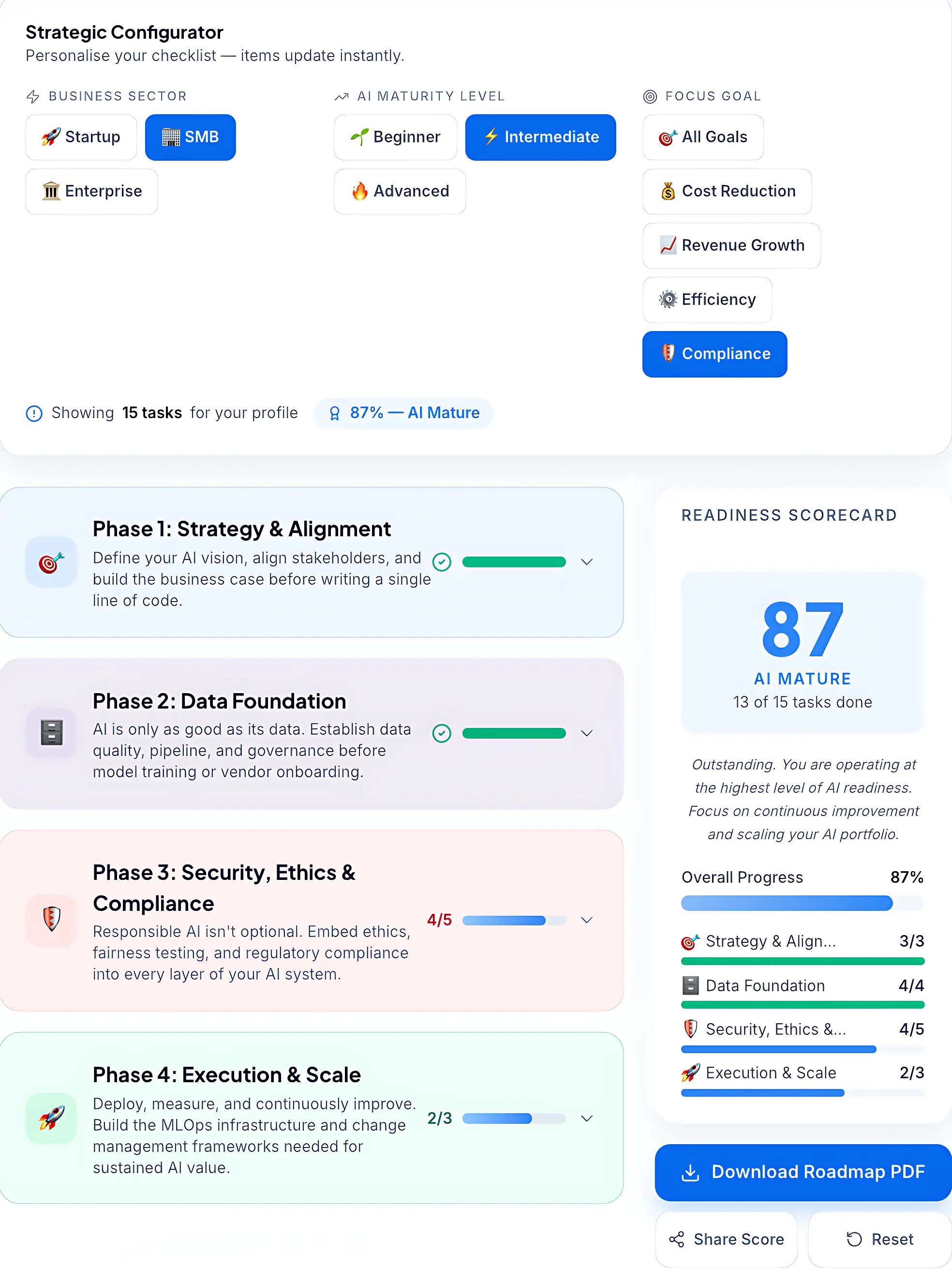
A strategic AI readiness scorecard and 4-phase rollout plan designed to help real estate agencies move from strategy to full-scale automation while maintaining 100% data compliance.
Most real estate businesses achieve better results when AI is implemented in stages rather than deployed across every workflow simultaneously. The goal is to solve the largest operational bottleneck first and expand only after measurable results are achieved.
Priority 1: Lead Response Performance
Start by evaluating your current lead management process. Measure lead-to-first-contact time across every lead source and review CRM follow-up completion rates for each agent. Slow response times and inconsistent follow-up often create the largest revenue leak in real estate operations.
Priority 2: AI-Powered Lead Qualification
Once performance gaps are identified, introduce AI lead qualification using platforms such as Structurely. Automated qualification helps engage prospects immediately, collect key information, and increase appointment opportunities without requiring constant agent involvement.
Priority 3: Automated Routing & Scheduling
After qualification is operating reliably, connect lead data directly to your CRM workflows. Routing rules based on geography, budget range, and agent availability ensure qualified prospects move automatically toward the next step instead of waiting for manual assignment.
Priority 4: Predictive Prospecting
With lead management automation established, expand into predictive seller identification. Tools such as SmartZip can help prioritize outreach efforts by identifying homeowners who show stronger indicators of listing activity, allowing teams to focus resources more efficiently.
Priority 5: Performance Optimization & Scaling
The final stage is continuous measurement. Compare response rates, appointment conversion, and closed transactions against your original baseline. Scale the automations producing consistent ROI and refine underperforming workflows before introducing additional AI systems.
Final Verdict: Is AI Worth It for Real Estate Agencies in 2026?
For agencies receiving consistent lead volume with CRM discipline and defined team structure, the commission math is clear. AI qualification and follow-up automation don't change the fundamentals of real estate — they protect the revenue already in your pipeline from the operational failures most agencies accept as normal.
Businesses that deploy AI automation against their highest-cost operational bottleneck — and measure results within 30 days — are significantly more likely to generate positive ROI within the first 60 days.
Start with response speed. Everything else compounds from there.
Final Thoughts
AI software for real estate agencies is not a feature upgrade — it is a commission protection and pipeline amplification system. The agencies generating the highest returns from AI in 2026 aren't deploying the most tools. They're deploying the right tools in the right sequence, measuring contact rate and close rate against a documented baseline, and scaling only what performs.
A solo agent stack at $150–300/month protecting $23,000–58,000 in annual net GCI. A team stack at $700–1,200/month adding $190,000–290,000 in net commission annually. At every level, one additional closing per month covers the full stack cost.
Evaluate rigorously. Implement deliberately. Measure from day one.