Why AI Selection is the Single Most Critical SMB Decision in 2026
Most small businesses don't have an AI problem. They have a prioritization problem.
They're running lean teams against rising operational costs, losing leads to slower follow-up, producing inconsistent marketing content, and making inventory or cash flow decisions on outdated data. AI software addresses each of these problems directly—but only when the right category of tool is matched to the right problem.
The global AI software market continues to grow rapidly across all business sizes. AI tool adoption has become mainstream — the majority of small and mid-sized businesses now use at least one AI tool. The most consistent benefit reported is time savings on high-frequency manual tasks, freeing teams to focus on higher-value work.
The challenge isn't access. It's selection. With hundreds of platforms competing for attention, most SMB owners either overbuy capability they don't use or underbuy and plateau quickly. This guide cuts through that noise with a structured, category-based comparison of the strongest AI software available to small businesses in 2026—complete with a decision framework, ROI modeling, and direct links to deeper guides for each category.
→ Not sure which AI tool fits your business? Use our AI Tool Selector to get a personalized recommendation in under 30 seconds.
The Five Categories of AI Software That Deliver SMB ROI
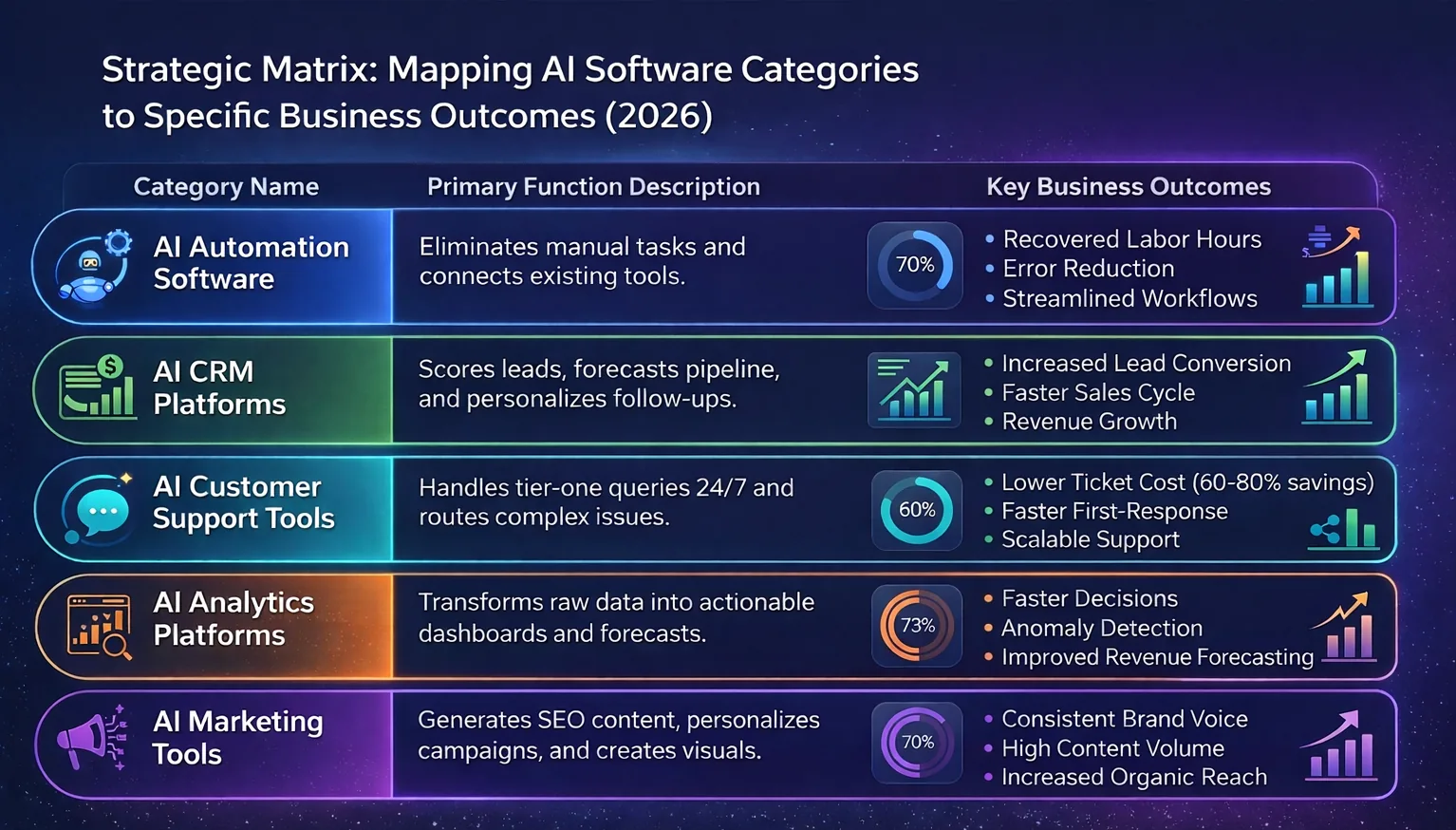
Not all AI tools serve the same function. Before evaluating specific platforms, identify which category addresses your primary operational constraint.
→ Strategy Tip: Picking a tool is only 20% of the battle. To see how to actually roll these out without failing, follow our Step-by-Step AI Implementation Guide (2026).
1. AI Automation Software
Connects existing tools and eliminates manual data transfer by triggering multi-step workflows without human input. Highest ROI for operations-heavy businesses managing multiple software platforms.
2. AI CRM Platforms
Scores leads, forecasts pipeline, personalises follow-up sequences, and surfaces deal risk automatically. Highest ROI for sales-driven businesses where lead management directly determines revenue.
3. AI Customer Support Tools
Handles tier-one inquiries 24/7, routes complex issues to human agents, and reduces support cost per ticket by 60–80%. Highest ROI for businesses with growing inbound support volume.
4. AI Analytics Platforms
Transforms raw business data into actionable dashboards, forecasts, and anomaly alerts without requiring a data analyst. Highest ROI for data-heavy operations needing faster, better-informed decisions.
5. AI Marketing Tools
Generates SEO-optimised content, personalises email campaigns, creates visual assets, and schedules distribution at scale. Highest ROI for content-driven businesses producing consistent marketing output.
Each category has distinct pricing models, implementation complexity, and return timelines. The sections below cover the leading platforms in each.
AI Software Comparison Table: Top Platforms for Small Businesses in 2026
| Tool | Category | Starting Price | AI Depth | Ease of Use | Ideal business Size | Best For |
|---|---|---|---|---|---|---|
| HubSpot | CRM | Free / $45/mo | Med-High | Easy | 1–100 employees | Sales pipeline management |
| Zoho CRM | CRM | $14/user/mo | High | Medium | 5–100 employees | All-in-one SMB CRM |
| Zapier | Automation | $20/mo | Medium | Easy | 1–50 employees | Multi-tool workflow automation |
| ChatGPT Plus | Marketing/Gener AI | $20/mo | High | Easy | 1–20 employees | Content,research,planning |
| Jasper | Marketing | $49/mo | High | Easy | 5–50 employees | High-volume content production |
| Intercom Fin | Customer Support | $74/seat/mo | High | Medium | 10–100 employees | SaaS and tech support |
| Tidio | Customer Support | $29/mo | Medium | Very Easy | 1–20 employees | SMB ecommerce support |
| Zoho Analytics | Analytics | $24/mo | Medium-High | Easy | 1–50 employees | SMB dashboard reporting |
| Microsoft Power BI | Analytics | $10/user/mo | High | Medium | 5–100 employees | Multi-source BI reporting |
| Canva | Marketing | Free / $15/mo | Medium | Very Easy | 1–30 employees | Visual marketing assets |
| Xero | Finance/Operations | $13/mo | Medium | Easy | 1–50 employees | Automated bookkeeping |
| Salesforce Essentials | CRM | $25/user/mo | High | Medium | 10–100 employees | Scaling startup CRM |
The "Best Tool" is a myth. The right tool is the one that integrates natively with your existing stack. A CRM that doesn't talk to your email platform isn't an asset it's a manual data entry chore.
Which Type of AI Software Is Right for Your Business?
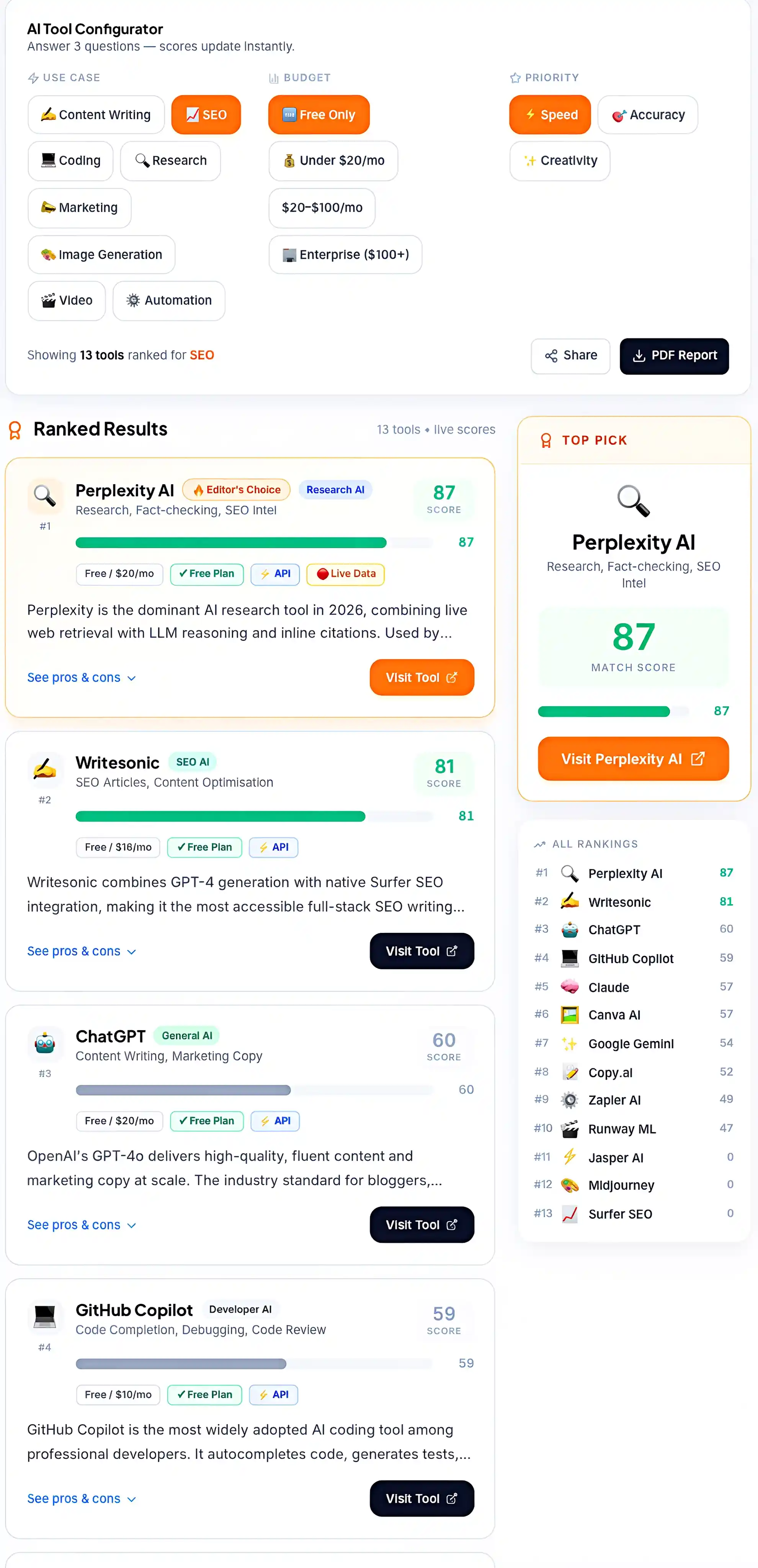
Compare and discover the right AI tools in seconds using our smart AI Tool Selector built for small businesses.
Use this decision framework before shortlisting platforms. The right category matters more than the right brand.
By Primary Business Problem
| Your Primary Problem | AI Category to Prioritise | Starting Platform |
|---|---|---|
| Losing leads due to slow follow-up | AI CRM | HubSpot (Free) |
| Manual data entry consuming team time | AI Automation | Zapier |
| Support tickets growing faster than headcount | AI Customer Support | Tidio or Intercom Fin |
| No visibility into business performance data | AI Analytics | Zoho Analytics |
| Content production is slow and inconsistent | AI Marketing Tools | ChatGPT Plus or Jasper |
| Bookkeeping taking 8+ hours monthly | AI Finance Tools | Xero |
→ Before choosing tools, calculate your total stack cost:Use the SaaS Pricing Calculator tto estimate your monthly AI software spend based on team size and tool combination.
By Business Stage and Size
Solopreneur / 1–3 people: Start with ChatGPT Plus ($20/month) plus HubSpot's free CRM. Total cost: $20/month. Covers content creation, lead tracking, and basic follow-up automation.
Early-stage SMB / 4–15 people: Add Zapier for workflow automation and Canva Pro for visual marketing. Recommended stack: ChatGPT + HubSpot + Zapier + Canva = approximately $70/month.
Growing SMB / 15–50 people: Introduce specialised tools—Jasper for content at scale, Zoho Analytics for business intelligence, and a dedicated customer support AI. Stack cost: $150–$300/month depending on volume.
Established SMB / 50–100 people: Evaluate enterprise-adjacent platforms: Salesforce Essentials, Intercom Fin, Microsoft Power BI. Integration depth and compliance features become critical at this stage.
By Technical Skill Level
| Skill Level | Suitable Tools |
|---|---|
| Non-technical | HubSpot Free, Canva, Tidio, ChatGPT Plus, Xero |
| Intermediate | Zoho CRM, Zapier, Jasper, Zoho Analytics |
| Technical / Developer | Salesforce, Intercom Fin, Power BI, Zapier (Advanced) |
My Evaluation Process
Evaluation Period: June 2026
To prepare this guide, I reviewed the official documentation, pricing pages, feature lists, and publicly available resources for the AI software covered in this comparison.
Each platform was evaluated based on:
- Core AI capabilities
- Ease of setup and onboarding
- Pricing transparency
- Integration options
- Suitability for different business sizes
- Long-term value and scalability
The recommendations in this guide are based on comparative research, official product information, and publicly available resources. They are intended to help small businesses understand the strengths, limitations, and ideal use cases of each platform before making a purchasing decision.
How to Choose AI Software for Your Small Business: A Six-Step Framework
Step 1: Define One Specific Business Problem
Write it as a measurable statement before evaluating any platform. Example: "Our sales team responds to new leads in 6 hours on average. AI should reduce that to under 30 minutes."
Vague intent produces unused subscriptions. Specific problems produce results you can track.
Step 2: Identify the AI Category That Addresses It
Map your problem to the five categories above. A lead response problem is a CRM problem—not a marketing or automation problem. Mismatching category to problem is the most common and costly selection error SMBs make.
Step 3: Audit Your Existing Tech Stack
List every tool your business currently uses. The AI platform you select must integrate with these systems without requiring custom development. A CRM that doesn't connect to your email platform creates more manual work than it eliminates. Verify native integrations specifically—not total integration counts listed in marketing materials.
Step 4: Shortlist Two to Three Platforms and Trial With Real Data
Every platform listed above offers a free tier or genuine trial. Use it with actual business data, real workflows, and real team members for at least two weeks. Demo environments never surface the adoption friction that appears in genuine operational use.
Step 5: Run a Controlled 30-Day Pilot
Limit initial deployment to one team and one workflow. Define two or three KPIs before launch. Track weekly. The pilot produces two outputs: proof of ROI and a deployment playbook for scaling to the wider team.
Step 6: Measure and Expand Deliberately
If the pilot delivers measurable improvement against your defined KPIs, build a phased expansion plan. If it falls short, diagnose whether the gap is in implementation quality, data completeness, or platform fit before investing further.
Businesses that rush from pilot to company-wide deployment encounter 3–4x higher failure rates than those expanding methodically over 6–12 months.
→ Don’t guess your implementation process:Generate a rollout plan using the AI Implementation Checklist tailored to your business.
Top AI Platforms by Category: What to Know Before You Buy
AI CRM Platforms
HubSpot CRM remains the most accessible entry point. The free tier includes lead scoring, pipeline management, email tracking, and a basic AI chatbot—genuinely useful without paying. Paid plans from $45/month add marketing automation, advanced AI features, and deeper analytics. Best for businesses new to CRM or wanting a single platform across sales, marketing, and support.
Zoho CRM delivers deeper AI capability at $14/user/month through its Zia AI engine: predictive lead scoring, sentiment analysis on customer communications, anomaly detection in pipeline data, and revenue forecasting. Best for SMBs willing to invest in setup to access enterprise-adjacent intelligence at affordable pricing.
Salesforce Essentials at $25/user/month suits businesses planning significant growth within 12–24 months. The platform scales to enterprise without migration, and its AppExchange integration library is the deepest in the category.
→ Scaling your CRM? Estimate your real cost using the CRM Cost Calculator based on contacts and team size.
AI Customer Support Tools
Tidio is the fastest-to-deploy option at $29/month flat. Setup takes under 30 minutes. Best for small ecommerce stores and service businesses with straightforward, high-frequency queries. Deflection rates of 40–55% are achievable within 60 days of proper implementation.
Intercom Fin, powered by GPT-4, operates as a genuine autonomous agent—not a scripted chatbot. At $74/seat plus $0.99 per AI resolution, it achieves 50–72% deflection in SaaS environments. Best for technology companies with strong knowledge base content and recurring support patterns.
The distinction between chatbot-tier and autonomous agent-tier tools matters significantly: chatbot-tier typically achieves 40–55% deflection; autonomous agent-tier reaches 65–80%. Match the tool to your expected volume and query complexity—not to the most impressive demo.
AI Analytics Platforms
Zoho Analytics at $24/month provides the most accessible entry point for SMB data intelligence. The Zia AI assistant generates automated insights, detects anomalies, and answers natural language questions about your business data. Pre-built connectors for Shopify, QuickBooks, and Google Ads produce usable dashboards within one day of setup.
Microsoft Power BI at $10/user/month delivers stronger forecasting capability and deeper multi-source integration for businesses with more complex data environments. Natural language querying and AI-powered trend detection make it the strongest mid-tier analytics option for growing SMBs.
AI Marketing and Automation Tools
ChatGPT Plus at $20/month remains the most versatile starting point for marketing content, research, planning, and communication drafting. Output quality scales with prompt sophistication—invest time in building reusable prompt templates for consistent brand voice across all content.
Jasper at $49/month is optimised specifically for marketing output: SEO blog posts, ad copy, email sequences, and long-form content with brand voice templates. For businesses producing 8+ pieces of content monthly, the time savings typically justify the cost within the first month of use.
Zapier at $20/month serves as the integration layer connecting your AI tools to each other and to your existing systems. The 5,000+ app library covers virtually every SMB tech stack, and its no-code visual builder makes complex multi-step automations accessible to non-technical team members.
ROI Modeling: What AI Software Is Realistically Worth
⚠️ Hypothetical estimates only. The figures in this section are illustrative examples based on industry averages and publicly available data. Actual results vary significantly by business size, industry, tool configuration, and team adoption. These numbers are not guarantees of return.
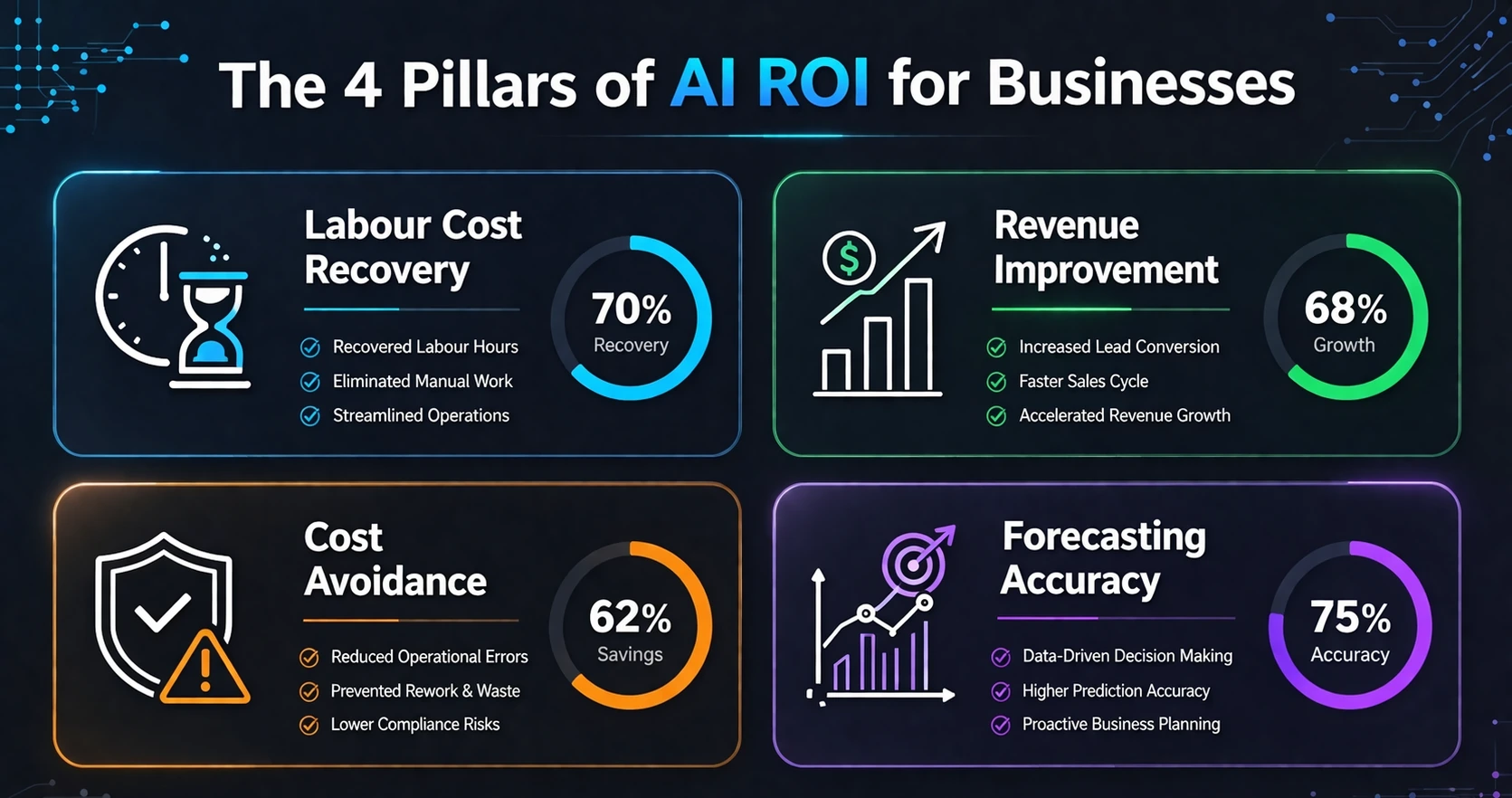
Most small businesses underestimate AI ROI because they measure tool cost but not the value of improved decisions, recovered time, and prevented revenue leakage.
Four-Driver ROI Framework
Driver 1: Labour cost recovered from manual tasks Identify weekly hours spent on tasks AI will automate. A 10-person team spending 4 hours weekly on manual data entry recovers 160 hours monthly. At $25/hour loaded cost: $4,000/month in recovered labour capacity.
Driver 2: Revenue improvement from better follow-up Research from CRM and sales software providers suggests that faster lead response times can improve conversion rates compared with delayed follow-up. However, results vary widely by industry and sales process.
For illustration only, a business with a $50,000 monthly pipeline and a 20% win rate may experience additional revenue if response times are reduced and lead engagement improves. This example is hypothetical and should not be interpreted as a guaranteed outcome.
Driver 3: Cost avoided through early anomaly detection AI analytics that flags a margin erosion problem in week two rather than week twelve prevents ten weeks of compounding loss. Quantify your last three operational surprises that earlier detection would have mitigated.
Driver 4: Forecasting accuracy improvement A 10% improvement in revenue forecast accuracy reduces over-hiring, inventory overstock, and cash flow pressure. Conservative annual value: $5,000–$20,000 for most SMBs operating without structured data review processes.
Worked Example
A practical illustration for a 15-person ecommerce company running a mixed AI stack:
| ROI Driver | Calculation | Monthly Value |
|---|---|---|
| Labour recovered (Zapier: 22 hrs/week on order processing + reporting) | 88 hrs × $25/hr | $2,200 |
| Content cost eliminated (ChatGPT: 8 product descriptions/day) | 160 assets × $12 freelance equivalent | $1,920 |
| Support deflection (Tidio: 55% on 800 tickets) | 440 tickets × $3.50 saved | $1,540 |
| Churn reduction (Zoho Analytics re-engagement alerts) | 18% reduction on 15 at-risk customers × $80 MRR | $216 |
| Total Monthly Return | $5,876 | |
| Total Stack Cost | Zoho Analytics + Zapier + Tidio + ChatGPT Plus | ~$122/mo |
| ROI | ((5,876 − 122) / 122) × 100 | ~4,716% |
Conservative assumptions throughout. Actual returns depend on current process efficiency, data quality, and implementation discipline—not tool selection alone.
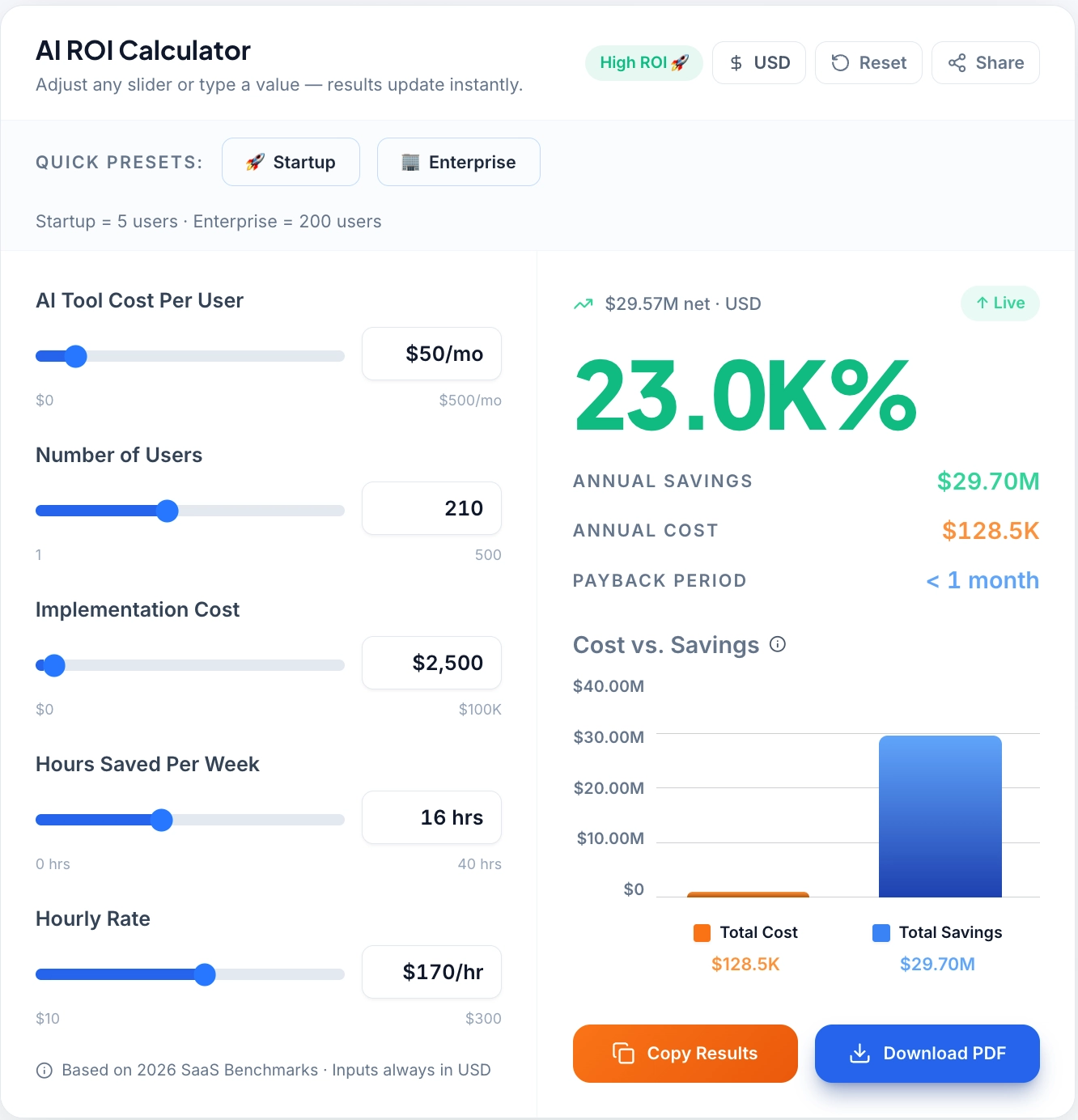
Maximize your investment by forecasting labor recovery and revenue growth with our interactive AI ROI Calculator.
→ Want real numbers for your business?Use the AI ROI Calculator to estimate your returns before investing.
Common Selection Mistakes That Reduce AI Software ROI
Selecting on price alone. The lowest-cost tool frequently produces the lowest deflection, automation rate, or output quality—meaning the underlying problem remains unsolved at a lower subscription cost.
Buying multiple tools before proving one. Three tools purchased simultaneously produce three half-implementations and no clear attribution of results. Prove ROI on one tool before adding the next.
Skipping the trial with real data. Demo environments are designed to impress, not reveal friction. Every platform here offers a free tier or trial. Use it with actual workflows before any financial commitment.
Ignoring integration requirements. A powerful AI tool that doesn't connect to your CRM or ecommerce platform creates manual bridging work that negates automation benefits. Verify specific integrations—not total integration counts.
No measurement framework. Without baseline metrics established before implementation, ROI cannot be calculated and expansion cannot be justified. Define two or three KPIs before launch and update them weekly during the pilot.
Your 2026 AI Action Plan
The businesses succeeding with AI in 2026 didn't start with the most tools. They started with the right tool, implemented it with discipline, and measured results before expanding.
Implementation roadmap
| Timeframe | Action |
|---|---|
| This week | Select one tool based on your highest-impact operational problem |
| This month | Implement fully and train your entire team with dedicated onboarding time |
| 60 days | Measure results against baseline metrics and calculate actual ROI |
| Quarter 2 | Add a second tool only after proving measurable success with the first |
Start focused. Measure obsessively. Scale deliberately. Tool selection is only the first decision.
Businesses that implement AI systematically are more likely to achieve long-term adoption and measurable results.
For a complete step-by-step deployment guide covering workflow redesign, pilot structure, ROI measurement, and expansion strategy, see: How to Implement AI in a Small Business (Step-by-Step Guide for 2026)
Final Verdict
The businesses generating measurable returns from AI software in 2026 treat tool selection as a business decision, not a technology purchase. They define the problem before evaluating the platform. They run pilots before full deployment. They measure before they scale.
The five AI categories covered here—automation, CRM, customer support, analytics, and marketing—address the operational constraints that limit most small business growth. The right choice depends on your specific problem, your team's current capability, and your commitment to proper implementation.
There is no shortcut between selecting a tool and generating returns from it. The implementation discipline—workflow redesign, baseline measurement, pilot structure, and gradual expansion—determines whether AI becomes a compounding operational advantage or an expensive subscription canceled at renewal.
Evaluate rigorously. Implement deliberately. Measure from day one.