The Strategic Shift: Scaling Support Without Scaling Headcount
The AI customer service market reached $13 billion in 2024 and is forecast to hit $47–84 billion by 2030, growing at a 23–26% CAGR. Ticket volumes are rising faster than hiring budgets, ecommerce is scaling globally, and labor shortages make human-only support economically unsustainable at scale.
For operators conducting an AI customer support software comparison today, the core question isn't whether to adopt—it's which platform delivers measurable deflection, integrates with existing infrastructure, and generates ROI within 60–90 days.
This guide covers ten leading AI helpdesk tools with pricing, deflection benchmarks, feature breakdowns, and the business contexts where each performs best. For a full software selection framework, see: Complete Guide to Choosing AI Software for Business (2026).
Why AI Customer Support Software Is a Strategic Priority in 2026

Ticket volumes are up 30–50% year-over-year across ecommerce and SaaS. Fully-loaded agent costs in developed markets run $45,000–$65,000 annually. The choice is clear: scale headcount linearly, or automate the tier-one support load so human agents handle work that actually requires them.
Mature AI implementations achieve 60–75% ticket deflection. Best-in-class deployments reach 80%+ on specific channels. AI-handled tickets on per-resolution models cost $0.69–$0.99. Human resolution costs $8–15 per ticket when factoring salary, benefits, and overhead. At scale, that gap is the entire business case.
The 2026 support environment also demands multichannel coverage (chat, email, voice, social, messaging), multilingual capability (30–100+ languages on leading platforms), and compliance infrastructure for GDPR, CCPA, and sector-specific regulations. Platforms handling EU data must provide data residency, audit trails, and consent management as baseline.
According to HubSpot’s 2026 Customer Support Trends Report, 92% of customer service leaders admit that AI has improved their response times, effectively removing support capacity as a growth constraint. As the AI learns from resolved interactions, deflection rates compound—making early implementation a structural competitive advantage.
- 60–75% average ticket deflection across SMB & SaaS
- 80%+ deflection in best-in-class enterprise deployments
- $0.69–$0.99 AI cost per resolution vs $8–15 human cost
- 30–50% YoY growth in support ticket volume
- 30–45 day payback period for high-volume teams
AI Customer Support Software Comparison: Full Platform Overview
| Tool | Starting Price | Best For | Deflection Rate | Key Strength |
|---|---|---|---|---|
| Zendesk AI | $55/agent/mo | Mid-market & enterprise | 60–70% | Ecosystem depth |
| Intercom Fin | $74/seat/mo | SaaS & tech companies | 50–72% | Conversational AI quality |
| Freshdesk Freddy | $15/agent/mo | SMB & growing teams | 40–60% | Value at entry tier |
| Crescendo.ai | Custom/per resolution | Enterprise CX operations | 70–80% | Autonomous resolution |
| Tidio | $29/mo flat | Small business & ecommerce | 40–55% | Ease of setup |
| Salesforce Einstein | $75+/user/mo | Salesforce-native enterprises | 55–70% | CRM integration depth |
| Gorgias | $10/mo + usage | Shopify ecommerce | 50–65% | Ecommerce automation |
| Ada | Custom pricing | Mid-market automation | 65–80% | No-code bot builder |
| Robylon | $0.69–0.99/resolution | High-volume operations | 70–85% | Per-resolution economics |
| Ultimate.ai | Custom/enterprise | Large support operations | 60–75% | Intent library depth |
Tool-by-Tool Breakdown
Zendesk AI
Pricing: $55–$115/agent/month; AI features at higher tiers
Core Features: Intelligent triage, intent detection, AI agent assist, automated responses, knowledge base suggestions
Integrations: 1,200+ apps including Salesforce, Shopify, Slack, Jira
Pros:
- Most mature ecosystem in the category
- Deep analytics and strong compliance certifications
- Extensive partner network
Cons:
- Add-ons escalate cost quickly
- AI capability locked to higher plans
- Complex for smaller teams
Best For: Mid-market and enterprise teams already in the Zendesk ecosystem needing broad integration coverage
Intercom Fin
Pricing: From $74/seat/month; Fin AI agent at $0.99/resolution
Core Features: GPT-4 powered autonomous agent, intent classification, conversation summarization, agent copilot, 43-language support
Integrations: Salesforce, HubSpot, Shopify, Stripe, GitHub, Jira, Slack, 350+ via App Store
Pros:
- Consistently high deflection in SaaS environments
- Fast deployment with strong documentation integration
Cons:
- Per-resolution pricing accumulates at volume
- Less suited to complex ecommerce workflows
Best For: SaaS companies and product-led growth businesses with strong knowledge base content
Freshdesk Freddy AI
Pricing: Free tier available; from $15/agent/month; Freddy AI add-on from $29/agent/month
Core Features: Answer Bot, Freddy Copilot, auto-triage, sentiment detection, response suggestions
Integrations: 1,000+ including Shopify, WooCommerce, Slack, Salesforce, Zoho
Pros:
- Best price-to-feature ratio for SMBs
- Fast onboarding and solid multichannel coverage
Cons:
- AI lags enterprise competitors on complex intent detection
- Less granular analytics
Best For: SMBs and growing teams needing affordable AI-assisted support with room to scale
Crescendo.ai
Pricing: Custom; per-resolution and outcome-based pricing available
Core Features: Autonomous AI agents, adaptive learning, sentiment analysis, complex workflow automation, voice AI
Integrations: API-first architecture; custom CRM and ERP connectivity
Pros:
- Among the highest deflection rates in the category
- Outcome-based pricing aligns incentives
- Enterprise compliance posture
Cons:
- No self-service setup; requires implementation engagement
- Minimum contract thresholds
Best For: Enterprise CX operations with high ticket volume and complex resolution requirements
Tidio
Pricing: Free tier; from $29/month flat; Lyro AI from $39/month
Core Features: Lyro AI chatbot, intent detection, automated conversation flows, visitor tracking
Integrations: Shopify, WooCommerce, WordPress, Wix, Magento, Mailchimp
Pros:
- Fastest setup in the category (under 30 minutes)
- Flat pricing simplifies budgeting
- Excellent for ecommerce storefronts
Cons:
- Scales poorly above ~5,000 monthly tickets
- Fewer enterprise integrations and limited analytics depth
Best For: Small businesses and ecommerce stores needing affordable AI chat with minimal technical setup
Salesforce Einstein
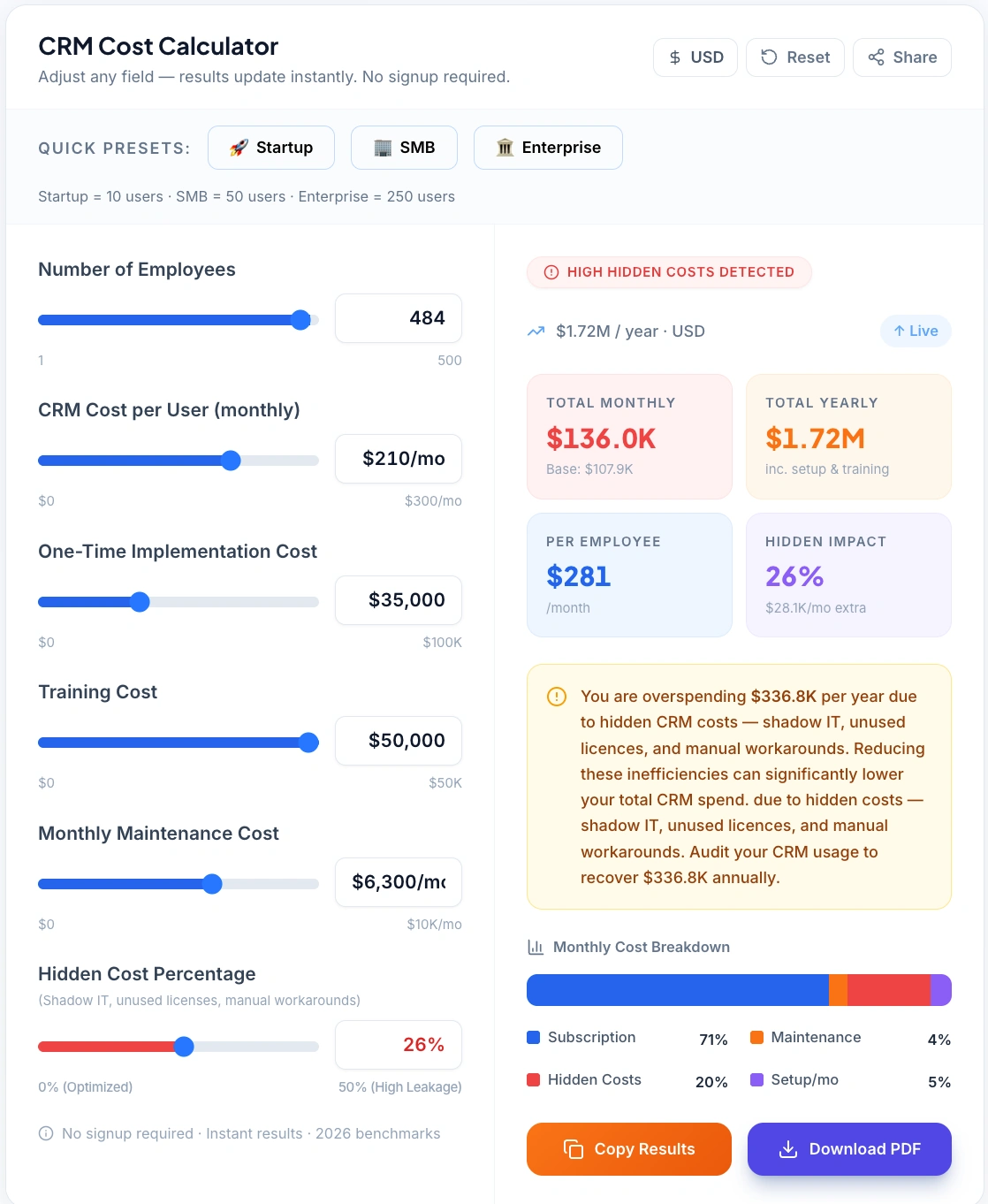
Total Cost Transparency: Use our CRM Cost Calculator to uncover hidden leaks like shadow IT and manual workarounds, providing a clear picture of your total stack investment.
Pricing: From $75/user/month; Einstein 1 Service from $500/user/month
Core Features: Einstein Bots, Case Classification, article recommendations, next-best-action, GPT for service, predictive routing
Integrations: Native Salesforce platform; 7,000+ apps via AppExchange
Pros:
- Unmatched CRM-to-support data integration
- Powerful predictive analytics
- Strong compliance for regulated industries
Cons:
- Expensive; only valuable for existing Salesforce customers
- Requires admin or partner resources to implement
Best For: Enterprises running Salesforce CRM needing AI support integrated with their customer data platform
According to Salesforce's State of Service report, 88% of service professionals say AI helps them serve customers faster—reinforcing why CRM-native AI delivers outsized impact compared to standalone tools for Salesforce-native organizations.
→ Estimating the full cost of a Salesforce or CRM-integrated support platform? Use the CRM Cost Calculator to model total ownership cost by team size and contact volume.
Gorgias
Pricing: From $10/month base + $0.36 per automated ticket
Core Features: AI auto-reply for orders, returns, and FAQs; sentiment detection; ecommerce macro automation; revenue-per-ticket reporting
Integrations: Shopify (deepest native integration in category), WooCommerce, BigCommerce, Klaviyo, Loop Returns, 100+ ecommerce apps
Pros:
- Best ecommerce-specific AI in the category
- Usage-based pricing favors lower-volume stores
- Strong revenue attribution
Cons:
- Scope limited to ecommerce
- Ineffective for SaaS or service businesses
- Weak on complex non-order queries
Best For: Shopify merchants with high order-related ticket volume
Ada
Pricing: Custom; estimated $40,000–$100,000+ annually
Core Features: No-code AI bot builder, 50+ language support, channel-agnostic deployment, proactive messaging
Integrations: Zendesk, Salesforce, Shopify, SAP, Twilio, custom API
Pros:
- Non-technical teams build and modify AI flows without engineering resources
- Strong multilingual performance and reliable escalation handling
Cons:
- Custom pricing creates budget uncertainty
- 4–8 week implementation for complex deployments
Best For: Mid-market companies with multilingual requirements needing autonomous resolution without engineering dependency
Robylon
Pricing: $0.69–$0.99 per resolution; no per-seat fees
Core Features: Autonomous AI agents, multi-step resolution, visual workflow automation, API and UI automation combined
Integrations: API-first; CRM, ERP, ticketing, and ecommerce platforms via API and UI automation layers
Pros:
- Best per-resolution economics at high volume
- Handles process-level automation across systems
- No seat fees favor large teams
Cons:
- Less established than category leaders
- Requires technical implementation
- Limited self-service documentation
Best For: High-volume operations prioritizing cost-per-resolution and needing AI that executes multi-system workflows
Ultimate.ai
Pricing: Custom enterprise; typically $50,000+ annually
Core Features: ULtimate AI engine, 1,000+ pre-built intents, conversation design studio, multilingual NLP, enterprise analytics
Integrations: Zendesk, Salesforce, Freshdesk, SAP, ServiceNow, custom CRM
Pros:
- Pre-built intent library reduces training time significantly
- Strong non-English NLP performance
- Gartner-recognized
Cons:
- Enterprise-only pricing
- Requires dedicated implementation engagement
- Not self-service
Best For: Large global support operations with existing enterprise helpdesk infrastructure
From Selection to Success: The Implementation Gap
Choosing the right tool is only 50% of the battle. Even the best AI helpdesk tools fail if they aren't fed with high-quality data or integrated correctly into your existing workflows. A "plug-and-play" approach often leads to low deflection rates and frustrated customers.
To ensure your chosen platform hits the 70%+ ROI targets mentioned above, you need a structured rollout plan—from knowledge base auditing to AI agent training.
→ Don't wing your rollout: Follow our exhaustive How to Implement AI in a Small Business: 2026 Step-by-Step Guide to ensure your transition from human support to AI-driven automation is seamless and high-performing.
Feature-Level Breakdown
Automation Depth: Chatbot vs. Autonomous Agent
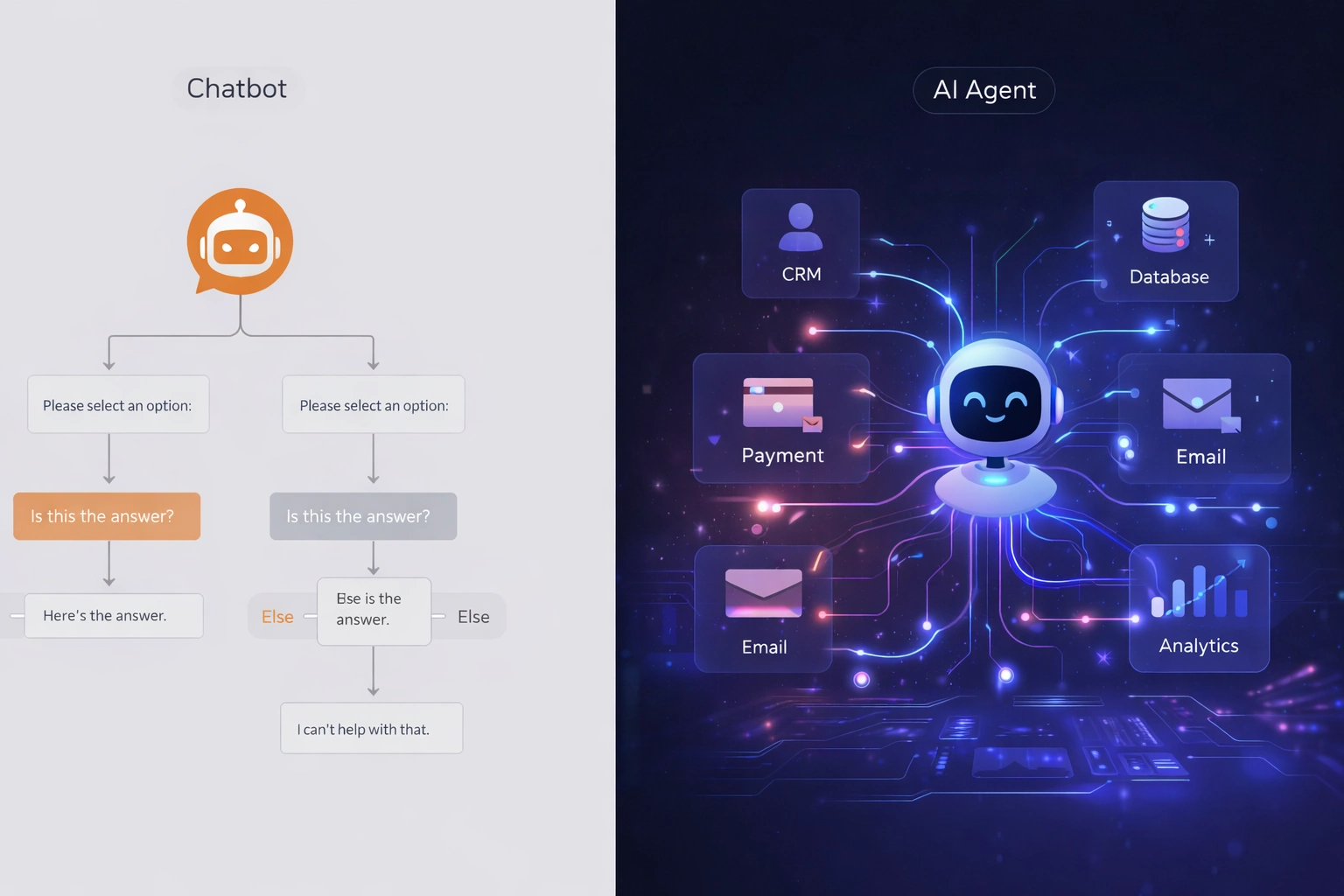
Resolution vs. Redirection: Unlike basic chatbots that follow rigid scripts, modern AI agents integrate directly with your business stack to resolve complex issues end-to-end.
This is the most consequential distinction in the category. Chatbot-tier tools (Tidio, Freshdesk Freddy entry) follow scripted decision trees with intent detection. Autonomous agent-tier tools (Robylon, Crescendo.ai, Intercom Fin, Ada) execute genuine resolution—accessing data, performing actions, and completing workflows without scripting.
Chatbot-tier achieves 40–55% deflection. Autonomous agent-tier reaches 65–85%. For teams evaluating AI chatbot software for business, understanding this divide before selecting a platform prevents the most common and costly mismatch in the category.
NLP, Sentiment Analysis, and Handoff Quality
Enterprise platforms—Zendesk AI, Ultimate.ai, Crescendo.ai—lead on NLP accuracy for complex queries. Intercom Fin benefits from GPT-4 for nuanced language. Gorgias and Tidio optimize for narrower, high-frequency query types.
Sentiment detection matters most for escalation triggering. Platforms that detect frustration and route accordingly reduce CSAT damage from automation failures. Handoff quality is equally critical: Intercom Fin and Zendesk AI lead in transferring full conversation context, intent flags, and suggested next actions to human agents. Platforms that hand off only a transcript—not structured data—increase agent handle time and erode the efficiency gains from deflection.
Integrations and Analytics
Evaluate integrations against your actual stack, not a platform's total integration count. Shopify-native tools (Gorgias, Tidio) provide the deepest ecommerce data access. CRM-native tools (Salesforce Einstein) offer superior customer history. API-first platforms (Robylon, Crescendo.ai) offer maximum flexibility.
For analytics, confirm the platform can report cost-per-resolution, deflection rate by channel, and CSAT by resolution type. These three metrics are the minimum needed to validate ROI internally. Build your projection model before committing to any platform contract.
ROI Illustration: 50-Agent Team, 10,000 Monthly Tickets
⚠️ Hypothetical estimates only. The figures in this section are illustrative examples based on industry averages and publicly available data. Actual results vary significantly by business size, industry, tool configuration, and team adoption. These numbers are not guarantees of return.
Before AI
- 10,000 tickets/month at $3.33 per ticket (8 min handle time, $25/hr agent cost)
- Monthly support cost: $33,300
After 70% Deflection
| Item | Cost |
|---|---|
| AI-resolved: 7,000 tickets × $0.99 | $6,930 |
| Human-resolved: 3,000 tickets × $3.33 | $9,990 |
| Platform cost | $2,000/month |
| Total monthly cost | $18,920 |
| Monthly savings | $14,380 |
| Annual savings | $172,560 |
ROI: ((14,380 − 2,000) / 2,000) × 100 = 619% monthly ROI on platform cost
Additional impact: headcount stays flat as ticket volume grows 50–70%; human agents shift to complex interactions; after-hours coverage extends without staffing cost. Payback period at this scale: 30–45 days.
Per-resolution pricing (Robylon at $0.69–$0.99) produces the strongest economics for high-volume operations. Seat-based models favor lower-volume teams still building deflection rates. Match pricing model to your volume trajectory.
According to McKinsey's research on customer operations automation, companies that deploy AI in customer service functions report 20–35% improvements in operational efficiency and measurable gains in customer satisfaction scores—confirming that the ROI benchmarks above reflect documented, real-world outcomes.
The ROI illustration above uses industry averages. Your actual returns depend on your ticket volume, current handle time, agent costs, and the deflection rate the platform achieves on your specific query mix.
→ Use the AI ROI Calculator to enter your real numbers and generate a custom payback projection before selecting a platform.
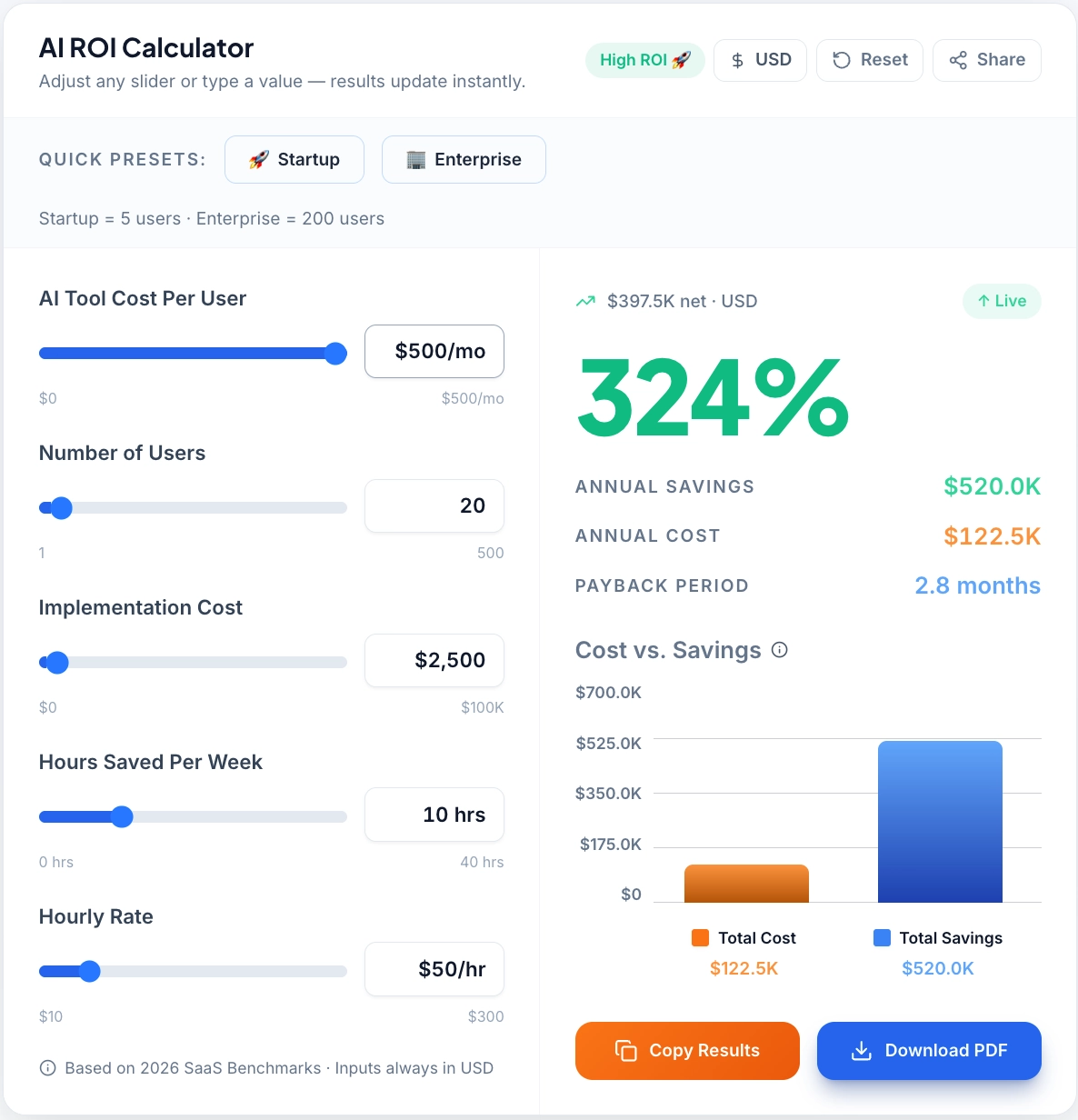
Predicting Performance: By inputting your specific team size and labor rates, you can generate a realistic payback period and annual savings projection before starting your AI pilot.
Best AI Customer Support Software for Small Businesses
SMBs need fast time-to-value, minimal IT overhead, and pricing that doesn't penalize growth. Three platforms lead for this segment.
Tidio is the fastest to deploy—flat pricing from $29/month, setup under 30 minutes, no technical resources required. Best for small ecommerce stores with straightforward, high-frequency queries.
Freshdesk Freddy offers the strongest feature depth at SMB price points. At $15–$29/agent/month, it covers multichannel support, sentiment detection, and a capable bot layer that most small teams won't outgrow quickly.
Gorgias is the definitive choice for Shopify merchants. Usage-based pricing ($10/month + $0.36/automated ticket) means small stores pay proportionally to volume—and its ecommerce automation depth exceeds general-purpose tools at comparable cost.
Pricing model matters as much as feature set for SMBs. Per-seat pricing penalizes growth; per-resolution pricing rewards efficiency; flat pricing maximizes budget predictability. Select the model that aligns with your ticket volume trajectory, not your current headcount.
Best Enterprise AI Customer Support Platforms
Enterprise buyers require platforms that scale to hundreds of thousands of monthly tickets, meet stringent compliance requirements, support multilingual global operations, and integrate with complex existing infrastructure.
Salesforce Einstein is the default for enterprises on the Salesforce platform. Its CRM-native architecture delivers customer context depth that standalone tools cannot match. Cost and implementation complexity are the trade-offs—full AI capability starts at $500/user/month and typically requires dedicated admin or partner resources.
Crescendo.ai leads on autonomous resolution rate (70–80%) with outcome-based pricing that aligns vendor incentives with customer results. Its API-first architecture handles complex integration environments, and its compliance posture covers regulated industries.
Ada serves enterprises needing multilingual autonomous resolution without engineering dependency. Its no-code builder allows CX teams to build and modify AI flows independently across 50+ languages—operationally sustainable for organizations without dedicated AI engineering staff.
Ultimate.ai performs strongest for large multilingual operations. Its 1,000+ pre-built intent library reduces training time significantly, and its Gartner recognition with deep integrations across Zendesk, Salesforce, and ServiceNow makes it credible for organizations with established enterprise helpdesk infrastructure.
Robylon offers the most differentiated economic model—per-resolution pricing with no seat fees—delivering superior economics at 50,000+ monthly tickets. Its multi-system workflow execution capability exceeds what conversation-only platforms can automate.
Enterprise evaluation criteria beyond price: compliance certification stack, multilingual NLP accuracy for your specific language mix, integration depth with existing CRM and ticketing infrastructure, and the quality of implementation support included in the contract.
Pricing Tiers Reference
Entry Level ($15–$55/agent/month)
Platforms: Freshdesk Freddy, Zendesk Suite entry, Tidio
Best for: Teams under 10 agents with moderate ticket volume. Annual billing discounts 15–20%.
Mid-Tier ($74–$200/agent/month)
Platforms: Intercom, Zendesk Professional, Salesforce Einstein mid
Best for: Full AI agent capability, analytics, multichannel coverage. Teams of 10–100 agents in growth phase.
Enterprise ($500+/user or custom/per-resolution)
Platforms: Salesforce Einstein 1, Crescendo.ai, Ada, Ultimate.ai, Robylon
Best for: Full autonomous resolution, compliance certifications, dedicated implementation. Per-resolution models deliver superior economics at 50,000+ monthly ticket volumes.
→ Before committing to any annual plan, model your total stack cost at current and projected volume using the SaaS Pricing Calculator.
Common Evaluation Mistakes
Selecting on Price Alone
The cheapest seat-based tool often produces the lowest deflection, meaning human agent costs don't decrease. Total cost of support—not license cost—is the correct comparison metric.
Ignoring Integration Depth
Verify your specific stack integrations during the trial. A platform with 1,000 listed integrations that doesn't connect natively to your CRM or ecommerce platform creates workarounds that reduce automation reliability.
Not Measuring During the Trial
Establish baseline metrics before the trial begins—ticket volume, handle time, cost per ticket. Trials without measurement produce no decision-relevant data.
Over-Automating Without Human Fallback
Platforms that can't smoothly escalate complex or emotionally charged conversations generate CSAT damage that outweighs deflection savings. Handoff quality is non-negotiable.
Underestimating Multilingual Requirements
If more than 10% of ticket volume is non-English, test multilingual NLP performance explicitly. Published language support counts don't reflect accuracy across all supported languages.
→ Before selecting your platform, generate your structured evaluation checklist using the AI Implementation Checklist—covering integration requirements, pilot structure, and go-live criteria.
Choosing the Right Platform in 2026
This AI customer support software comparison spans a category that now delivers genuine results at every price tier—from $29/month tools that reduce small business support load to automated customer service platforms achieving 80%+ deflection at under $1 per resolution.
Platform selection is only one variable. Integration quality, knowledge base depth, and measurement discipline determine whether any tool reaches its published benchmarks in your specific environment.
Evaluate in this order:
- Integration fit with your stack
- Deflection rate performance on your actual ticket composition
- Total cost of support—not license cost
A platform that costs $200/month more but eliminates $3,000/month in agent hours is the correct economic decision.
Run a structured 30-day pilot with real ticket data. Establish baseline metrics before day one. Track deflection rate and cost per resolution as your primary KPIs. Platforms that cannot demonstrate measurable improvement within 30 days are unlikely to deliver projected ROI at full deployment.
The best AI support software 2026 deployments share one trait: they were implemented with the same rigor applied to any operational investment. Define the outcome, measure from day one, and expand only after the pilot proves the return.
Find the right tech for your growth: Use our AI Tool Selector (Tool 5) to find the best tools for your business size.
Evaluation Process
This comparison was created by evaluating each AI customer support platform using publicly available information from official vendor websites, product documentation, pricing pages, customer case studies, independent reviews, and industry research available as of 2026.
Each platform was assessed using a consistent set of business-focused criteria:
- AI automation capabilities and ticket deflection features
- Pricing model and overall cost structure
- Integration options with CRM, ecommerce, and helpdesk platforms
- Deployment complexity and implementation requirements
- Scalability for SMBs and enterprise teams
The rankings and recommendations are based on this comparative evaluation rather than hands-on testing of every platform. Because actual performance depends on factors such as ticket types, knowledge base quality, workflow design, and system integrations, businesses should validate shortlisted tools through a pilot using their own customer support data before making a long-term purchasing decision.
Final Verdict
Choosing the right AI customer support software in 2026 is less about features and more about fit and cost efficiency. The best platform is the one that integrates with your existing stack, matches your ticket volume, and delivers measurable deflection within the first 30–60 days.
Instead of committing upfront, run a small pilot with real data. Track key metrics like deflection rate, cost per resolution, and customer satisfaction. Tools that prove value quickly are the ones worth scaling across your support operations.
Ultimately, AI support is not just a productivity upgrade—it’s a cost optimization strategy. Businesses that focus on reducing total support cost (not just software pricing) will see the strongest ROI and long-term advantage.
The technology is proven. The ROI benchmarks are documented. The variable is execution discipline—and that starts with a structured evaluation, not a feature checklist.