The Real Problem With Proposal Creation in 2026
Most sales teams know the problem intimately. A prospect asks for a proposal on Thursday afternoon. Someone opens a Word doc, copies from an old proposal, manually fills in the client name and pricing, and sends something that looks like it was assembled in 45 minutes — because it was. The proposal arrives late, the pricing has an error, and the follow-up gets lost in a shared inbox.
AI proposal software addresses the entire workflow: content pulled from CRM data, pricing calculated automatically, engagement tracking so you know when the prospect actually read it, and e-signatures so the deal closes without a separate DocuSign flow.
The market has matured considerably. Tools that launched two years ago with basic template automation now include NLP-powered drafting, grounded content generation from your past winning proposals, and multi-agent AI architectures that handle RFP responses at scale.
For a broader framework on selecting AI software, see: Complete Guide to Choosing AI Software for Your Business (2026 Edition).
- Global proposal management software market: $3.2 billion (2025), projected $5.8 billion by 2028
- AI proposal tools reduce creation time by 80%+ vs. manual drafting
- Sales teams using AI tools close 27% more deals than manual processes
- AI saves sales professionals 4.8 hours per week on average
- 80%+ of proposal teams expected to use AI by 2028 (vs. ~75% today)
Best AI Proposal & Quote Writing Tools at a Glance
| Tool | Best For | AI Writing | Quote Builder | E-Signature | Starting Price |
|---|---|---|---|---|---|
| PandaDoc | Overall | ✅ Strong | ✅ CPQ integrations | ✅ Unlimited | $19/user/mo |
| Proposify | Agencies | ✅ Light AI | ✅ Interactive tables | ✅ Built-in | $19/user/mo |
| Qwilr | Interactive proposals | ✅ Basic AI | ✅ Dynamic pricing | ✅ On-page | $35/user/mo |
| Better Proposals | Small businesses | ✅ Premium only | ✅ Interactive tables | ✅ Legal | $19/mo |
| GetAccept | Salesforce teams | ✅ Native AI | ✅ QuoteGen (SFDC) | ✅ Electronic | $25/user/mo |
| Loopio | RFP automation | ✅ AI auto-fill | ❌ Not CPQ | ❌ No | ~$20K/year |
| Responsive | Enterprise RFPs | ✅ Multi-agent AI | ❌ Not CPQ | ❌ No | $7K–$28K/year |
| HubSpot Sales Hub | HubSpot users | ✅ Breeze AI | ✅ AI-powered CPQ | ✅ Pro+ | $20/mo |
| Nusii | Freelancers | ✅ Basic | ✅ Price tables | ✅ Instant | $29/mo |
| SiftHub | AI-first teams | ✅ Strong | ✅ CPQ integration | ❌ Not highlighted | Contact |
What Is AI Proposal & Quote Writing Software?
AI proposal writing software uses natural language processing and machine learning to automate proposal creation, content personalization, and pricing calculations. At the functional level, it ingests your approved content library, CRM data, and past winning proposals — then generates drafts, suggests relevant sections, and automates pricing based on product configurations and deal history.
The practical difference from a template tool is significant. Template tools require manual data entry and content selection. AI tools pull client information from your CRM automatically, match proposal sections to the specific opportunity context, and flag content that's underperforming based on win rate analytics.
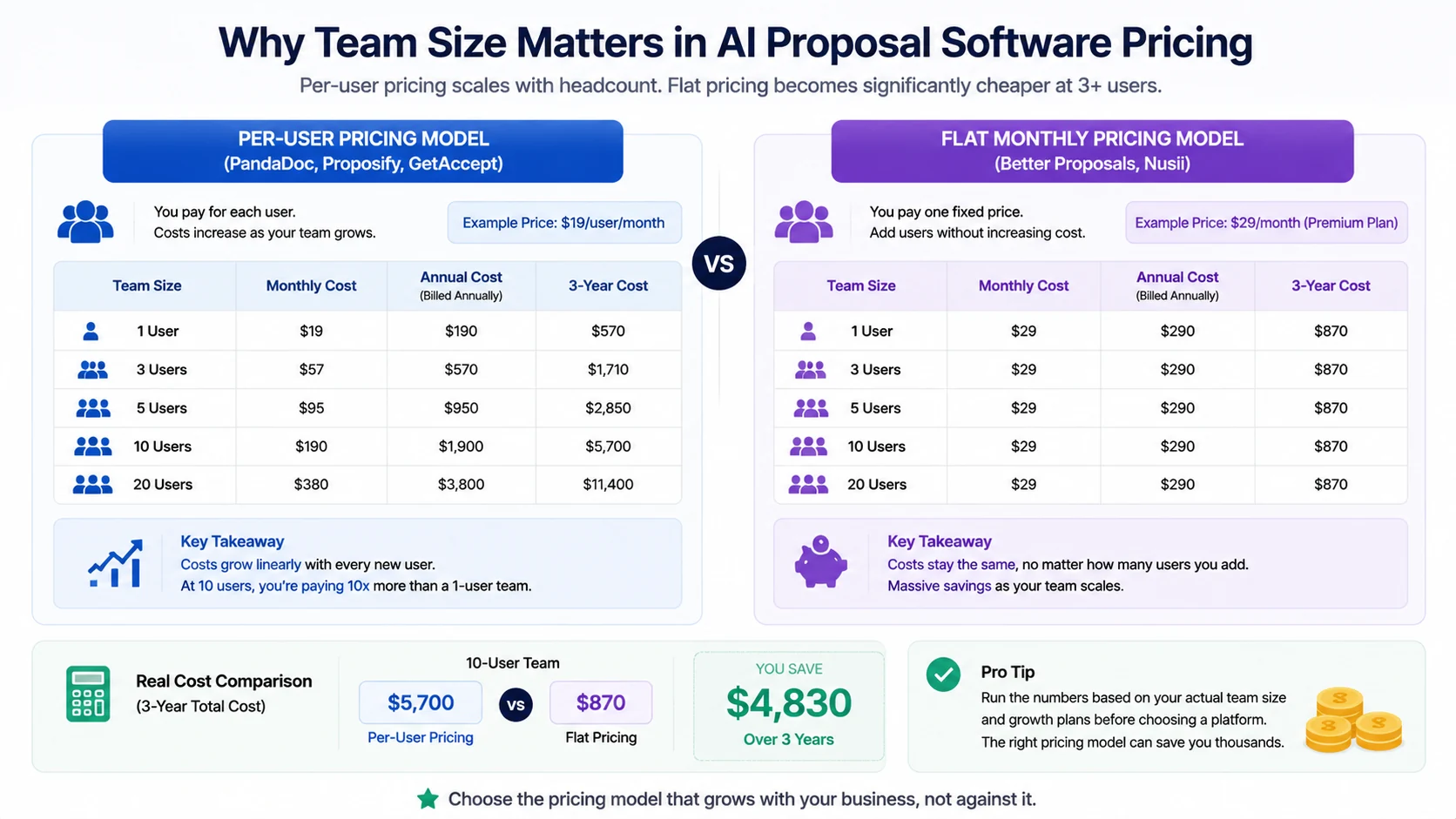
How modern AI proposal software automates the proposal lifecycle from CRM data and content generation to pricing, e-signatures, analytics, and deal closure.
Who actually needs this: Sales teams sending more than five proposals a month. Agencies managing proposal creation across multiple clients. Consulting firms responding to competitive RFPs. Any business where proposal quality and speed meaningfully affects close rates.
Who probably doesn't: Solo freelancers sending occasional project proposals can get by with a well-designed template and a simple e-signature tool. The monthly cost of a full proposal platform isn't justified at low volume.
Best AI Proposal & Quote Writing Tools in 2026
1. PandaDoc — Best Overall AI Proposal Software
Best for: Sales teams needing end-to-end proposal management with strong CRM integrations and interactive pricing
PandaDoc is the most complete proposal platform at this price point. The AI document assistant generates content suggestions and automates text for common proposal sections — not transformative AI, but genuinely time-saving for teams building proposals at volume. The interactive pricing tables let prospects configure quantities and options directly in the proposal, which eliminates a back-and-forth round of "can you update the pricing to reflect option B" emails.
The document tracking is where PandaDoc earns its position. You get real-time notifications when a prospect opens a proposal, page-level analytics showing where they spent time, and CRM sync that logs all activity automatically. For a sales manager, that visibility changes how the team follows up.
What Works: Native Salesforce and HubSpot integrations are solid. Unlimited e-signatures across all paid plans. Centralized content library with team permissions. The real-time analytics are the strongest in this category.
Where It Falls Short: The Essentials plan limits you to 5+ templates, which feels restrictive. The jump to Business plan pricing ($65+/user/month) is steep. Per-user pricing adds up for larger teams.
Pricing: Free: 5 docs/month | Essentials: $19/user/mo | Professional: $49/user/mo | Business: $65+/user/mo
Mini Verdict: The default choice for most sales teams. If you're evaluating proposal software seriously and don't have a strong reason to choose otherwise, start here.
→ Teams struggling to create effective proposal prompts and AI-assisted sales content can use our AI Prompt Generator to generate optimized prompts for proposals, quotes, sales outreach, and client communication.
2. Proposify — Best for Design-Focused Agencies
Best for: Agencies and creative teams that want customizable, visually polished proposals with flexible pricing tables
Proposify's AI features are lighter than PandaDoc's — content suggestions and smart structure recommendations rather than full AI drafting. What it does better is design flexibility and pricing transparency. The Team plan includes unlimited sending and unlimited users, which changes the economics significantly for agencies with larger teams.
The interactive pricing tables are well-executed. Clients can select service tiers, adjust quantities, and see totals update in real time before signing. That interaction model works particularly well for agencies presenting multiple service configurations to the same client.
One limitation worth noting: the Business tier at $65/user/month with a 10-user minimum ($650/month floor) is difficult to justify for smaller agencies. The Team plan at $41/user/month is where most agencies will find the right balance.
What Works: Transparent all-inclusive pricing on the Team plan. Strong template customization. Document analytics including live notifications and client interaction tracking. 14-day free trial.
Where It Falls Short: AI capabilities are lighter than competitors. The Business tier pricing structure makes it expensive for small teams. Advanced AI requires pairing with other tools.
Pricing: Basic: $19/user/mo | Team: $41/user/mo | Business: $65/user/mo (10-user minimum)
Mini Verdict: The right choice for agencies that care about proposal aesthetics and need unlimited sending. Not the right choice if deep AI drafting capability is the priority.
3. Qwilr — Best for Interactive Web-Based Proposals
Best for: Agencies and consultants who want proposals that feel like a branded web experience rather than a PDF attachment
Qwilr proposals open in a browser — not as a downloaded file — and can embed videos, interactive maps, calendars, and forms directly in the content. For agencies presenting creative work or consultants walking through a complex recommendations deck, that format creates a meaningfully different client experience from sending a PDF.
The dynamic pricing tables work the same as Proposify's, but the page-level analytics are more granular. You can see not just whether a proposal was opened, but which sections the prospect spent time on and which they skipped — which tells you exactly where to focus the follow-up conversation.
There's no free version, only a trial. And at $590/month for 10 Enterprise users, it's the most expensive mid-market option on this list.
What Works: Interactive proposals with embedded media are genuinely differentiated. HubSpot automation integration is strong. Page-level analytics provide useful sales intelligence.
Where It Falls Short: No free plan. Enterprise pricing is expensive relative to competitors. AI features are basic compared to GetAccept or PandaDoc.
Pricing: Business: $35/user/mo (annual) | Enterprise: $590/mo for 10 users
Mini Verdict: Worth the premium if your proposal format is a meaningful differentiator in your sales process. Less compelling if you're primarily optimizing for speed and CRM integration.
4. Better Proposals — Best for Small Businesses and Freelancers
Best for: Small businesses and freelancers who need professional proposals, e-signatures, and payment collection without per-user pricing
The flat monthly fee is the headline. $19/month for 10 proposals, $29/month for 50 proposals with AI features, $49/month unlimited — none of it per-user. For a three-person sales team, that's a meaningful cost difference compared to PandaDoc or Proposify.
The AI features arrive at the Premium tier ($29/month) — light AI suggestions for proposal structure and wording. Not sophisticated, but functional for small teams that don't need RFP automation or deep CRM integration. Payment integration through Stripe and PayPal means a client can sign and pay in the same session, which shortens the close cycle for straightforward engagements.
What Works: Flat pricing model is genuinely competitive for small teams. Payment integration is a practical differentiator. Multi-language support. 14-day free trial.
Where It Falls Short: Starter plan limits you to 10 proposals/month, which forces an upgrade at moderate volume. AI features are basic compared to enterprise tools. CRM integrations require the Premium tier minimum.
Pricing: Starter: $19/mo (10 proposals) | Premium: $29/mo (50 proposals, AI included) | Enterprise: $49/mo (unlimited)
Mini Verdict: The clearest value option for small businesses and freelancers. The per-flat-fee model beats per-user pricing at any team size above one.
5. GetAccept — Best for Salesforce-Integrated Teams
Best for: B2B sales teams running Salesforce who want AI-generated proposals populated directly from CRM data
GetAccept's QuoteGen feature is the differentiator. It's included in the Salesforce integration at no additional cost and automatically populates product line items, pricing, and client data from Salesforce CPQ into the proposal — without manual data entry. For teams that spend meaningful time copying information from Salesforce into proposal documents, this is a significant time recovery.
The Digital Sales Rooms are a newer feature worth noting. Rather than sending a standalone proposal PDF, you can create a microsite-style engagement environment where proposals, videos, case studies, and communication all live in one place. Enterprise B2B teams have found these particularly effective for complex, multi-stakeholder deals.
The AI pulls from winning proposals in your content library — not generic templates — which means the quality of the suggestions improves as you use the platform longer.
What Works: Native Salesforce CPQ integration is the strongest in this category. Digital Sales Rooms for enterprise deal management. AI content that learns from your winning proposals. HubSpot 2-way sync is well-implemented.
Where It Falls Short: Pricing isn't publicly transparent beyond the base tiers. Professional plan requires a 5-user minimum ($245/month floor). Takes more time to configure than simpler tools.
Pricing: eSign: $25/user/mo | Deal Room: $39/user/mo | Professional: $49/user/mo (5-user min) | Full suite: $79/user/mo
Mini Verdict: Teams that already use Salesforce will find GetAccept pays for itself quickly through the time saved on manual data entry. If you're not in Salesforce, the differentiation is less compelling.
6. Loopio — Best for RFP Automation
Best for: Enterprise and mid-market companies that respond to competitive RFPs, RFIs, DDQs, and security questionnaires at volume
Loopio is not a sales proposal tool — it's an RFP response platform, and the distinction matters. There are no e-signatures, no CPQ pricing tables, no client-facing interactive proposals. What Loopio does is automate the content side of RFP responses: AI auto-fill matches incoming questions to your approved answer library, AI response generation drafts new answers when no library match exists, and content freshness scoring flags answers that are outdated and need review.
For a team responding to 20+ RFPs a year, the time savings are substantial. Loopio users report 70% faster response times and 50% cost reduction on RFP processes. The AI is specifically designed for this use case — grounded in your approved source material with citations, so reviewers can verify the supporting content before approving a response.
What Works: AI auto-fill from approved content library is genuinely capable. Grounded generation with source citations is important for compliance-sensitive industries. Cross-team collaboration across sales, legal, and IT in a single workflow.
Where It Falls Short: No e-signatures. No CPQ or interactive pricing. Pricing starts around $20,000/year — not a tool for small teams. The AI struggles with highly complex or novel proposal requirements.
Pricing: Not public; mid-market approximately $20,000/year; enterprise pricing negotiated
Mini Verdict: The right tool for teams where RFP volume is a significant part of the sales process. Wrong for everyone else — the cost and complexity aren't justified for occasional proposal creation.
Consulting firms and proposal-heavy agencies may also benefit from our guide to Best AI Tools for Coaches & Consultants in 2026, which covers AI software for client management, meeting notes, CRM workflows, research, and consulting operations.
7. Responsive — Best for Enterprise Proposal Teams
Best for: Enterprise teams running high-stakes competitive RFPs with compliance requirements and multi-agent AI workflows
Responsive (formerly RFPIO) takes a more sophisticated AI architecture than Loopio — multiple specialized AI agents handle different parts of the response process, from document import and question parsing to answer generation and confidence scoring. The AI Writing Agent surfaces relevant answers during drafting and shows confidence cues that tell reviewers which responses are ready to approve and which need human attention.
The Claude Desktop MCP integration and browser extension allow team members to work in their preferred environment rather than switching entirely into the Responsive platform. For large consulting and legal teams with established workflows, that flexibility matters.
Custom pricing in the $7,000–$28,000/year range makes it a procurement conversation rather than a quick trial decision.
What Works: Multi-agent AI architecture is the most sophisticated in the RFP category. Source citations and confidence cues improve review quality. Governance features for content compliance. Grounded generation reduces hallucination risk.
Where It Falls Short: Pricing requires a sales conversation — no self-serve trial. Complex to implement for teams without dedicated proposal management resources. AI still struggles with highly novel or complex proposal requirements.
Pricing: $7,000–$28,000/year depending on team size; contact for specifics
Mini Verdict: Enterprise teams that take proposal quality seriously and have the budget will find Responsive the most capable platform available. Everyone else should look elsewhere.
8. HubSpot Sales Hub — Best for HubSpot Users
Best for: Companies already using HubSpot CRM who want quotes, e-signatures, and AI prospecting in one platform
If your team lives in HubSpot, the case for adding a separate proposal tool is weaker than it looks. HubSpot Sales Hub Professional includes an AI-powered CPQ engine, branded quote templates, and e-signatures — and because everything is native to the CRM, deal records update automatically without integration configuration.
The Breeze AI prospecting agent is the newer addition worth noting. It handles multi-step outreach sequences, deal scoring, and company intelligence without requiring a separate sales intelligence tool. That consolidation reduces the number of subscriptions in the stack.
The main limitation: you need Sales Hub Professional at $99/user/month to access the most useful features. The Starter tier at $20/month is too limited for teams with active proposal workflows.
What Works: Native CRM integration means zero data entry between proposal creation and deal tracking. AI-powered CPQ for automated quoting. Breeze AI for prospecting. Free tier available for evaluation.
Where It Falls Short: Meaningful features require the $99/user/month Professional tier. Quotes are effectively gated behind a sales platform subscription. Not the right choice if you're not already committed to the HubSpot ecosystem.
Pricing: Free: $0 | Starter: $20/mo | Professional: $99/user/mo | Enterprise: custom
Mini Verdict: The right choice if you're already paying for HubSpot Sales Hub. The wrong choice if you're buying it specifically for proposals — PandaDoc at $19/user/month covers more proposal-specific functionality at lower cost.
9. Nusii — Best Budget Alternative
Best for: Small agencies and freelancers who need unlimited templates, instant eSigning, and payment collection at an affordable flat rate
Nusii's Agency plan at $40.83/month includes 5 users — a pricing model that makes it the most affordable multi-user option in this category. The templates are genuinely interactive (embedded videos, images, price tables), and the instant eSigning with credit card and ACH payments on any device shortens the time between proposal acceptance and first payment.
The HubSpot marketplace app launched in May 2025, which adds CRM integration for teams already in that ecosystem.
What Works: Affordable multi-user pricing. Unlimited templates. Instant eSigning with payment collection. HubSpot integration.
Where It Falls Short: Active proposal limits on lower tiers force upgrades at higher volume. AI features are less advanced than competitors. Smaller user community means fewer integrations and resources.
Pricing: Freelancer: $29/mo | Professional: $49/mo | Agency: $40.83/mo (5 users) | Business: $107.50/mo
Mini Verdict: The strongest budget option for small agencies that need multiple users without per-user fees. Worth the 14-day trial if pricing is a primary constraint.
10. SiftHub — Emerging AI Proposal Platform
Best for: Modern sales teams that want AI-first proposal automation with strong CRM and CPQ integration
SiftHub is built around AI from the ground up rather than AI layered onto an existing template tool. Automated drafting pulls from CRM and CPQ data to produce proposals tailored to the specific deal — not generic templates with client names swapped in. The vendor claims 50% higher win rates with expert integration, though independent verification is limited given the platform's age.
What Works: AI-first architecture. Strong CRM/CPQ integration. Purpose-built automation rather than bolt-on AI features.
Where It Falls Short: Limited public reviews. Pricing not disclosed. Less proven at enterprise scale.
Pricing: Contact for pricing
Mini Verdict: Worth a demo call if you specifically want an AI-first platform. Established teams should evaluate PandaDoc or GetAccept first.
Best AI Proposal Tool by Use Case
| Use Case | Recommended Tool | Why |
|---|---|---|
| Small business / freelancer | Better Proposals | Flat pricing, e-signatures, payment collection |
| Agency | Proposify | Design flexibility, unlimited sending on Team plan |
| Salesforce-heavy team | GetAccept | QuoteGen auto-populates from Salesforce CPQ |
| HubSpot-heavy team | HubSpot Sales Hub | Native CRM, AI CPQ, e-signatures in one platform |
| RFP automation (mid-market) | Loopio | AI auto-fill, content library, cross-team collaboration |
| Enterprise RFPs | Responsive | Multi-agent AI, governance, compliance features |
| Interactive proposals | Qwilr | Web-based format, embedded media, page analytics |
| Overall / undecided | PandaDoc | Strong all-around, best balance of features and price |
How to Choose the Right AI Proposal Software
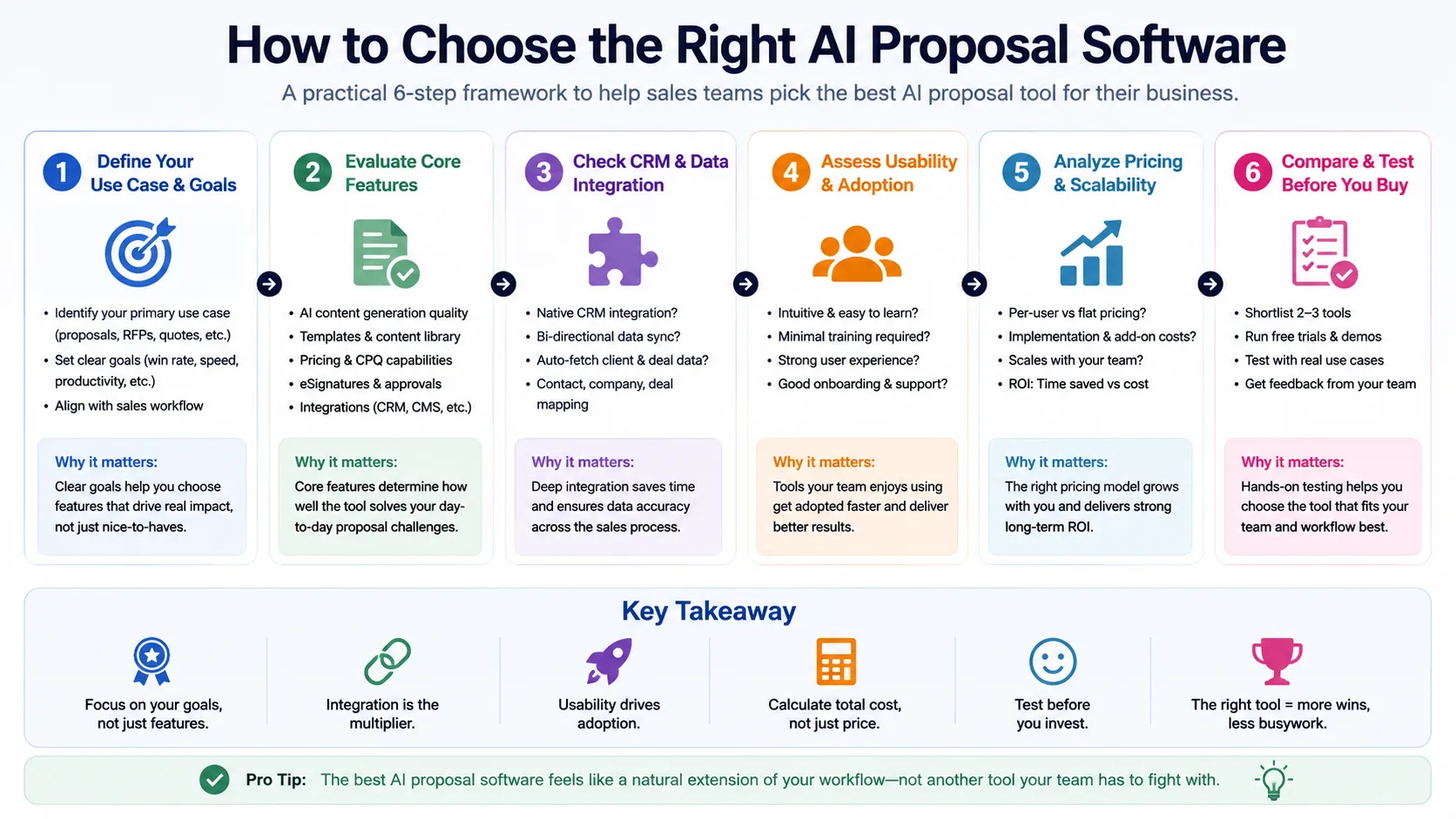
A practical framework for evaluating AI proposal software based on use case, integrations, pricing, usability, and long-term ROI.
Team size matters more than it looks. Per-user pricing (PandaDoc, Proposify, GetAccept) scales linearly with headcount. Flat monthly pricing (Better Proposals, Nusii) becomes significantly cheaper at 3+ users. Run the actual math at your team size before comparing feature sets.
CRM integration depth varies significantly. "Integrates with Salesforce" can mean native 2-way sync or a Zapier connection. GetAccept's Salesforce integration auto-populates pricing data. PandaDoc's is native but requires Business plan for full functionality. Loopio and Responsive use REST API. Verify the specific data flow you need during the trial.
Proposal volume drives tool selection at the extremes. Under five proposals a month, any tool works. Above 50 RFP responses a year, Loopio or Responsive are purpose-built for that volume. Most sales teams fall in the middle, where PandaDoc, Proposify, or Better Proposals are the practical choices.
E-signature is a harder requirement than it seems. Loopio and Responsive don't include it. If you need one tool that handles both proposal content and signature collection, confirm e-signature is included before starting a trial.
Budget for the full platform, not the entry price. Starter plans often limit proposal volume or restrict the features you actually need. Map your use case to the specific tier required before comparing headline prices.
If your organization relies heavily on CRM workflows, Salesforce's guide to sales proposal management and automation provides useful context on how proposal software integrates with customer data, quoting systems, and revenue operations.
Common Mistakes to Avoid
Choosing based on price alone. A $19/month tool that requires manual data entry for every proposal may cost more in staff time than a $65/month tool that pulls from your CRM automatically. Calculate the time cost, not just the subscription cost.
Ignoring CRM integration depth. Generic "CRM integration" claims often mean Zapier webhooks, not native sync. If your CRM data needs to flow into proposals automatically, confirm that specific integration works during the trial.
Selecting RFP tools for general proposals. Loopio and Responsive are excellent RFP platforms. They don't include e-signatures or interactive pricing. If you need those features, they're the wrong tools regardless of their AI capabilities.
Underestimating implementation time. Proposal tools that learn from your content library (Loopio, Responsive, GetAccept) require upfront configuration to populate that library. Plan for two to four weeks before the AI suggestions become genuinely useful.
Buying enterprise tools at small-team scale. Loopio at $20,000/year is hard to justify below 20 RFP responses annually. The ROI calculation requires matching tool cost to actual proposal volume.
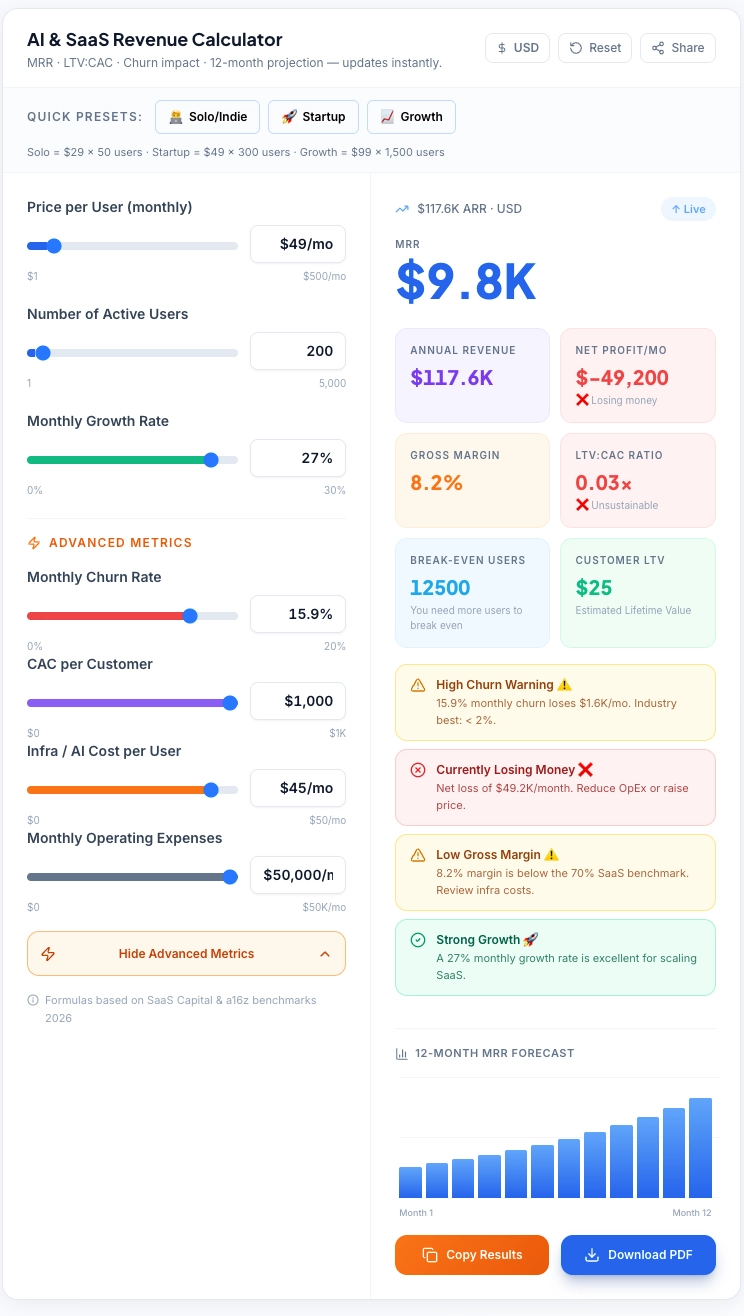
Before choosing an AI proposal platform, model user-based pricing, churn, growth, and operating costs to understand the true long-term software investment.
→ Many teams underestimate how quickly per-user pricing scales. Our SaaS Pricing Calculator can help model monthly and annual costs before choosing a platform.
AI Proposal Software Market Trends for 2026
Multi-agent AI is replacing single-model approaches. Responsive already ships with specialized agents for document import, answer generation, and confidence scoring. This architecture reduces hallucination risk and improves review efficiency compared to single-model generation.
Real-time AI-human collaboration is emerging. Rather than generating complete drafts, newer tools suggest improvements as you type — closer to an intelligent writing assistant than a document generator. This approach produces higher-quality output because it keeps the human in the loop throughout drafting.
CPQ integration is becoming table stakes. AI-powered configure-price-quote capabilities are now available across HubSpot, GetAccept, and PandaDoc. Teams that still calculate pricing manually are at a competitive disadvantage in speed-sensitive sales cycles.
Digital Sales Rooms are expanding beyond enterprise. GetAccept popularized the Digital Sales Room model for SMB teams. Expect other proposal platforms to add microsite-style deal environments as a standard feature over the next 12–18 months.
The AI proposal software market is growing at 22% CAGR overall, with the AI-specific segment at 35% CAGR. The business case for adoption is straightforward — 4.8 hours saved per week per sales professional adds up to meaningful capacity recovery at any team size.
A recent article from Harvard Business Review highlights how AI is increasingly being used across sales, proposal creation, and knowledge-work functions to improve productivity and decision-making quality.