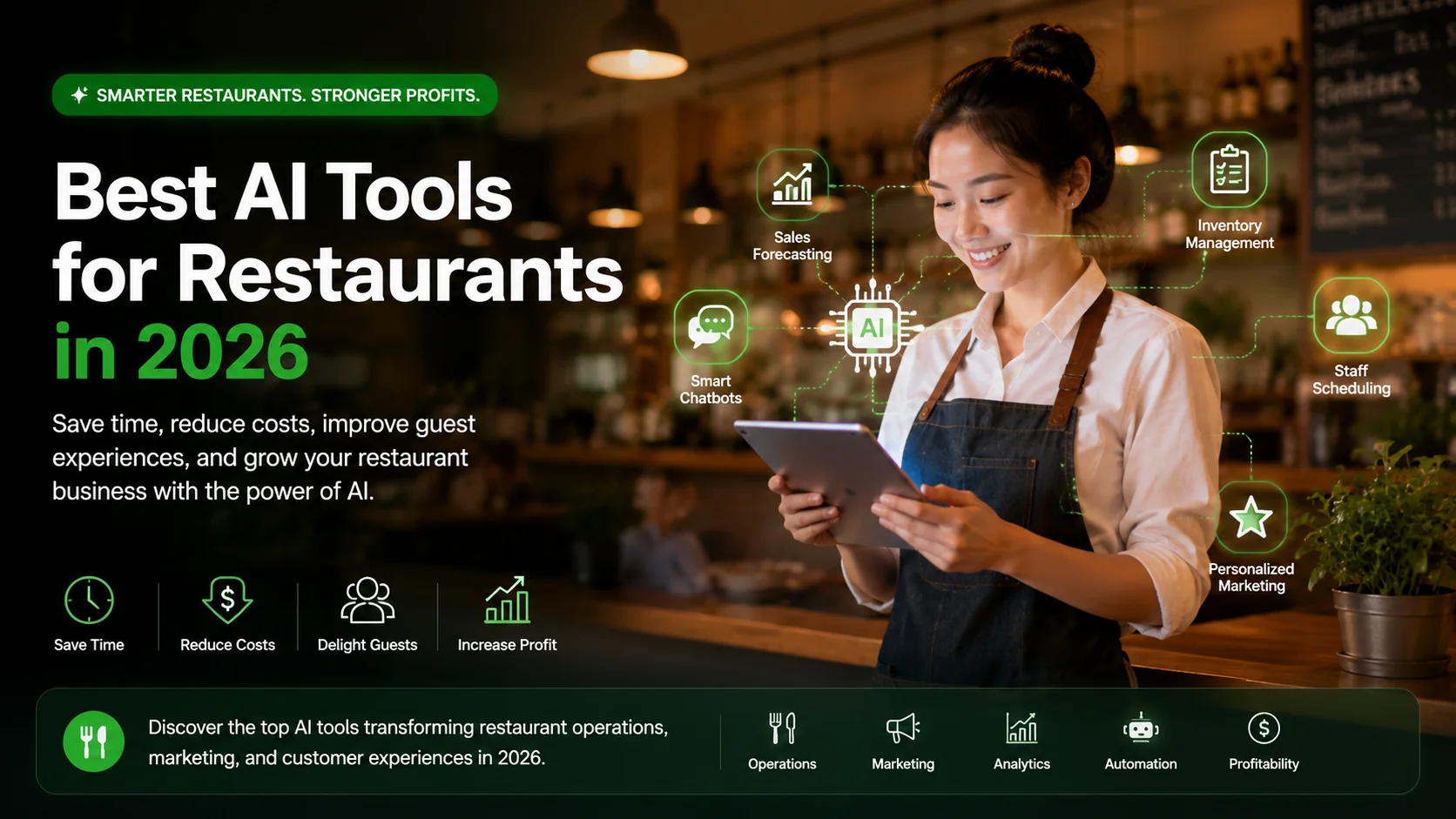
Why Restaurants Are Adopting AI Faster Than Ever in 2026
Running a restaurant has always been a margin game. You manage unpredictable demand, expensive labor, perishable inventory, and customers who will write a one-star review if they wait three minutes for their call to be answered. In 2026, AI tools are addressing all of these problems — and the adoption numbers show it.
In 2023, 24% of restaurants were using AI tools. By 2025, that number had jumped to 48%, according to the National Restaurant Association. That's not hype — it reflects operators discovering that AI scheduling reduces overstaffing, AI inventory tools cut food waste, and AI phone systems stop revenue from walking out the door every time a call goes unanswered during service.
The underlying pressure isn't going away. Food costs have surged 28% since 2020. Profit margins remain at 3–5%. And 82% of restaurants still report staffing challenges. AI doesn't solve every problem, but it directly addresses the three biggest controllable cost drivers: labor, food waste, and missed revenue opportunities.
- 48% of restaurants now use AI tools — up from 24% in 2023 (NRA)
- 82% of operators report ongoing staffing challenges
- Restaurants miss 30–60% of incoming calls during peak service hours
- 55% of operators use AI specifically for marketing content creation
- Food costs have risen 28% since 2020, putting margin pressure at record levels
- AI scheduling tools reduce overstaffing by an average of 12% while maintaining service quality
How We Evaluated These Tools
Each platform was assessed on: AI feature depth, POS integration quality, ease of deployment, pricing transparency, restaurant-size fit, and real-world operator results. Vendor claims are noted where used. Published research and operator-reported outcomes are cited separately.
For a broader framework on evaluating business AI software, see: Complete Guide to Choosing AI Software for Your Business (2026 Edition).
Best AI Tools for Restaurants at a Glance
| Tool | Category | Best For | Starting Price | Overall Rating |
|---|---|---|---|---|
| Lineup.ai | Forecasting + Scheduling | Any size restaurant | $79/location/mo | 9.5/10 |
| MarketMan | Inventory Management | 5+ locations | $199/location/mo | 9.3/10 |
| SevenRooms | Guest CRM + Reservations | Fine dining & groups | Custom quote | 9.2/10 |
| Slang.ai | AI Phone Answering | Full-service restaurants | $199/mo | 9.0/10 |
| Winnow | Food Waste Reduction | High-volume kitchens | Custom quote | 8.9/10 |
| 5-Out | Sales Forecasting | Multi-location operators | Custom quote | 8.8/10 |
| 7shifts | Workforce Management | Budget-conscious any size | Free / $35/mo | 8.7/10 |
| Popmenu | Marketing + AI Answering | Independent restaurants | $179/mo | 8.6/10 |
| MARA AI | Review Management | Any size | EUR 79/mo | 8.5/10 |
| IAMenu | AI Menu Engineering | Any size | $39/mo | 8.4/10 |
Why These Tools Made Our List
Restaurant software vendors increasingly market almost every feature as AI-powered. However, not every platform delivers measurable operational value.
For this guide, we prioritized tools that help restaurants solve real business problems such as labor optimization, inventory control, demand forecasting, guest experience management, and revenue growth.
Several platforms were reviewed but excluded because their AI capabilities were limited to basic automation or reporting. The tools featured below demonstrated practical use cases, strong adoption among restaurant operators, and clear potential for measurable ROI.
The 10 Best AI Tools for Restaurants in 2026
1. Lineup.ai — Best Overall AI Tool for Restaurants
Best for: Any size restaurant that wants to reduce labor costs immediately
Lineup.ai combines demand forecasting with automated schedule building in a single platform. It pulls in historical sales data, weather forecasts, local events, and holidays to predict exactly how busy each shift will be — then builds a schedule that matches staffing levels to that prediction. Operators consistently report 2–5% labor cost reduction within the first month, which at a restaurant doing $100K/month in revenue means $2,000–$5,000 back in the budget every 30 days.
What Works: The forecasting accuracy is the strongest in the category. The $79/month entry plan for forecasting-only is genuinely low-risk. Integrates with Toast, Square, Lightspeed, and Clover out of the box.
Where It Falls Short: Costs more than 7shifts. Smaller single-location restaurants sometimes find the full feature set more than they need at launch.
Mini Verdict: Among the scheduling platforms reviewed, Lineup.ai offers one of the strongest combinations of forecasting accuracy, ease of deployment, and measurable labor savings. Restaurants dealing with unpredictable demand are likely to see the most value. Start with the $79 Forecasts Only plan to validate accuracy against your sales history before committing to the full $149/month plan.
2. MarketMan — Best for Inventory Management
Best for: Restaurants spending $10,000+ monthly on ingredients (typically 5+ locations)
MarketMan is the gold standard for AI-powered restaurant inventory. Its standout feature is an AI recipe builder that creates recipes from ingredient screenshots — eliminating hours of manual data entry. It also handles demand forecasting, automated purchase orders, real-time food cost tracking, and supplier management in one platform. In high-volume kitchens where ingredient spend is the largest variable cost, MarketMan delivers ROI faster than almost any other tool.
What Works: AI recipe builder genuinely saves hours per week. Real-time food cost tracking catches discrepancies before they compound. Demand forecasting reduces over-ordering.
Where It Falls Short: $199/location/month is a high entry price for single-location independents or new openings. Most value is realized at $10K+ monthly ingredient spend.
Mini Verdict: The best inventory management tool in the category. If you're not yet spending $10K/month on ingredients, start with TouchBistro at $69/month and upgrade when you're ready.
3. SevenRooms — Best Reservations and Guest CRM Platform
Best for: Fine dining restaurants and restaurant groups focused on repeat customers
SevenRooms goes well beyond reservation management. It builds AI-powered guest profiles with dining preferences, dietary restrictions, visit history, and spending patterns — then uses that data to drive automated marketing campaigns and personalized service. Unlike OpenTable, it gives restaurants full ownership of their guest data. Marriott and MGM use it across their F&B operations, which signals enterprise reliability.
What Works: Full guest data ownership is the key differentiator. Table optimization and revenue management features are strong. No per-cover fees is a significant cost advantage for busy restaurants.
Where It Falls Short: Custom pricing creates budget uncertainty. Configuration is complex for single-location independents who just need a basic reservation tool.
Mini Verdict: The most comprehensive guest intelligence platform available. If understanding your customers is as important as seating them, SevenRooms is the right choice.
4. Slang.ai — Best AI Phone Answering System
Best for: Full-service restaurants where phone reservations remain common
Restaurants miss 30–60% of incoming calls during peak service. Every missed call is a potential lost reservation, a catering inquiry that goes to a competitor, or a regular customer who feels ignored. Slang.ai solves this with 24/7 natural voice AI that handles reservations, hours, directions, menu questions, and waitlist management — all without pulling a team member off the floor. It integrates with OpenTable, Resy, and Yelp, and can be custom-trained on your specific menu and restaurant details.
What Works: The natural voice quality is high enough that callers rarely realize they're talking to AI. Pays for itself with two to three additional reservations per week. Available around the clock without any staffing cost.
Where It Falls Short: $199–$349/month is a meaningful cost for restaurants that don't get heavy call volume. Less relevant for fast-casual concepts where customers rarely call.
Mini Verdict: Restaurants that depend heavily on reservations and phone inquiries are likely to benefit the most from Slang.ai. The ability to capture customer interactions outside business hours can create value beyond simple labor savings.
5. Winnow — Best Food Waste Reduction Tool
Best for: High-volume kitchens, hotel restaurants, catering operations, and institutional food service
Winnow uses AI cameras and a smart scale to identify and track what gets thrown away in commercial kitchens — automatically, without requiring any manual input from kitchen staff. It recognizes individual food items, logs waste by category, and surfaces the patterns that drive the biggest losses. Operators report 30–50% food waste reduction within six months. IKEA and Compass Group deploy Winnow across hundreds of locations, which reflects its reliability at scale.
What Works: Passive data collection means kitchen staff don't change any behavior to make it work. Waste pattern analysis identifies root causes rather than just symptoms.
Where It Falls Short: Custom pricing and enterprise focus makes it less accessible for single-location independents. Overkill for restaurants with low food waste to begin with.
Mini Verdict: The most proven food waste solution available. If you're running a high-volume kitchen and food cost is eroding margin, Winnow delivers ROI faster than any other approach.
6. 5-Out — Best Sales Forecasting for Multi-Location Operators
Best for: Multi-location restaurants needing precise demand prediction
5-Out generates 21-day sales predictions with 98% confidence by analyzing an unusually wide range of signals — weather, local events, social media trends, news cycles, and historical performance. That 21-day window matters: most ordering and staffing decisions need to be made a week or more in advance, and 5-Out gives operators data accurate enough to make those decisions confidently. The automated purchasing recommendations based on forecasts close the loop between prediction and action.
What Works: The forecasting window and external signal integration are the deepest in the category. Purchasing automation reduces the gap between forecast and actual ordering.
Where It Falls Short: Custom pricing and multi-location focus means single-location restaurants won't find clear-cut value here.
Mini Verdict: The best pure forecasting engine available. For multi-location operators where even a 1% improvement in demand accuracy translates to thousands of dollars, 5-Out earns its cost quickly.
7. 7shifts — Best Budget Workforce Management Tool
Best for: Any size restaurant not ready to invest in Lineup.ai
7shifts is the most accessible workforce management tool in the category. Its free tier covers a single location with up to 30 employees and includes AI-powered scheduling, shift trading, and employee communication tools that genuinely work — not a stripped-down version designed to frustrate users into upgrading. Over 50,000 restaurants use it, and the platform processes more than $17 billion in annual wages, which reflects real operational scale.
What Works: Free tier is the most capable in the category. Paid plans at $35/month are still affordable. The breadth of the user base means integrations and support are well-developed.
Where It Falls Short: Forecasting quality does not match Lineup.ai. For restaurants where demand variability is high and scheduling accuracy is critical, the gap matters.
Mini Verdict: For independent restaurants and smaller teams, 7shifts remains one of the lowest-risk starting points. The free plan is practical enough to evaluate scheduling improvements before committing to a larger platform investment. If you're consistently losing money to overstaffing or understaffing after that, upgrade to Lineup.ai.
8. Popmenu — Best All-in-One Marketing Platform for Independents
Best for: Independent US restaurants needing website, marketing, and AI phone answering in one place
Popmenu bundles what most independent restaurants need into a single $179/month platform: a restaurant website with interactive menus, marketing automation, AI phone answering, SEO tools, and online reputation management. For an owner-operator running one location without a dedicated marketing person, replacing five separate subscriptions with one tool that handles all of it is genuinely valuable.
What Works: The all-in-one model reduces the overhead of managing multiple tools. AI phone answering included in the base price is a strong value add.
Where It Falls Short: Less powerful than dedicated tools for any single function. Multi-location groups will quickly outgrow it.
Mini Verdict: The best single-platform choice for independent restaurants. If you're running one location and currently have no marketing system at all, Popmenu gets you from zero to operational fast.
9. MARA AI — Best Review Management Tool
Best for: Any restaurant that needs to respond to Google, TripAdvisor, and Yelp reviews consistently
MARA AI generates personalized review responses — not template-based replies that customers recognize and dismiss, but responses that match the tone of the original review, address specific points the customer made, and read like they were written by a real person. It supports multiple languages, making it particularly valuable for restaurants in tourist areas or European markets. GDPR compliance and European company status matter for EU operators who need data residency certainty.
What Works: Response quality is consistently high. Multi-language support is a genuine differentiator. Sentiment analysis across platforms gives a consolidated view of reputation performance.
Where It Falls Short: EUR 79/month pricing creates currency uncertainty for US restaurants. Review volume at very small operations may not justify the cost.
Mini Verdict: If you're currently not responding to reviews consistently, or if you're responding with copy-paste templates, MARA AI pays for itself in reputation improvement within the first month. For chatbot-based customer engagement, see our guide to AI chatbots for lead conversion.
10. IAMenu — Best AI Menu Engineering Tool
Best for: Any restaurant looking to optimize menu design, pricing, and allergen management
IAMenu uses AI to create, optimize, and manage menus — including allergen detection, visual menu generation, and pricing analysis. At $39/month it's the lowest entry price on this list for a purpose-built AI tool. Menu engineering has a direct impact on average check size: strategically highlighting high-margin items and presenting pricing in ways that reduce price sensitivity can move revenue meaningfully without changing a single ingredient.
What Works: Allergen detection and management reduces liability exposure. AI menu creation saves significant design time for operators who update seasonal menus frequently.
Where It Falls Short: Less critical than scheduling or inventory tools for most operators. Impact is harder to measure directly than labor cost reduction.
Mini Verdict: At $39/month, this is an easy addition after you've addressed the higher-impact categories. Start with labor and inventory, then add IAMenu when the fundamentals are running smoothly.
Restaurant AI Adoption Statistics 2026
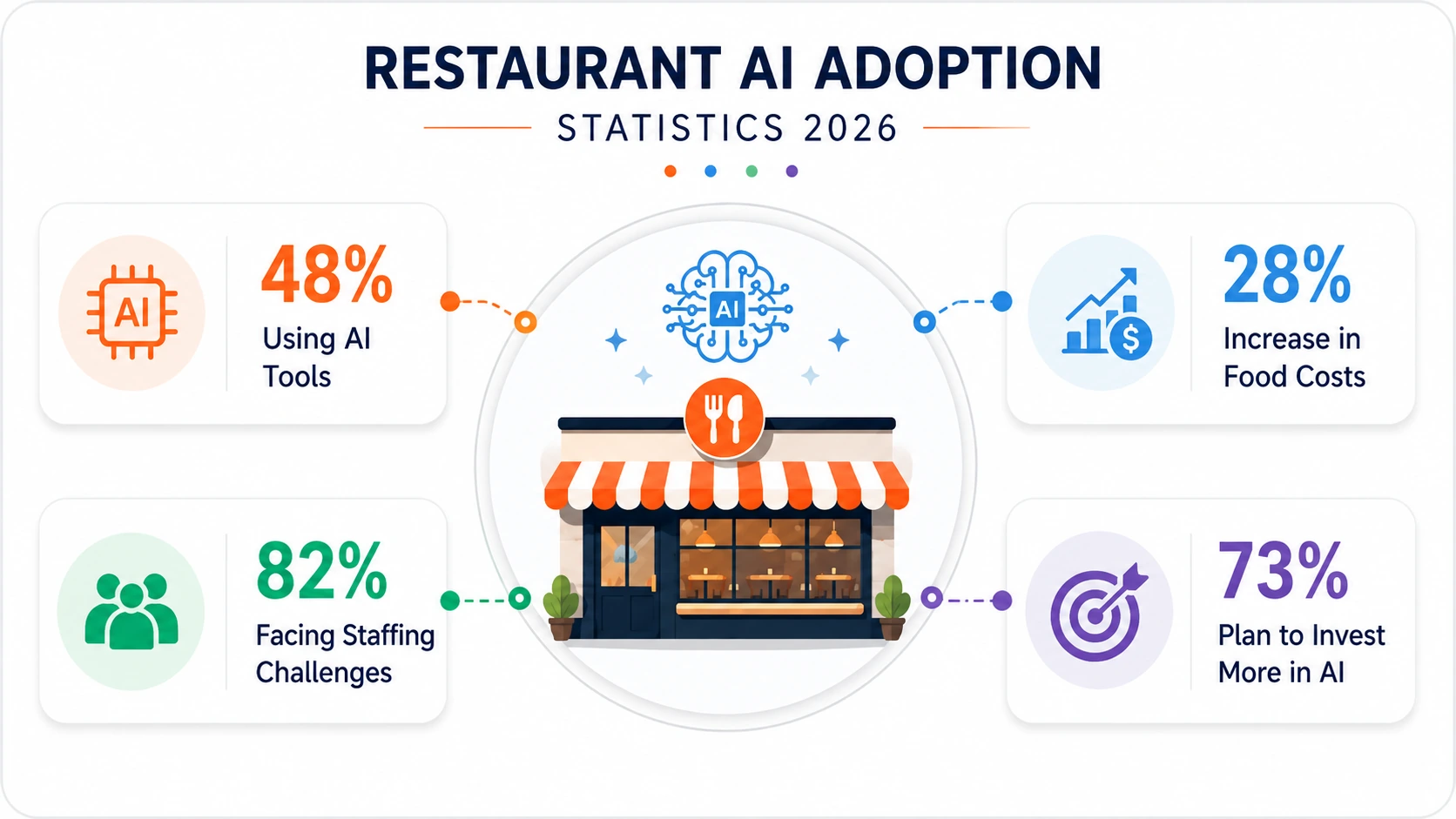
Restaurant AI adoption trends in 2026, highlighting AI usage, staffing challenges, rising food costs, and planned technology investments among restaurant operators.
| Metric | Value | Source |
|---|---|---|
| Restaurants using AI tools | 48% (up from 24% in 2023) | NRA, 2025 |
| Operators reporting staffing challenges | 82% | NRA, 2025 |
| QSR chains with AI ordering deployed | 72% | QSR Magazine, 2025 |
| Calls missed during peak service | 30–60% | Popmenu, 2025 |
| Operators using AI for marketing content | 55% | NRA, 2025 |
| Food cost increase since 2020 | 28% | Industry data |
| Labor cost reduction from AI scheduling | 2–5% within first month | Lineup.ai |
| Food waste reduction over 6 months | 30–50% | Winnow |
→ Need ready-made AI prompts for your restaurant staff — from writing menu descriptions to responding to reviews? Use the AI Prompt Generator to build prompts tailored to your restaurant type and use case.
Which AI Tool Is Right for Your Restaurant?
| Restaurant Type | Primary Recommendation | Secondary Add-On |
|---|---|---|
| Fine dining (1–3 locations) | SevenRooms | MARA AI |
| Casual dining (1–10 locations) | Lineup.ai | MarketMan |
| Fast casual & QSR (5+ locations) | 5-Out | 7shifts |
| Independent (single location) | 7shifts free | IAMenu ($39/mo) |
| Restaurant groups | MarketMan | Slang.ai |
| High-volume kitchen | Winnow | MarketMan |
| US independent needing marketing | Popmenu | — |
| European restaurants | MARA AI | SevenRooms |
How to Choose the Right AI Tool for Your Restaurant
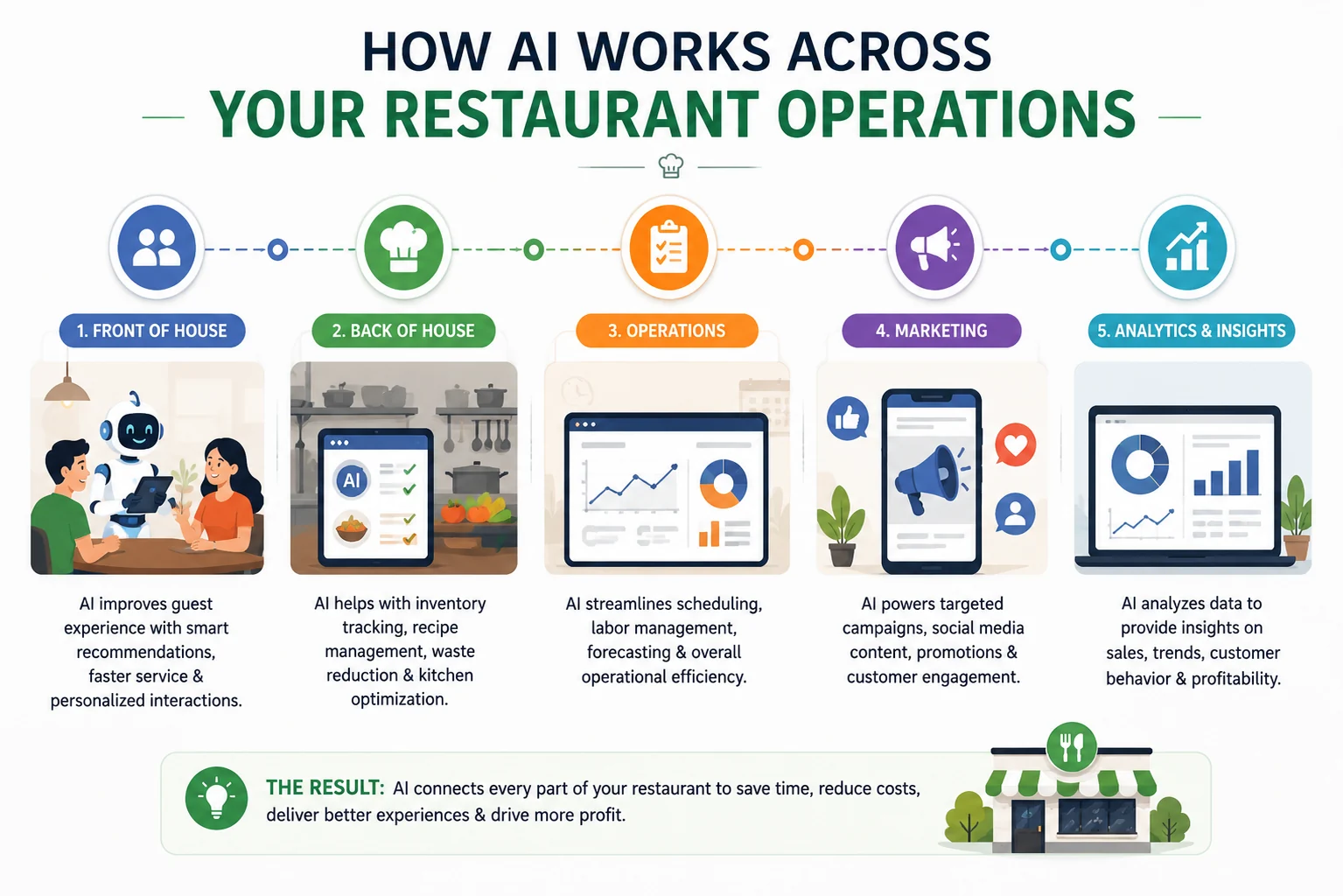
Key areas where AI supports restaurant operations, including guest experience, kitchen management, workforce optimization, marketing, and analytics.
The most common mistake restaurant operators make with AI is buying too many tools at once. One tool, fully adopted and integrated into daily operations, delivers more ROI than five tools that nobody uses consistently.
In 2026, the restaurant AI question is no longer "should we use it?" The question is "which problem costs us the most money, and which tool solves that problem fastest?" Start there. Everything else can wait.
For independent restaurants: Labor is almost always the biggest controllable cost. Start with 7shifts free tier. Once scheduling is under control, add Slang.ai or Popmenu to capture the phone revenue you're currently missing. Only then consider inventory or marketing tools.
For multi-location operators: Invest in Lineup.ai and MarketMan together. The forecasting and inventory combination drives the strongest combined ROI across locations. Add 5-Out when you need deeper predictive analytics for purchasing decisions.
For fine dining restaurants: Guest experience is the product. SevenRooms pays for itself through better table utilization, repeat visit rates, and personalized service that customers remember. Pair it with MARA AI to manage your online reputation consistently.
For fast casual and QSR: Volume is everything. 5-Out's 21-day forecasting window and 7shifts' scheduling automation address the two highest-cost variables — inventory waste and labor inefficiency — at the speed QSR operations require.
For restaurant chains: Crunchtime or a custom combination of Lineup.ai, 5-Out, and MarketMan. At scale, the integration between forecasting, scheduling, and inventory management determines whether you're running efficiently or leaving significant margin on the table across every location.
The common thread: identify your highest-cost operational problem first. Then buy the tool that solves it. Expand from there.
Expected ROI From Restaurant AI Software
The ROI case for restaurant AI is stronger than most operators expect, and it becomes clearer once you break it down by category.
Labor savings from Lineup.ai average 2–5% within the first month. For a restaurant with a $50,000/month labor bill, that's $1,000–$2,500 every 30 days — significantly more than the $149/month software cost.
Food waste reduction from Winnow averages 30–50% over six months. For a kitchen currently wasting $3,000/month in ingredients, that's $900–$1,500 back per month. MarketMan's real-time food cost tracking catches over-ordering and preparation waste before it compounds.
Missed reservations recovered by Slang.ai depend on your call volume, but the math is simple. If Slang.ai captures three additional reservations per week at an average check of $80, that's $960/month in recovered revenue — more than twice the monthly subscription cost.
Marketing ROI from Popmenu and MARA AI is harder to quantify directly, but restaurants that respond consistently to reviews and maintain an active online presence measurably outperform those that don't in local search rankings and repeat visit rates.
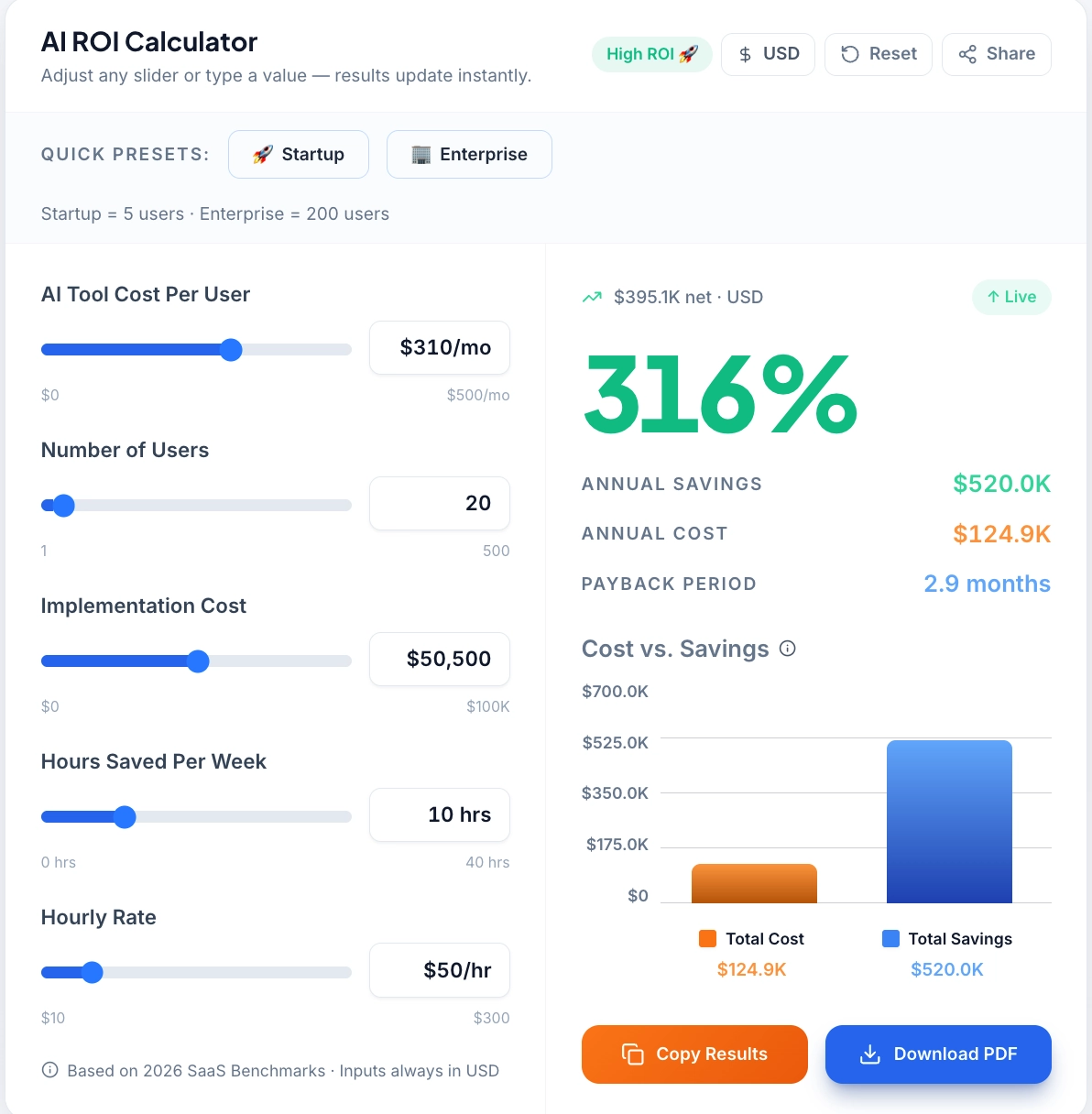
AI ROI Calculator estimating annual savings, implementation costs, payback period, and overall return on investment from AI software adoption.
→ Want a number specific to your restaurant? Use the AI ROI Calculator to estimate labor savings, food waste reduction, and revenue recovery based on your actual volume and costs.
Buying Guide
POS integration: Verify your specific POS version and integration depth during the trial period. Don't accept "we support Toast" as sufficient — confirm that the integration includes the specific data feeds your workflow depends on.
Start small: Deploy one tool at a time. Give it 60 days to show results before adding a second tool. The operators with the best AI outcomes are those who fully integrate one platform rather than superficially adopting five.
Free tiers and trials: 7shifts free tier and available vendor trial programs provide a practical way to evaluate restaurant AI software before committing to paid subscriptions. Test one tool at a time and measure operational impact before expanding your stack.
Pricing model fit: Usage-based pricing (Bite Buddy, Loman AI) works better for restaurants with variable call volume. Fixed monthly pricing (Lineup.ai, 7shifts) is easier to budget around.
Deployment timeline: If you need a solution running this week, Loman AI and Bite Buddy (<24 hour setup) and MARA AI (hours) are the right choices. MarketMan, SevenRooms, and Lineup.ai need a week or more to configure properly.
→ Building a phased AI rollout plan for your restaurant? Use the AI Implementation Checklist to structure your evaluation, deployment, and staff adoption process.
The National Restaurant Association's 2025 research highlights that AI adoption in restaurants has accelerated fastest in marketing automation and labor scheduling — the two categories with the clearest, fastest return on investment.