What Is AI Legal Research Software?
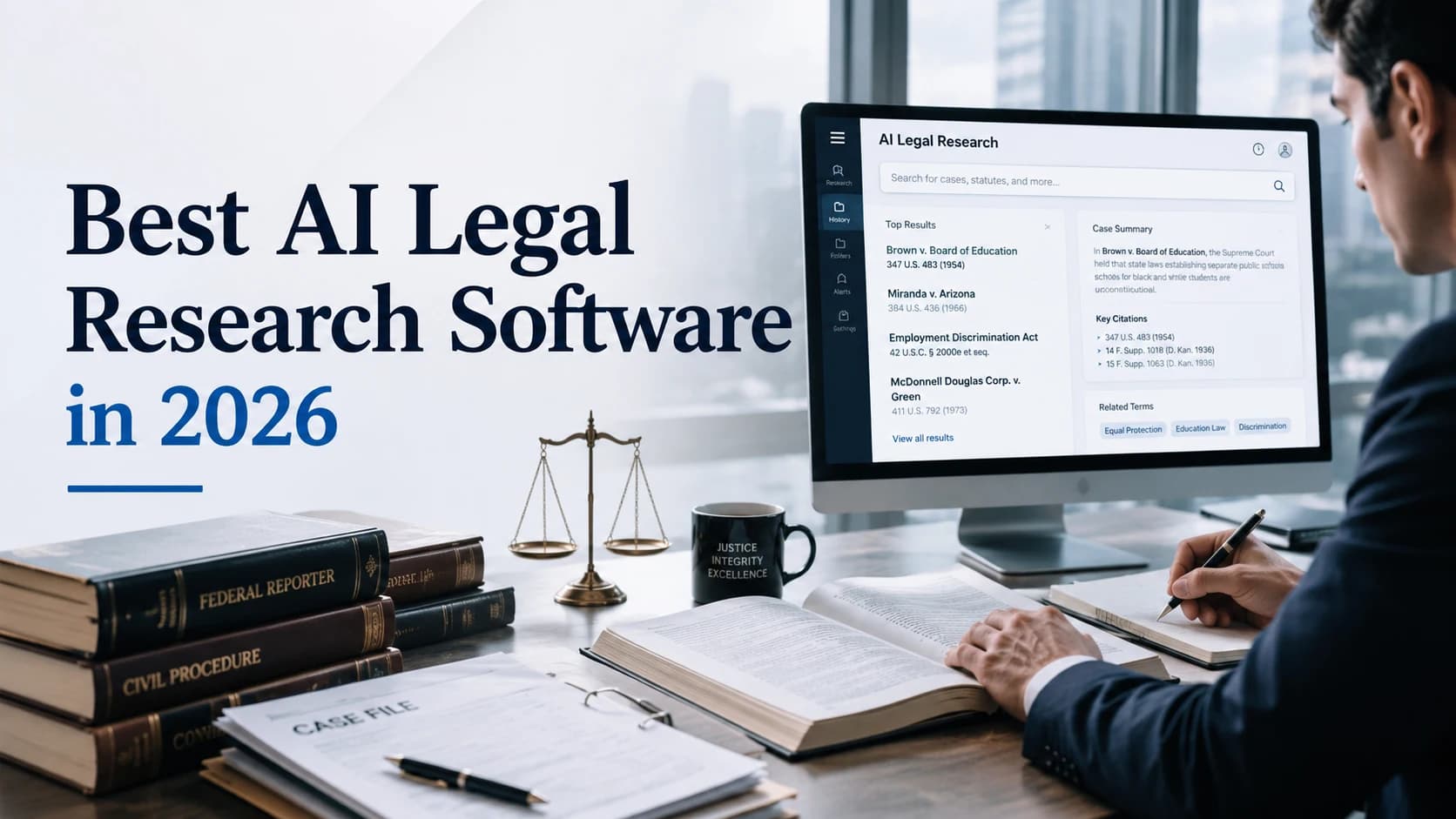
AI legal research software combines generative AI, machine learning, and legal databases to help lawyers find relevant case law, statutes, regulations, and legal commentary faster than traditional research methods.
Unlike general-purpose AI chatbots, legal research platforms retrieve information from curated legal databases and provide citation-backed answers linked to primary legal authorities. Many modern platforms use Retrieval-Augmented Generation (RAG), which grounds responses in real legal sources rather than relying solely on model memory.
The best legal AI tools can assist with:
- Case law research
- Statutory interpretation
- Legal memo drafting
- Contract review
- Due diligence
- Regulatory compliance research
- Document summarization
- Citation verification
However, AI does not replace legal judgment. Attorneys remain responsible for verifying authorities, checking citations, and ensuring professional compliance before relying on AI-generated output.
How We Evaluated These Tools
Legal AI isn't like other software categories. A wrong recommendation in productivity tools costs efficiency. A wrong recommendation here — a tool that confidently cites a case that doesn't exist — costs a lawyer their professional standing.
Each platform was assessed across:
- legal research accuracy and citation traceability
- case law and statutory database depth by jurisdiction
- hallucination risk and source verification approach
- drafting and document workflow capabilities
- contract review and analysis quality
- pricing transparency and firm-size fit
- data security and confidentiality controls
- compliance with professional responsibility obligations
We also reviewed the Litify 2025 State of AI in Legal report, the Federal Bar Association's 2025 AI survey, ABA Formal Opinion 512, and coverage from Reuters Legal and Law360. Platforms were assessed on what they actually deliver in legal workflows — not what the sales materials claim.
For a complete framework on evaluating AI tools across different business functions, see: Choosing AI Software for Business: Complete 2026 Guide.
How AI Legal Research Software Works
Modern legal AI platforms combine large language models with legal databases, search indexes, and document analysis systems.
The most advanced tools rely on Retrieval-Augmented Generation (RAG), which retrieves relevant legal authorities before generating a response. This process helps reduce hallucinations and improves citation accuracy.
A typical workflow looks like this:
- The lawyer submits a natural language legal question.
- The platform searches indexed legal databases.
- Relevant cases, statutes, regulations, and commentary are retrieved.
- AI summarizes the findings.
- Citations are attached to supporting authorities.
This approach allows lawyers to move from legal questions to verified research faster while maintaining a clear path back to the primary source materials.
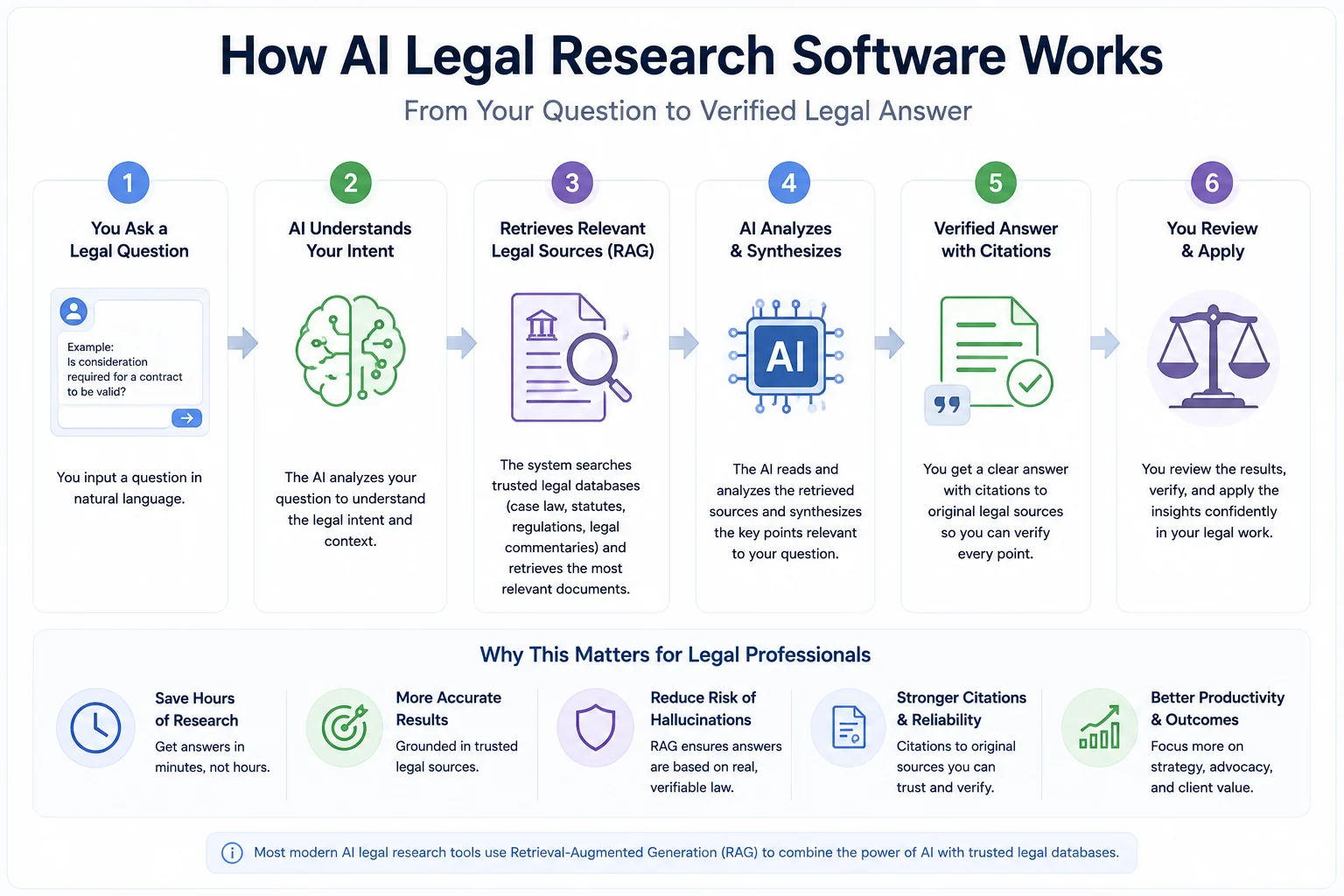
Typical workflow of modern AI legal research platforms, from legal query submission to citation-backed legal analysis and drafting.
Most modern legal AI platforms also support:
- Case summarization
- Legal drafting
- Contract analysis
- Document review
- Regulatory research
- Due diligence workflows
The quality of results depends heavily on database coverage, citation grounding, and jurisdiction-specific legal content.
→ Getting weak or incomplete legal AI responses? Use the AI Prompt Generator to create structured research, case analysis, contract review, and legal drafting prompts in seconds.
Why Legal AI Adoption Has Accelerated
78% of legal professionals were using AI tools by 2026, according to the Litify 2025 State of AI in Legal report. The Federal Bar Association's 2025 survey found 39% generative AI adoption in firms with 51 or more lawyers. Even in smaller practices — under 50 lawyers — adoption reached approximately 20%.
The driver isn't enthusiasm for technology. It's billable hours. Legal research, contract review, document summarisation, and first-draft memo work are time-intensive, repeatable, and exactly the kind of tasks that AI handles well. Firms where associates bill 2,000 hours per year can't ignore tools that compress research time from eight hours to two.
The risks are equally real. Courts in the US, Canada, and Australia have already penalised lawyers for submitting AI-generated fake citations. The ABA's Formal Opinion 512 makes the professional responsibility framework explicit: competence, confidentiality, supervision, and candour to the tribunal all apply to AI-assisted work.
- 78% of legal professionals were using AI tools by 2026 (Litify 2025 State of AI in Legal).
- 39% generative AI adoption in law firms with 51+ lawyers (Federal Bar Association 2025 survey).
- Courts in the US, Canada, and Australia have scrutinised or penalised lawyers for AI-generated fake citations (Reuters, 2025).
- AI shortens first-pass legal research significantly — vendor and independent benchmarks consistently show time savings on search, summarisation, and first-draft work.
- vLex published a 2025 benchmark in which Vincent AI produced fewer hallucinations than a reasoning model and fewer than upper-level law students on the same task.
According to the American Bar Association, AI adoption continues to expand across legal practice areas as firms look to improve research efficiency, drafting workflows, and client service delivery.
Understanding the Market: Three Categories, Not One
Before comparing individual tools, the most important framing is structural. AI legal software splits into three distinct product categories with different use cases, different accuracy profiles, and different pricing models.
Legal Research Platforms — These are database-first products. Lexis+ AI, Westlaw Precision AI, Bloomberg Law AI, and Vincent AI retrieve from their own curated collections of case law, statutes, regulations, and secondary sources. AI enhances the search, summarisation, and drafting — but the authority of the answer comes from the database, not the model. This distinction matters enormously for citation reliability.
Legal Drafting and Workflow AI — Harvey AI, CoCounsel, Paxton AI, and Clearbrief fall into this category. They handle drafting, document review, memo preparation, due diligence, and matter-specific analysis. Some integrate with research databases; others rely on the documents you provide. The output quality is strong for drafting tasks but depends heavily on the quality and completeness of inputs.
Contract Intelligence Platforms — Spellbook, Luminance, Lawgeex, and Genie AI focus specifically on contract work — drafting, review, redlining, clause extraction, and risk identification. These are not research tools and shouldn't be evaluated as though they are. Their value is in contract workflow efficiency, not legal research depth.
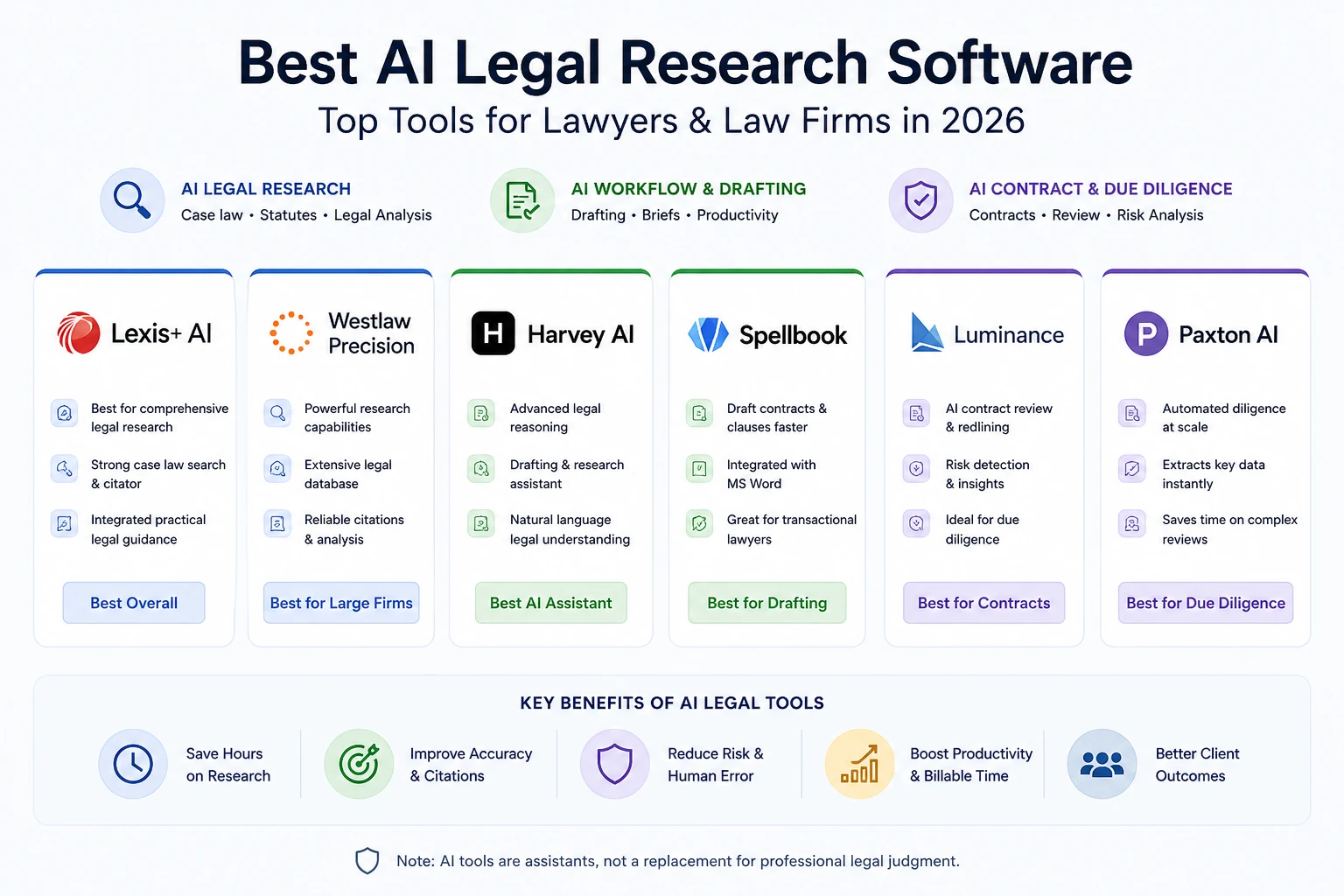
Comparison of leading AI legal research, drafting, and contract intelligence platforms used by lawyers and law firms in 2026.
Quick Comparison: AI Legal Research Software in 2026
| Tool | Category | Best For | Research Depth | Contract AI | Pricing |
|---|---|---|---|---|---|
| Lexis+ AI | Research Platform | Overall research, litigation | High | Medium | Custom |
| Westlaw Precision AI | Research Platform | Litigation, US case law | High | Medium | Custom |
| CoCounsel | Drafting + Research | Drafting, document review | Medium | Medium | Custom |
| Vincent AI | Research Platform | International, cross-border | High | Medium | Custom |
| Harvey AI | Drafting + Workflow | Enterprise firms, due diligence | Medium | High | Custom |
| Bloomberg Law AI | Research Platform | Regulatory, business law | High | Medium | Custom |
| Spellbook | Contract Intelligence | Contract drafting in Word | Low | High | Custom |
| Luminance | Contract Intelligence | Due diligence, contract review | Low | High | Custom |
| Clearbrief | Drafting + Litigation | Brief writing, citation linking | Medium | Low | Custom |
| Paxton AI | Drafting + Workflow | Solo lawyers, small firms | Medium | Medium | Custom |
The Best AI Legal Research Tools in 2026
1. Lexis+ AI — Best Overall for Legal Research
Best for: Research-heavy firms, litigation teams, mixed practice groups needing conversational search with verified citations
LexisNexis has been building legal databases for decades. Lexis+ AI puts a generative AI layer over that foundation — but the critical distinction is that the AI retrieves from LexisNexis's own indexed primary sources rather than generating answers from model memory. Ask a question in natural language and the platform returns a structured answer with citations that link back to the actual case or statute text.
The practical workflow value is in three areas: conversational research that doesn't require Boolean search expertise, document summarisation that compresses long judgments into structured analyses, and drafting assistance that can pull relevant authorities into a memo structure directly from search results.
Key Features:
- Conversational natural language legal research across case law, statutes, and regulations
- Document analysis and summarisation — upload briefs, contracts, or filings for AI-assisted review
- Citation-backed answers with traceable links to primary sources
- Drafting assistance that integrates research into memo and brief frameworks
Pricing: Custom — individual and firm subscriptions; contact LexisNexis directly
What Works:
The database depth for US, UK, Canadian, and Australian common-law research is the strongest in the category. The AI's citation grounding means answers trace back to actual indexed sources — the hallucination risk is lower than tools that rely on model memory alone, though it is never zero.
Where It Falls Short:
Pricing is opaque and typically enterprise-oriented. International coverage outside common-law markets is less comprehensive than Vincent AI. The interface has improved but still reflects its enterprise database heritage more than a modern AI-native product.
Who Should Use This: Litigation teams, research-heavy practices, and firms that need the deepest US, UK, and Canadian case law coverage available.
Who Should Skip This: Solo practitioners who don't need full database depth, or firms whose primary work is contract drafting rather than legal research.
Mini Verdict: Lexis+ AI is the most capable legal research platform in 2026 for common-law jurisdictions. The database-backed AI approach delivers the citation reliability that filing-ready legal work requires.
2. Westlaw Precision AI / CoCounsel — Best for Litigation Research and Drafting Workflows
Best for: Litigation teams that want research, memo drafting, and document review in a single connected workflow
Thomson Reuters' approach is worth understanding: Westlaw Precision AI handles the research database side, while CoCounsel Legal handles the drafting, memo preparation, and document review layer on top. In practice, most enterprise firms access both through a combined subscription.
The integrated workflow is the headline advantage. A litigator can research a legal question in Westlaw, generate a memo draft in CoCounsel with cited authorities pulled from that research, then review opposing counsel's documents in the same environment. The context carries across tasks rather than requiring the lawyer to re-enter information manually.
Key Features:
- Westlaw's case law and statutory database with AI-enhanced search and summarisation
- CoCounsel memo drafting with authority integration from Westlaw research
- Document review and analysis for large matter files
- Authority checking that flags weak or overruled precedent
Pricing: Custom — enterprise-focused; individual Westlaw tiers available
Why Litigators Choose This:
Westlaw's case law database is the benchmark for US litigation research. The KeyCite citation treatment system is the industry standard for understanding precedent strength. CoCounsel adds the drafting layer that converts research into usable outputs, reducing the gap between finding the law and filing the argument.
The Honest Limitation:
The combined platform is primarily optimised for US litigation. International coverage is improving but trails Vincent AI for cross-border work. And for firms that don't need deep drafting integration, paying for both Westlaw and CoCounsel may over-provision relative to simpler tools.
Who Should Use This: US litigation teams, large firms with document-heavy matters, and practices that want a single vendor handling research through drafting.
Who Should Skip This: International practices prioritising multi-jurisdiction coverage, or transactional teams whose primary need is contract intelligence rather than litigation research.
The Bottom Line: The strongest combined research-and-drafting workflow for US litigation. The integration between Westlaw's database and CoCounsel's drafting layer is the most developed in the category.
3. Harvey AI — Best for Enterprise Law Firms
Best for: Large law firms needing AI across research, drafting, due diligence, and regulatory work at scale
Harvey AI is purpose-built for large law firms. It doesn't compete with Lexis or Westlaw on database depth — it competes on workflow breadth and firm-specific customisation. Harvey can be trained on a firm's own precedent library, practice-specific templates, and matter files, which means the AI outputs reflect the firm's actual drafting style and institutional knowledge rather than generic legal writing.
The due diligence application is where Harvey earns its enterprise positioning. Processing hundreds of documents across a transaction — extracting key provisions, flagging risks, summarising contract terms — is exactly the kind of high-volume, repeatable analytical work that AI handles faster than human review teams.
Key Features:
- Firm-specific training on institutional precedent and templates
- Due diligence automation across large document sets
- Regulatory research and analysis
- Multi-matter workflow management with enterprise permissions
Pricing: Custom — enterprise only
What Stands Out:
The firm-specific customisation model. Harvey trained on your firm's 20 years of M&A precedent writes like your firm, flags the issues your practice cares about, and avoids the generic legal voice that undermines trust in AI-generated drafts.
Drawbacks:
Harvey is not a legal research database. Citation reliability depends on the materials you provide rather than a curated indexed database. For research requiring authoritative source retrieval, Harvey is best deployed alongside Westlaw or Lexis — not as a replacement.
Who Should Use This: Large law firms with significant precedent libraries, high-volume due diligence practices, and enterprise legal departments that can invest in the customisation and onboarding process.
Who Should Skip This: Small and mid-size firms without the document volume to justify enterprise pricing, or practices primarily needing database research rather than drafting and analysis.
Verdict: Harvey AI is the strongest enterprise drafting and workflow tool in the category. The customisation depth justifies the investment for large firms — but it requires genuine institutional engagement to get there.
4. Vincent AI (vLex) — Best for International and Cross-Border Research
Best for: International practices, cross-border transactions, multi-jurisdiction comparative research
Vincent AI is the research tool that the major US platforms underserve: genuine multi-jurisdiction coverage. vLex indexes legal content from over 200 jurisdictions — case law, statutes, regulations, and commentary — with AI that can compare legal positions across different countries' legal systems.
A 2025 benchmark published by vLex found that Vincent AI produced fewer hallucinations than a large reasoning model and fewer than upper-level law students on the same research task. That's a meaningful data point in a category where citation reliability is the primary purchase criterion.
Key Features:
- 200+ jurisdiction coverage with verified citations
- Multi-jurisdiction comparative research in a single query
- AI-powered workflow automation for cross-border matter prep
- Structured source citation with primary authority links
Pricing: Custom
What Works:
International coverage depth that Lexis and Westlaw don't match outside common-law markets. For practices doing comparative law, international arbitration, cross-border transactions, or work in civil law jurisdictions, the coverage breadth is the decisive advantage.
Where It Falls Short:
For purely US-focused litigation teams, Westlaw and Lexis offer deeper annotation, KeyCite-equivalent citation treatment, and more developed drafting integrations. Vincent AI's strength is breadth — depth within a single jurisdiction is still better served by the dominant domestic platform.
Who Should Use This: International law firms, arbitration practices, cross-border transaction teams, and any practice requiring research across multiple legal systems.
Who Should Skip This: US-only litigation teams with no cross-border work — Westlaw or Lexis will serve better.
Mini Verdict: The clearest category leader for international legal research. If your work crosses jurisdictions, no other platform comes close.
5. Bloomberg Law AI — Best for Regulatory and Business Law
Best for: Corporate and regulatory practices, big law and in-house teams, financial services legal departments
Bloomberg Law AI combines legal research with business intelligence — news, regulatory developments, deal data, and financial information alongside case law and statutes. For corporate lawyers and in-house teams where understanding a regulatory development's business context is as important as the legal analysis, that integration is genuinely useful.
The AI adds research summarisation, document analysis, and workflow support on top of Bloomberg's existing legal content. For practices where the line between legal and business intelligence is thin — financial regulation, M&A, securities, tax — the combined platform reduces the number of sources a lawyer needs to check.
Pricing: Custom — enterprise-focused
What Makes It Work:
The business intelligence integration. A securities lawyer researching an SEC enforcement matter gets the legal authority and the market context in the same interface. For in-house teams supporting business decisions, that dual-purpose coverage reduces context switching.
The Honest Tradeoff:
Bloomberg Law is stronger in US regulatory and business law than in litigation-heavy research. The AI capabilities are solid but trail Lexis+ AI's conversational research depth. For firms whose work is primarily litigation rather than regulatory or transactional, the Bloomberg premium doesn't fully pay off.
Who Should Use This: Corporate and regulatory practices, financial services legal departments, and in-house teams where legal and business intelligence are intertwined.
Who Should Skip This: Litigation-focused firms without significant regulatory or transactional work — Westlaw or Lexis offer better litigation research value.
6. Spellbook — Best for Contract Drafting
Best for: Transactional lawyers doing active contract drafting and redlining in Microsoft Word
Spellbook sits inside Microsoft Word. That's its entire value proposition — and for transactional lawyers who live in Word, it's a more practical integration than any browser-based platform. Ask Spellbook to suggest a clause, flag missing provisions, redline a counterparty's draft, or explain a term — it works within the document you're already editing.
The research depth is not comparable to Lexis or Westlaw. Spellbook is a contract drafting tool, not a legal research platform. Evaluating it on case law coverage misses the point.
Pricing: Custom
Why Transactional Lawyers Use It:
Zero workflow disruption. The AI is available inside the drafting environment without opening a separate tab, re-entering context, or learning a new interface. For lawyers who draft contracts in Word all day, that friction elimination is the actual productivity gain.
The Limitation:
Outside contract drafting, Spellbook's utility drops sharply. It doesn't do legal research, it doesn't support litigation workflows, and it shouldn't be used as a substitute for authoritative source retrieval. It's a specialised tool for a specific task.
Who Should Use This: Transactional lawyers, contract teams, in-house counsel, and any practice where Word-based contract drafting is the primary daily workflow.
Who Should Skip This: Litigators, research-heavy practices, or anyone expecting a general legal research capability.
Mini Verdict: The most practical contract drafting AI available for lawyers who work in Word. Narrow in scope — exactly right within that scope.
7. Luminance — Best for Contract Intelligence and Due Diligence
Best for: M&A teams, due diligence practices, large-volume contract review and negotiation
Luminance has been in the legal AI market since 2016, longer than most platforms on this list. The focus is contract intelligence — not drafting, but reading, understanding, and analysing existing contracts at scale. Uploading 500 agreements from a target company's contract room and extracting key provisions, flagging unusual terms, and identifying risk concentrations is where Luminance operates.
The negotiation support capability is more developed than most contract AI tools: Luminance can compare a counterparty's draft against standard positions, highlight deviations, and suggest redlines based on pre-set negotiation parameters.
Pricing: Custom
What Works:
Volume contract review. For due diligence exercises where a team needs to process hundreds of documents quickly, Luminance's AI extracts structured data from contracts faster and more consistently than human review at the same scale. The platform's maturity shows in the reliability of its extraction — less surprising behaviour than newer entrants.
What Requires Consideration:
Luminance is a contract intelligence specialist — it doesn't do legal research, and it's not a drafting tool in the way Spellbook is. For firms that need both contract review and research capabilities, Luminance works best as part of a broader stack alongside a research platform.
Who Should Use This: M&A and private equity practices, due diligence teams, firms with high-volume contract review workloads, and enterprise legal departments managing large contract portfolios.
Who Should Skip This: Litigation teams with no significant contract work, or small firms without sufficient contract volume to justify enterprise pricing.
The Call: The most mature contract intelligence platform available. For due diligence at scale, nothing else on this list matches its combination of accuracy and volume capacity.
8. Clearbrief — Best for Brief Writing and Litigation Support
Best for: Litigators, brief writers, legal teams that need AI-assisted fact-to-record citation linking
Clearbrief solves a specific litigation problem: connecting factual assertions in briefs and motions to the underlying record with verifiable citations. The AI reads your brief, identifies factual claims, and links them to the supporting record evidence — flagging where citations are missing or where the record doesn't support the assertion made.
For litigators who spend hours manually checking record citations before filing, this is a genuine workflow compression.
Pricing: Custom
What Stands Out: Record citation verification is Clearbrief's core capability and it does it better than any general-purpose legal AI. For appellate litigators and teams working on complex factual records, the citation integrity checking alone justifies the tool.
The Honest Tradeoff: Clearbrief is a litigation support specialist — not a comprehensive legal research platform. Factual record management, not legal authority research, is its domain.
Who Should Use This: Litigators, appellate teams, brief writers, and any practice where managing factual records and citations is a significant time burden.
Mini Verdict: Narrow focus, strong execution. For its specific use case in litigation support, it's the most capable tool available.
9. Paxton AI — Best for Solo Practitioners and Small Firms
Best for: Solo lawyers, small firms, and practitioners who need research and drafting capability without enterprise pricing
Paxton AI covers legal research and drafting for smaller practices at a price point that enterprise platforms don't offer. The research capability doesn't match Lexis or Westlaw on database depth, but for many small-firm workflows — drafting letters, researching procedural questions, preparing client-facing summaries — it covers the practical need.
Pricing: Custom — lower entry point than enterprise platforms
Why Small Firms Use It: The combination of research and drafting in a single lower-cost platform reduces the decision to one subscription rather than separate research and drafting tools. For solos doing general practice work, the practical adequacy of the output often exceeds what the pricing suggests.
The Limitation: Research depth and citation reliability trail the major database platforms. For complex litigation requiring authoritative source retrieval across large case law bodies, the limitations show. Use Paxton AI for practical daily workflows; add a primary research platform for high-stakes research tasks.
Mini Verdict: The most practical AI legal tool for solo practitioners and small firms that need both research and drafting without enterprise costs.
10. Genie AI — Best for SMBs and In-House Contracting Teams
Best for: SMBs, in-house legal teams, and businesses needing accessible AI contract drafting and review
Genie AI targets the mid-market and SMB segment that enterprise contract platforms overprice. The platform covers contract drafting, review, and clause guidance — built for in-house teams and smaller firms that handle standard commercial contracts without complex M&A volume.
Pricing: Custom — accessible entry point for SMB and in-house teams
What Works: Contract template access, AI-assisted drafting, and clause suggestions without the implementation overhead or pricing of enterprise platforms. For in-house teams drafting standard NDAs, vendor agreements, and employment contracts, Genie AI delivers practical value at an accessible price.
The Limitation: Not a legal research platform. Not suited for complex due diligence volume. The value is in standard contract workflows, not high-stakes M&A or complex negotiation.
Mini Verdict: The right contract tool for SMBs and in-house teams that need practical AI contract capability without enterprise complexity.
How Different Legal Practice Areas Use AI Research Tools
Legal research requirements vary significantly across practice areas. The most effective AI platform often depends on the type of matters a lawyer handles.
Criminal Law
Criminal lawyers use AI tools to review case law, procedural requirements, sentencing precedents, and statutory interpretation. AI can rapidly surface relevant judgments and summarize lengthy court decisions.
Family Law
Family law practitioners use AI for divorce matters, custody disputes, maintenance calculations, and family court precedents. Document summarization can significantly reduce review time in large case files.
Corporate and Commercial Law
Corporate lawyers often rely on AI for regulatory research, due diligence, contract review, compliance analysis, and transactional drafting.
Intellectual Property Law
IP attorneys use AI to research trademarks, copyrights, patents, licensing agreements, and infringement disputes across multiple jurisdictions.
Employment and Labor Law
Employment lawyers use AI to analyze labor regulations, workplace policies, employment contracts, and tribunal decisions.
Immigration Law
Immigration practices benefit from AI-assisted policy research, visa regulations, procedural updates, and jurisdiction-specific guidance.
Human Rights and Constitutional Law
These areas often involve extensive precedent analysis and comparative legal research. AI helps identify relevant authorities more efficiently across large bodies of case law.
International Law and Arbitration
Cross-border legal work requires access to multiple jurisdictions. Platforms such as Vincent AI provide broader international coverage for comparative legal research and arbitration matters.
AI Legal Research for Indian Lawyers
India's criminal law reform — the transition from the Indian Penal Code (IPC) to the Bharatiya Nyaya Sanhita (BNS), the Code of Criminal Procedure (CrPC) to the Bharatiya Nagarik Suraksha Sanhita (BNSS), and the Indian Evidence Act to the Bharatiya Sakshya Adhiniyam (BSA) — creates a research verification challenge that international AI platforms handle inconsistently.
The practical issue: many AI tools trained on Indian legal content through 2023 will retrieve IPC sections, CrPC provisions, and Evidence Act citations without flagging that the statutory framework has changed. A response citing Section 302 IPC needs to be verified against whether the BNS provision mapping is current and whether the platform's database has been updated to reflect the new statutory text.
What Indian lawyers need to verify before using any AI legal research tool:
- Does the platform index BNS, BNSS, and BSA current statutory text — or only legacy IPC/CrPC/Evidence Act?
- Does the AI flag when a cited provision has been renumbered or restructured under the new codes?
- Are Supreme Court and High Court judgments interpreting the new statutes indexed and retrievable?
For Indian practitioners, SCC Online and Manupatra remain the most reliable primary-source databases for domestic case law and statutory research. International AI platforms — including Lexis+ AI and Westlaw — can supplement research on common-law principles and cross-border matters, but should not be the primary source for BNS, BNSS, and BSA statutory verification. Always confirm the platform's India statutory indexing currency before relying on AI-generated section references.
For Indian lawyers working on international arbitration, cross-border transactions, or matters involving foreign law, Vincent AI's 200+ jurisdiction coverage is the most practical international research tool. For domestic Indian practice under the new criminal law codes, the verification burden on AI-generated section references remains higher than in more established AI-indexed jurisdictions.
For practitioners monitoring legal technology trends and AI adoption across law firms, the Thomson Reuters Institute regularly publishes research on legal innovation, AI usage, and professional workflows.
Benefits of AI Legal Research Software
The strongest value proposition of legal AI is not replacing lawyers — it is reducing the time spent on repetitive research and document-intensive tasks.
Faster Legal Research
AI significantly reduces the time required to locate relevant authorities, statutes, and precedents. Lawyers can start with natural language questions rather than complex Boolean searches.
Better Case Discovery
Modern AI tools can identify relevant cases and legal authorities that might otherwise be overlooked during manual research.
Improved Drafting Efficiency
Many platforms assist with first-draft memos, briefs, client letters, and legal summaries, allowing lawyers to focus on analysis and strategy.
Faster Contract Review
Contract intelligence platforms automate clause extraction, risk identification, and document comparison across large contract portfolios.
Reduced Research Costs
By shortening research workflows, firms can reduce non-billable time and improve overall productivity.
Enhanced Compliance Workflows
AI can assist compliance teams with regulatory monitoring, policy analysis, and ongoing legal research requirements across multiple jurisdictions.
Legal AI platforms often process confidential client information. To understand how modern AI vendors handle security, compliance, and data protection, read: Best AI Cybersecurity Tools in 2026.
Risks and Limitations Every Legal Professional Should Know
AI hallucinations in legal research are not a theoretical risk — they are a documented, ongoing problem with real professional consequences.
Reuters reported multiple instances through 2025 of courts scrutinising lawyers for AI-generated citations that didn't exist. Judges in the US, Canada, and Australia have issued sanctions, costs orders, and disciplinary referrals. The common thread: a lawyer trusted an AI-generated case citation without verifying it against the primary source.
The professional responsibility framework:
The ABA's Formal Opinion 512 addresses generative AI use directly. Competence (Model Rule 1.1) requires understanding AI limitations. Confidentiality (Model Rule 1.6) applies to client data uploaded to AI platforms. Supervision (Model Rule 5.3) means attorneys are responsible for AI-assisted work product. Candour to the tribunal (Model Rule 3.3) makes citation accuracy a professional obligation, not just a quality preference.
Practical risk management:
- Treat every AI-generated case citation as unverified until confirmed against the primary source
- Never file AI-generated content without attorney review — this applies to citations, quotations, and factual characterisations
- Review platform data handling terms before uploading client matter materials
- Use database-backed platforms (Lexis, Westlaw, Vincent AI) for citation-sensitive research rather than general-purpose AI tools
→ Not sure which legal AI platform fits your practice? Try the AI Tool Selector to compare AI tools based on your workflow, budget, and firm size.
Which AI Legal Tool Is Right for You?
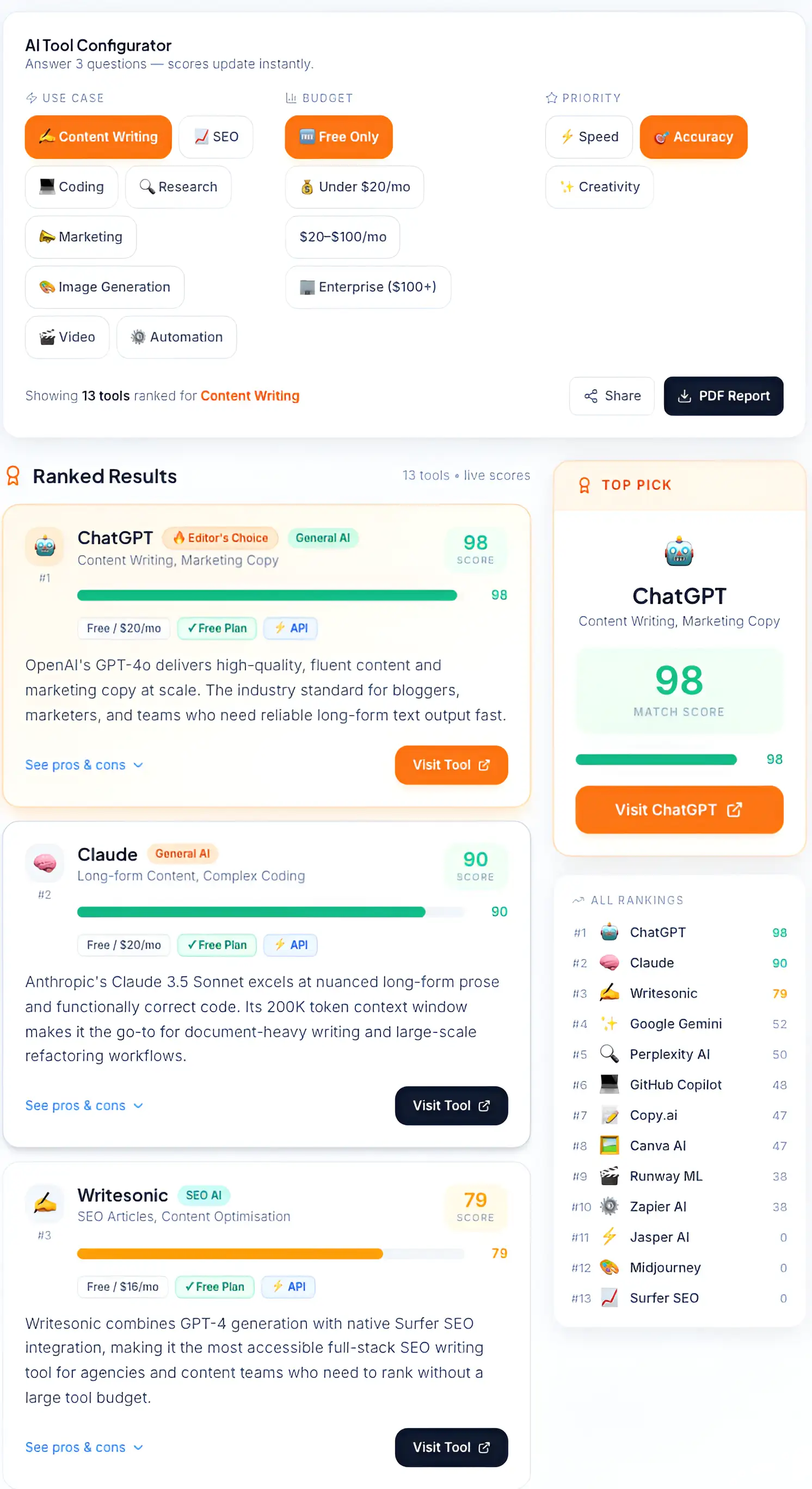
The AI Tool Selector helps legal professionals identify the most suitable AI research, drafting, and legal workflow software based on firm requirements.
Best Legal AI Tools by Firm Type and Use Case
| Firm Type / Use Case | Recommended Tool | Primary Reason |
|---|---|---|
| Litigation Research (US/UK/Canada) | Westlaw Precision AI + CoCounsel | Deep case law database with integrated drafting and document review workflows |
| Case Law Research (Overall) | Lexis+ AI | Conversational legal research with citation-backed answers |
| International / Cross-Border Research | Vincent AI (vLex) | Coverage across 200+ jurisdictions with verified citations |
| Enterprise Law Firms | Harvey AI | Firm-specific customization, due diligence, and workflow automation |
| Contract Drafting | Spellbook | Microsoft Word-native drafting and redlining assistance |
| Contract Due Diligence | Luminance | High-volume contract review and risk extraction |
| Regulatory / Business Law | Bloomberg Law AI | Combines legal research with business intelligence and regulatory tracking |
| Brief Writing / Litigation Support | Clearbrief | Fact-to-record citation verification and litigation workflow support |
| Solo Practitioners | Paxton AI | Research and drafting capabilities at a more accessible price point |
| SMBs / In-House Legal Teams | Genie AI | Practical contract drafting and review without enterprise complexity |
| Indian Domestic Practice | SCC Online / Manupatra + Vincent AI | Better coverage of BNS, BNSS, BSA, and Indian legal research requirements |
If your focus is reviewing contracts, managing legal documents, or automating contract workflows rather than legal research, read: Best AI Legal & Contract Tools for Small Businesses (2026).