How I Evaluated These AI Cybersecurity Tools
Evaluating enterprise security platforms isn't the same as comparing SaaS productivity tools. The stakes are different. A wrong recommendation here doesn't mean slower code — it means an undetected breach.
Each platform was assessed across:
- AI detection capability (behavioural vs. signature-based)
- XDR coverage and data correlation depth
- Cloud security integration
- SOC analyst productivity impact
- Pricing transparency and total cost of ownership
- Compliance support (SOC 2, ISO 27001, HIPAA, PCI DSS)
- Integration breadth with existing security stacks
- Response automation capability
I also reviewed the IBM Cost of Data Breach Report 2025, Verizon DBIR 2025, and Gartner's security platform forecasts. Where vendor-reported performance figures are used, that's noted. I prioritised platforms with verifiable enterprise deployments over those with impressive demos.
The same evaluation framework applies beyond cybersecurity. If you're comparing AI platforms across multiple business functions, our guide to choosing AI software for business in 2026 explains how to assess ROI, integration requirements, security, and long-term scalability before making a purchasing decision.
Why AI Cybersecurity Tools Matter in 2026
The numbers from the IBM Cost of Data Breach Report are the clearest way to frame this. The average breach now costs $4.88 million. Organisations using AI and automation in security had breach costs averaging $2.2 million less than those without. That's not a marginal improvement — it's the difference between a manageable incident and a company-defining event.
The Verizon Data Breach Investigations Report (DBIR) adds the attacker-side context: the median time from initial access to data exfiltration is now under 24 hours in ransomware cases. Traditional security tools — built around signature-based detection and manual alert review — can't keep pace with that timeline. AI-powered platforms detect anomalous behaviour patterns in real time rather than matching known attack signatures after the fact.
Gartner forecasts global security and risk management spending will reach $215 billion in 2026, with AI-integrated platforms capturing the largest growth share. That spending reflects a real shift: security teams are no longer asking whether AI security tools deliver value — they're asking which platform fits their environment.
- Average data breach cost: $4.88 million (IBM Cost of Data Breach Report 2025).
- Organisations using AI security tools contained breaches 108 days faster on average.
- AI and automation reduced breach costs by $2.2 million on average vs. non-AI organisations.
- Median time from initial access to exfiltration in ransomware attacks: under 24 hours (Verizon DBIR 2025).
- Global security spending forecast: $215 billion in 2026 (Gartner).
- 75% of SOC analysts report alert fatigue as their primary productivity challenge.
→ If you're evaluating whether an AI security platform can justify its cost, use our AI ROI Calculator to estimate potential savings from faster threat detection, reduced breach impact, and analyst productivity improvements.
Quick Comparison: 10 Best AI Cybersecurity Tools in 2026
| Tool | Best For | AI Copilot | XDR | Cloud Security | Starting Price |
|---|---|---|---|---|---|
| CrowdStrike Falcon | Overall enterprise | ⭐⭐⭐⭐⭐ | ⭐⭐⭐⭐⭐ | ⭐⭐⭐⭐⭐ | $59.99/endpoint/yr |
| SentinelOne | SMBs & mid-market | ⭐⭐⭐⭐ | ⭐⭐⭐⭐⭐ | ⭐⭐⭐ | $69.99/endpoint/yr |
| Microsoft Security Copilot | Microsoft stack | ⭐⭐⭐⭐⭐ | ⭐⭐⭐⭐ | ⭐⭐⭐ | Included M365 E5 |
| Wiz | Cloud security | ⭐⭐ | ❌ | ⭐⭐⭐⭐⭐ | Custom |
| Darktrace | Threat detection | ⭐⭐⭐ | ⭐⭐⭐⭐ | ⭐⭐⭐ | Custom |
| Palo Alto Cortex XSIAM | XDR platform | ⭐⭐⭐⭐ | ⭐⭐⭐⭐⭐ | ⭐⭐⭐⭐ | Custom |
| Vectra AI | Network security | ⭐⭐⭐ | ⭐⭐⭐⭐ | ⭐⭐⭐ | ~$11/asset/month |
| IBM QRadar Suite | Compliance & SIEM | ⭐⭐⭐ | ⭐⭐⭐⭐ | ⭐⭐⭐ | ~$100K/year |
| Arctic Wolf | Managed SOC | ⭐⭐⭐ | ⭐⭐⭐⭐ | ⭐⭐⭐ | ~$1,500/month |
| Recorded Future | Threat intelligence | ⭐⭐⭐ | ❌ | ❌ | Custom |
The 10 Best AI Cybersecurity Tools in 2026
1. CrowdStrike Falcon — Best Overall Enterprise Security Platform
Best for: Enterprise endpoint security, threat intelligence, and AI-driven detection across hybrid environments
CrowdStrike built its reputation on stopping breaches. The Falcon platform's AI, powered by the Threat Graph — a cloud-native graph database processing over 1 trillion security events per week — detects adversarial behaviour rather than matching signatures. That's the distinction that matters: when attackers use living-off-the-land techniques with no malware footprint, Falcon's behavioural AI still catches the lateral movement.
Charlotte AI, CrowdStrike's security copilot, lets analysts query incidents in natural language, run threat hunts, and build response workflows without writing detection rules manually. The intelligence layer — 24+ adversary groups actively tracked — is what separates Falcon from platforms that rely on community threat feeds.
Key AI Features:
- Charlotte AI for natural language incident investigation and response
- Threat Graph processing 1 trillion+ events weekly for behavioural detection
- AI-powered threat hunting with adversary-level intelligence
- Automated response playbooks with human-in-the-loop escalation
Pricing: Falcon Go at $59.99/endpoint/year → Falcon Pro → Falcon Enterprise → Falcon Premium (custom)
Pros:
- Best-in-class threat intelligence from 24+ tracked adversary groups
- Charlotte AI delivers practical SOC productivity gains, not just demo-ware
- Lightest endpoint agent footprint in the enterprise category
- Strong XDR data correlation across endpoint, identity, and cloud
Cons:
- Premium tiers scale into six figures for large enterprises — budget accordingly
- Full platform value requires buying multiple modules; point-solution pricing adds up
- Smaller organisations may find the intelligence depth more than they need
Who Should Buy This: Enterprise security teams that need the deepest adversarial intelligence, proven breach prevention track record, and a security copilot that actually reduces analyst workload.
Who Should Skip This: SMBs with fewer than 100 endpoints or teams looking for cloud-native agentless security — Wiz or SentinelOne offer better fit there.
Mini Verdict: CrowdStrike Falcon is the benchmark for enterprise AI security in 2026. If you're building a serious security programme and can justify the cost, this is where to start.
2. SentinelOne — Best for SMBs and Mid-Market Teams
Best for: SMBs and mid-market organisations wanting enterprise-grade AI detection without enterprise complexity
SentinelOne's Singularity platform runs its AI detection entirely on the endpoint — no cloud dependency for the core detection engine. That matters in environments with intermittent connectivity or latency-sensitive operations. More practically, it means the endpoint keeps detecting and responding even when your SIEM is down.
Purple AI is where SentinelOne earns its place on this list. The natural language threat investigation — type a question about a suspicious process, get a structured investigation summary — reduces the analyst skill requirement for tier-1 triage. For SMBs without a full SOC team, that capability shift is meaningful.
Pricing: Singularity Core at $69.99/endpoint/year → Singularity Control → Singularity Complete → Enterprise: custom
Why We Like It:
The on-device AI model means detection without cloud round-trips. Purple AI makes threat investigation accessible to security generalists, not just experienced threat hunters. And the automated response — isolate, rollback, remediate — happens in seconds, not minutes.
Where It Falls Short:
Cloud security coverage is narrower than CrowdStrike or Wiz. The XDR capabilities are strong on endpoint and identity but don't match Palo Alto Cortex XSIAM's data correlation depth. For organisations with complex multi-cloud environments, SentinelOne needs to be part of a broader stack.
Who Should Buy This: SMBs and mid-market teams (50–2,000 endpoints) that want strong AI detection, a security copilot that non-specialists can actually use, and automated response without hiring a full SOC team.
Who Should Skip This: Large enterprises needing deep multi-cloud XDR and advanced threat intelligence — CrowdStrike or Palo Alto will serve better.
The Bottom Line: SentinelOne hits a price-to-capability ratio that most mid-market organisations can justify. Purple AI is the most accessible security copilot in this category for teams without deep analyst expertise.
3. Microsoft Security Copilot — Best AI Security Assistant for Microsoft Environments
Best for: Organisations running Microsoft 365 E5, Azure, and the broader Microsoft security stack
Microsoft Security Copilot is the only AI security tool in this list that's embedded directly into the analyst workflow rather than accessed through a separate interface. When your security stack already includes Defender, Sentinel, Entra, and Purview, Security Copilot pulls context from all of them simultaneously. An analyst can ask "summarise all high-severity incidents from the last 48 hours affecting our finance team" and get a structured answer with recommendations — without leaving the tool they're already in.
The caveat is equally important to name: Security Copilot's value is almost entirely a function of how much of the Microsoft security ecosystem you've deployed. If you're not on M365 E5 and Azure, the integration depth disappears and the tool becomes expensive for what it delivers.
Pricing: Included with Microsoft 365 E5 → Security Copilot add-on: consumption-based pricing
What Stands Out:
The natural language query across the entire Microsoft security graph. Incident triage, threat investigation, policy recommendations, and compliance reporting — all through conversational prompts without custom query syntax. For organisations already running Sentinel, this compresses analyst workload meaningfully.
→ Security teams looking to improve the quality of incident investigation prompts can also use our AI Prompt Library to create structured security analysis, threat hunting, and compliance-review prompts for AI copilots.
Drawbacks:
Hard Microsoft dependency. If you're running CrowdStrike on endpoints, a third-party SIEM, and AWS as your cloud, Security Copilot loses most of its value proposition. The consumption-based add-on pricing is also opaque — costs can scale unexpectedly for high-volume environments.
Who Should Buy This: Organisations 80%+ committed to the Microsoft security stack who want to extract maximum analyst productivity from tools they're already paying for.
Who Should Skip This: Multi-vendor environments, AWS-native organisations, or teams without M365 E5 — the integration value won't materialise.
Verdict: The most capable AI security copilot available — if you live in the Microsoft ecosystem. Outside it, better options exist.
4. Wiz — Best Cloud Security Platform
Best for: Cloud-native and multi-cloud organisations needing comprehensive cloud security posture management
Wiz solved a real problem that most CSPM tools hadn't: instead of generating endless lists of individual misconfigurations, it maps the relationships between vulnerabilities, misconfigurations, exposed credentials, and network paths into a risk graph. An analyst sees "this S3 bucket is public, connected to a workload with a critical CVE, accessible by an over-privileged IAM role" — not three separate alerts with no context connecting them.
The agentless deployment is the operational advantage. No agents to manage, no performance overhead on workloads. Wiz scans the cloud control plane and workload snapshots directly. Enterprise teams that have fought agent deployment fatigue for years find this meaningful.
Pricing: Custom — based on cloud spend and environment size
Key AI Features:
- Security Graph for contextual risk visualisation across cloud resources
- AI-powered prioritisation of critical attack paths vs. noise
- Agentless scanning across AWS, Azure, GCP, and Kubernetes
- Natural language policy queries and compliance reporting
Strengths:
- Agentless deployment eliminates rollout friction in large cloud environments
- Risk graph reduces critical alert volume by surfacing exploitable paths, not individual findings
- Strong compliance coverage (SOC 2, PCI DSS, HIPAA, CIS Benchmarks)
- Fastest time-to-value of any enterprise cloud security platform tested
Limitations:
- No XDR — Wiz is a cloud security specialist, not a full security platform
- Custom pricing with no published tiers makes budget planning harder
- Less useful for organisations with minimal cloud footprint
Who Should Buy This: Cloud-native companies, enterprises running significant AWS/Azure/GCP workloads, and any team that's tried other CSPM tools and found the alert volume unmanageable.
Who Should Skip This: Primarily on-premises organisations, or teams looking for a single platform that covers endpoint, network, and cloud — Wiz doesn't cover the first two.
Mini Verdict: Wiz is the clearest category leader in cloud security. The risk graph approach is genuinely better than the alert-list model it replaced.
5. Darktrace — Best Autonomous Threat Detection
Best for: Organisations needing AI-driven detection across network, email, cloud, and OT environments without writing custom detection rules
Darktrace's core model is different from signature-based and rule-based tools. The platform builds a probabilistic baseline of normal behaviour for every device, user, and connection in your environment — then detects deviations from that baseline in real time. There's no rule writing. The AI learns what "normal" looks like for your specific network and flags anomalies that don't match.
The Autonomous Response feature — RESPOND — takes this further, automatically containing threats by restricting connections or enforcing normal behaviour patterns without blocking legitimate traffic. For network-layer threats moving laterally at machine speed, this matters more than any human response time.
Pricing: Custom — based on environment size and modules selected
What Works:
Darktrace catches what signature-based tools miss. Novel malware, insider threats, slow-burn lateral movement, compromised credentials used in abnormal patterns — the unsupervised learning model detects these precisely because it's not looking for known attack patterns. Coverage across IT, cloud, email, and OT in a single platform is genuinely differentiated.
What Requires Consideration:
The "black box" concern is legitimate. When Darktrace flags a deviation, analysts can't always trace exactly why the AI made the call. For teams with compliance requirements around explainable security decisions, that's a real operational issue. The autonomous response also requires careful tuning — false positives in RESPOND mode can disrupt legitimate traffic.
Who Should Buy This: Enterprises with complex network environments, OT/ICS exposure, or insider threat risk where traditional rules-based detection consistently misses early-stage attacks.
Who Should Skip This: Organisations that require full explainability on every detection, or teams without the analyst capacity to tune autonomous response carefully during deployment.
The Call: Darktrace is the right tool when you need detection that adapts to your specific environment rather than relying on shared threat intelligence. The explainability tradeoff is real — plan for the tuning investment.
6. Palo Alto Cortex XSIAM — Best XDR Platform
Best for: Large enterprises wanting a unified AI-driven security operations platform that consolidates endpoint, network, cloud, and identity data
Cortex XSIAM is built around a different premise from traditional XDR: instead of correlating alerts from disparate tools, it ingests raw telemetry from all sources and applies AI to the unified data layer. The result is detection that sees patterns across endpoint events, network flows, cloud logs, and identity signals simultaneously — rather than correlating pre-processed alerts that have already lost context.
For large enterprise SOCs drowning in alert volume, the noise reduction is the headline number: Palo Alto reports 75–90% reduction in alert volume after deployment. That's the difference between a SOC team triaging 2,000 alerts per day versus 200.
Pricing: Custom — enterprise only
Key AI Features:
- AI-driven data ingestion and correlation across all telemetry sources
- Automated threat investigation with AI-generated incident summaries
- XSIAM alert reduction through behavioural correlation
- Built-in SOAR for automated response playbooks
Pros:
- The most complete XDR data correlation in this category
- Alert volume reduction is transformative for large SOC teams
- Strong cloud security integration alongside endpoint and network coverage
- SOAR capabilities reduce manual response workload significantly
Cons:
- Enterprise-only pricing — not practical for SMBs or mid-market without large security budgets
- Significant implementation investment — expect 3–6 months for full deployment value
- Requires skilled XSIAM administrators; the platform's depth demands expertise to configure
Who Should Buy This: Large enterprises with mature security programmes, significant SOC staff, and a real alert volume problem that simpler tools aren't solving.
Who Should Skip This: Organisations under 500 employees, teams without dedicated security operations staff, or anyone looking for quick deployment — this is a programme-level investment.
Mini Verdict: Palo Alto Cortex XSIAM is the most complete AI security operations platform available for large enterprises. The implementation investment is real — so is the alert reduction payoff.
7. Vectra AI — Best for Network Threat Detection
Best for: Organisations prioritising network-level AI detection and hybrid cloud attack surface coverage
Vectra AI focuses specifically on detecting attacker behaviour in network traffic — the lateral movement, privilege escalation, and command-and-control patterns that endpoint tools often miss because the attacker is using legitimate tools and protocols. The platform applies AI to network metadata and cloud logs to surface attacker behaviours, not just anomalies.
The pricing model — approximately $11/asset/month — is more transparent than most enterprise security platforms, making budget planning realistic before procurement.
Pricing: ~$11/asset/month (published starting price)
What's Good: Network-layer AI detection catches attack patterns that evade endpoint-only tools. The Cognito platform's attack signal intelligence reduces analyst investigation time by surfacing prioritised, high-confidence detections rather than raw alerts. Integration with existing SIEM tools means it complements rather than replaces existing infrastructure.
What's Not: Vectra is a network detection specialist — not a full platform. Cloud coverage is growing but still narrower than Wiz. For organisations wanting a single-platform approach to security operations, Vectra needs to be part of a broader stack alongside endpoint and cloud tools.
Who Should Buy This: Mid-market to enterprise teams with network-heavy attack surfaces, hybrid environments, and existing SIEM investments they want to augment rather than replace.
Who Should Skip This: Organisations looking for an all-in-one endpoint-to-cloud platform — Vectra's specialisation means it doesn't replace CrowdStrike or Wiz.
Mini Verdict: The most transparent pricing of any enterprise AI security platform, with genuine network-layer detection capability. Best deployed alongside endpoint and cloud tools rather than as a standalone.
8. IBM QRadar Suite — Best for Compliance-Heavy Environments
Best for: Large enterprises with complex compliance requirements, hybrid SIEM deployments, and existing IBM infrastructure
IBM QRadar has been a SIEM staple for over a decade. The modern QRadar Suite adds AI-powered threat detection, automated investigation, and compliance reporting on top of the log management and correlation capabilities that enterprise security teams already depend on. For organisations where the security programme was built around QRadar, the Suite upgrade path preserves existing integrations while adding AI detection layers.
The compliance posture is QRadar's clearest differentiation: pre-built regulatory frameworks for PCI DSS, HIPAA, SOX, GDPR, and ISO 27001 with AI-assisted audit reporting reduce the manual work that compliance teams absorb quarterly.
Pricing: ~$100,000/year enterprise entry point (custom above that)
Where It Leads:
Compliance reporting depth and log management scale. Organisations processing billions of events per day with strict regulatory audit requirements will find QRadar's framework coverage and long-term log retention capabilities difficult to match.
The Honest Tradeoff:
QRadar's interface reflects its enterprise heritage — it's powerful but not intuitive. Implementation timelines are long, and analyst training requirements are significant. The ~$100K entry point also means this is firmly an enterprise conversation, not a mid-market one.
Who Should Buy This: Large enterprises in regulated industries (financial services, healthcare, critical infrastructure) where compliance reporting depth and proven log management scale matter more than deployment speed.
Who Should Skip This: SMBs, cloud-native organisations without on-premises log infrastructure, or teams prioritising modern UI and fast deployment over compliance reporting depth.
Bottom Line: QRadar Suite is the right choice when your security programme is built around compliance requirements and you need proven log management at enterprise scale. For greenfield deployments without legacy infrastructure, more modern platforms offer faster time-to-value.
9. Arctic Wolf — Best Managed Security Service
Best for: Organisations that need strong security outcomes but lack the staff to run a 24/7 SOC internally
Arctic Wolf's model is different from every other platform on this list. Instead of selling software and expecting your team to operate it, Arctic Wolf provides the technology and the security analysts — a managed detection and response (MDR) service that monitors your environment continuously. The Concierge Security team assigned to each customer provides personalised threat investigation, not just automated alerts.
For SMBs and mid-market organisations without dedicated security staff, this matters more than any feature comparison. A tool no one is actively monitoring doesn't protect you. Arctic Wolf solves that operational gap.
Pricing: ~$1,500/month (starting, scales with environment size)
What Makes It Work:
The Concierge model removes the "who's watching this at 2am" problem. Arctic Wolf's SOC monitors continuously, investigates alerts, and contacts your team when action is needed — not for every tier-1 false positive. For organisations without security staff, the $1,500/month starting price compares favourably to a single junior security analyst's salary.
What It Can't Replace:
Managed services introduce response latency compared to on-premises tools with autonomous response. Arctic Wolf's analysts investigate and recommend — your team still executes the remediation in most cases. For organisations needing millisecond-level automated containment, CrowdStrike or SentinelOne with automated response are more appropriate.
Who Should Buy This: SMBs and mid-market organisations (50–1,000 employees) without dedicated security staff who need verifiable 24/7 monitoring without building an internal SOC.
Who Should Skip This: Large enterprises with mature internal SOC teams, or organisations requiring autonomous real-time response — the managed model adds response latency.
Verdict: Arctic Wolf solves the staffing problem that makes most SMB security programmes theoretical rather than operational. For teams without security specialists, the managed model delivers more real protection than any self-operated tool they'd leave under-monitored.
10. Recorded Future — Best Threat Intelligence Platform
Best for: Enterprise security teams, threat intelligence analysts, and organisations in high-risk sectors needing adversary-level intelligence
Recorded Future does something distinct from every other platform on this list — it focuses on what's happening outside your perimeter rather than inside it. The platform collects intelligence from the open web, dark web, technical sources, and curated analyst reporting to surface adversary TTPs, emerging threat campaigns, and indicators of compromise before they show up in your environment.
For security teams doing active threat hunting or building proactive defences, that external intelligence layer changes the quality of decisions. You're not responding to what attackers did yesterday — you're anticipating what they're likely to do next.
Pricing: Custom — based on modules and intelligence scope
The Genuine Advantage:
External threat intelligence at scale. Recorded Future's AI correlates millions of intelligence signals into prioritised, actionable intelligence that human analysts couldn't process manually. Brand protection, vulnerability intelligence (knowing which CVEs are being actively exploited in the wild before patching), and third-party risk monitoring are capabilities that complement every other platform on this list.
Where It Has Limits:
Recorded Future is a pure intelligence platform — there's no endpoint protection, no XDR, no SIEM. It enriches and informs your security operations; it doesn't replace them. The value is highest for mature security programmes with the analyst capacity to act on intelligence proactively. For organisations still working on basic detection and response, the ROI is harder to justify.
Who Should Buy This: Enterprise security teams with mature programmes, dedicated threat intelligence analysts, and organisations in sectors facing sophisticated adversaries (financial services, critical infrastructure, defence supply chain).
Who Should Skip This: Organisations still building foundational security capabilities — invest in detection and response tools first. Recorded Future's value multiplies an existing programme; it doesn't substitute for one.
Mini Verdict: The strongest external threat intelligence platform available. Complements every tool on this list — but only delivers full value to security programmes mature enough to operationalise intelligence proactively.
AI vs Traditional Cybersecurity: What Actually Changes
The practical differences between AI-powered and traditional security tools aren't abstract — they show up in specific operational metrics.
| Capability | Traditional Tools | AI-Powered Tools |
|---|---|---|
| Threat detection speed | Hours to days (signature matching) | Minutes to seconds (behavioural AI) |
| Zero-day detection | Limited — requires known signatures | Behavioural anomaly detection catches novel attacks |
| False positive rate | High — 80%+ of alerts are false positives | Reduced 75–90% through AI correlation |
| SOC analyst workload | Manual alert triage dominates analyst time | AI triage surfaces only high-confidence incidents |
| Mean time to contain | 207 days average (IBM 2025) | 99 days average with AI-assisted response |
| Coverage breadth | Separate tools for each domain | Unified XDR correlates across endpoint, network, cloud, identity |
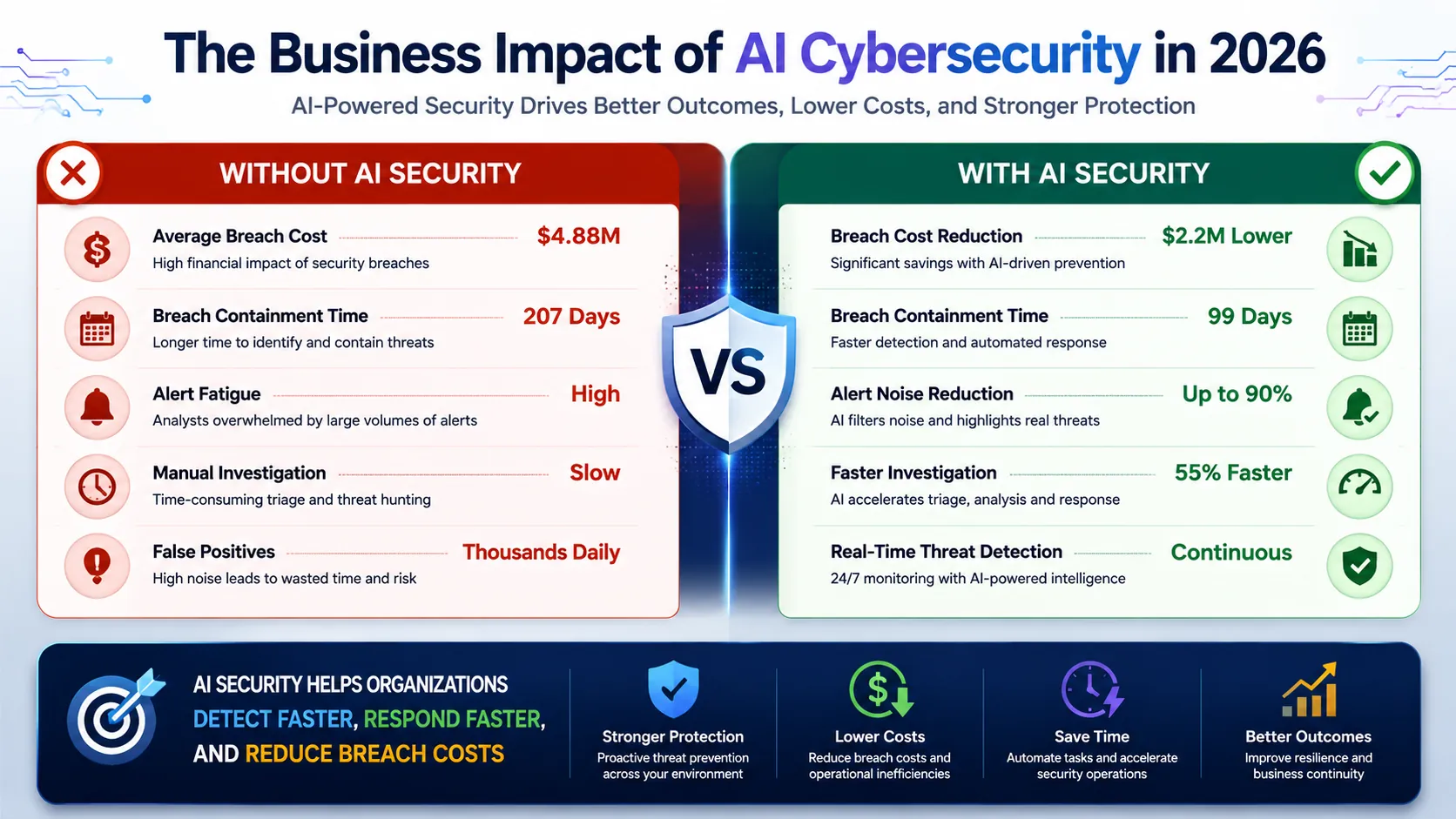
Organizations using AI-powered cybersecurity platforms detect threats faster, reduce alert fatigue, lower breach costs, and contain security incidents significantly sooner than teams relying on traditional security tools alone.
Source: IBM Cost of Data Breach Report 2025, Verizon DBIR 2025, Gartner Security Research 2026.
The 108-day reduction in breach containment time from IBM's research translates directly to cost. At $4.88M average breach cost and a typical cost-per-day-of-exposure calculation, that time saving alone justifies significant security investment.
Security Risks of AI Cybersecurity Tools
AI security platforms are not infallible. Understanding their failure modes is as important as understanding their capabilities.
Adversarial AI attacks — where threat actors deliberately manipulate inputs to evade AI detection — are a growing concern. Attackers who understand that a platform uses behavioural baselines can slow their activity to blend into normal patterns. No AI security tool should be the only layer of defence.
What security teams need to understand before deploying AI security platforms:
- AI hallucinations in security copilots — natural language security tools can misinterpret queries or generate plausible-sounding but incorrect investigation conclusions. Human review of AI-generated incident summaries is essential.
- Baseline poisoning — for tools that build behavioural baselines over time (Darktrace, Vectra AI), attackers who establish persistence before the baseline is fully built can become "normal." Deployment timing matters.
- Privacy and data handling — platforms that ingest endpoint telemetry, network traffic, and user behaviour data create significant data governance obligations. Verify data residency and retention policies before deployment in regulated industries.
- Vendor dependency risk — consolidating your security stack onto a single platform (CrowdStrike, Palo Alto) creates concentration risk. A platform outage or vendor breach impacts your entire security posture.
- Alert fatigue remains possible — AI reduces false positives significantly but doesn't eliminate them. SOC teams still need processes for managing residual alert volume effectively.
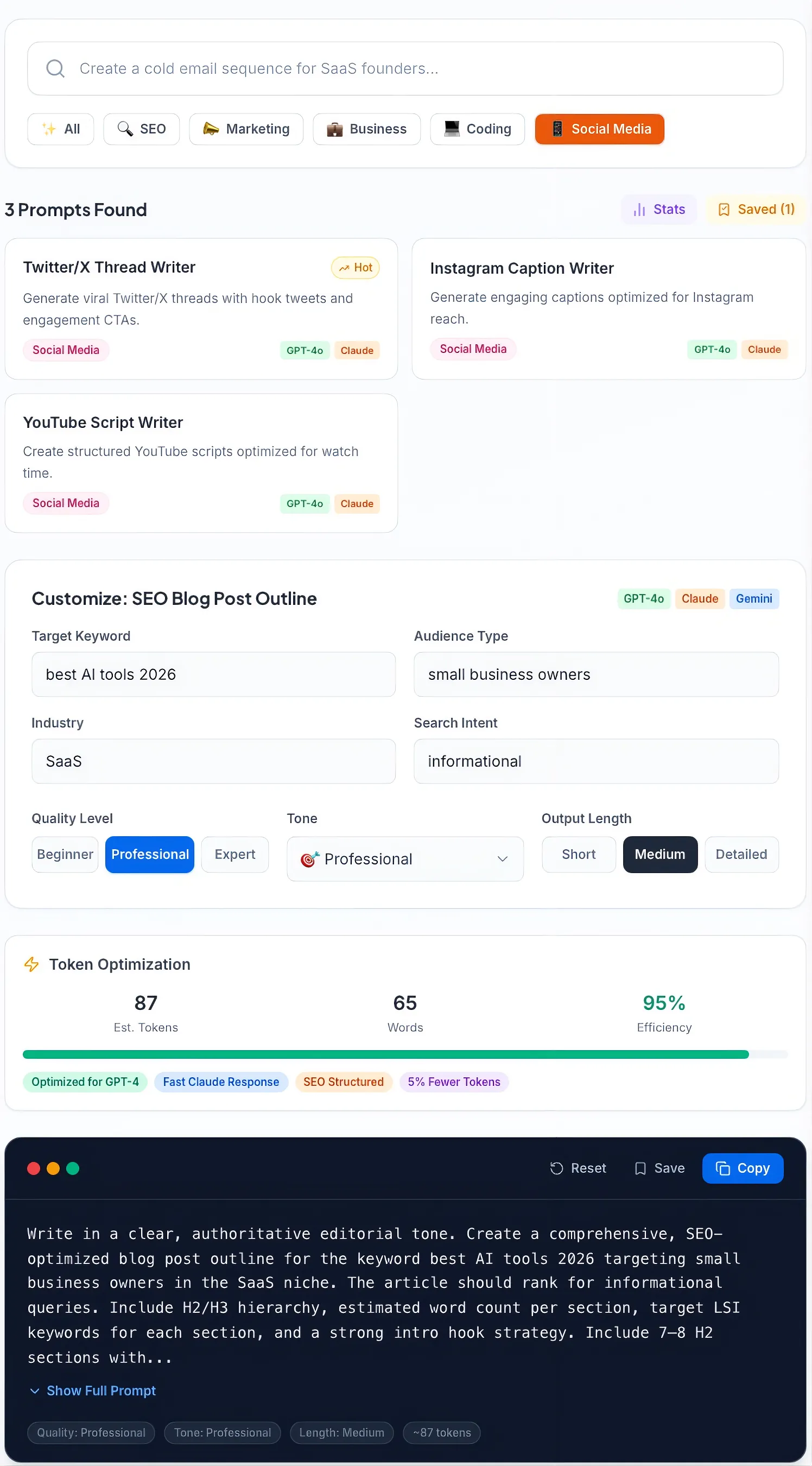
Structured prompts help security teams generate better incident reports, compliance documentation, risk assessments, threat investigation workflows, and security awareness content with more consistent AI outputs.
Which AI Cybersecurity Tool Is Right for You?
Best AI Cybersecurity Tools by Organisation Type
| Organisation Type | Recommended Tool | Primary Reason |
|---|---|---|
| Large Enterprise (1,000+ endpoints) | CrowdStrike or Palo Alto Cortex XSIAM | Depth of AI detection, XDR coverage, adversary intelligence |
| SMB (50–500 endpoints) | SentinelOne | Enterprise AI at mid-market pricing; Purple AI reduces analyst skill requirement |
| Cloud-Native Company | Wiz | Agentless cloud security, risk graph approach, fastest cloud time-to-value |
| Microsoft-Stack Organisation | Microsoft Security Copilot | Embedded in existing workflow; cross-product intelligence correlation |
| No Internal SOC | Arctic Wolf | Managed detection and response removes the staffing gap |
| Network-Heavy Environment | Vectra AI | Network-layer AI detection, transparent pricing, SIEM integration |
| Compliance-Driven Enterprise | IBM QRadar Suite | Regulatory framework depth, long-term log management scale |
| Threat Intelligence Need | Recorded Future | External adversary intelligence; complements any detection platform |
| OT/ICS Environment | Darktrace | Cross-domain coverage including OT; behavioural AI without rules |
| High-Sophistication Adversaries | CrowdStrike + Recorded Future | Detection plus proactive intelligence — the strongest combination |
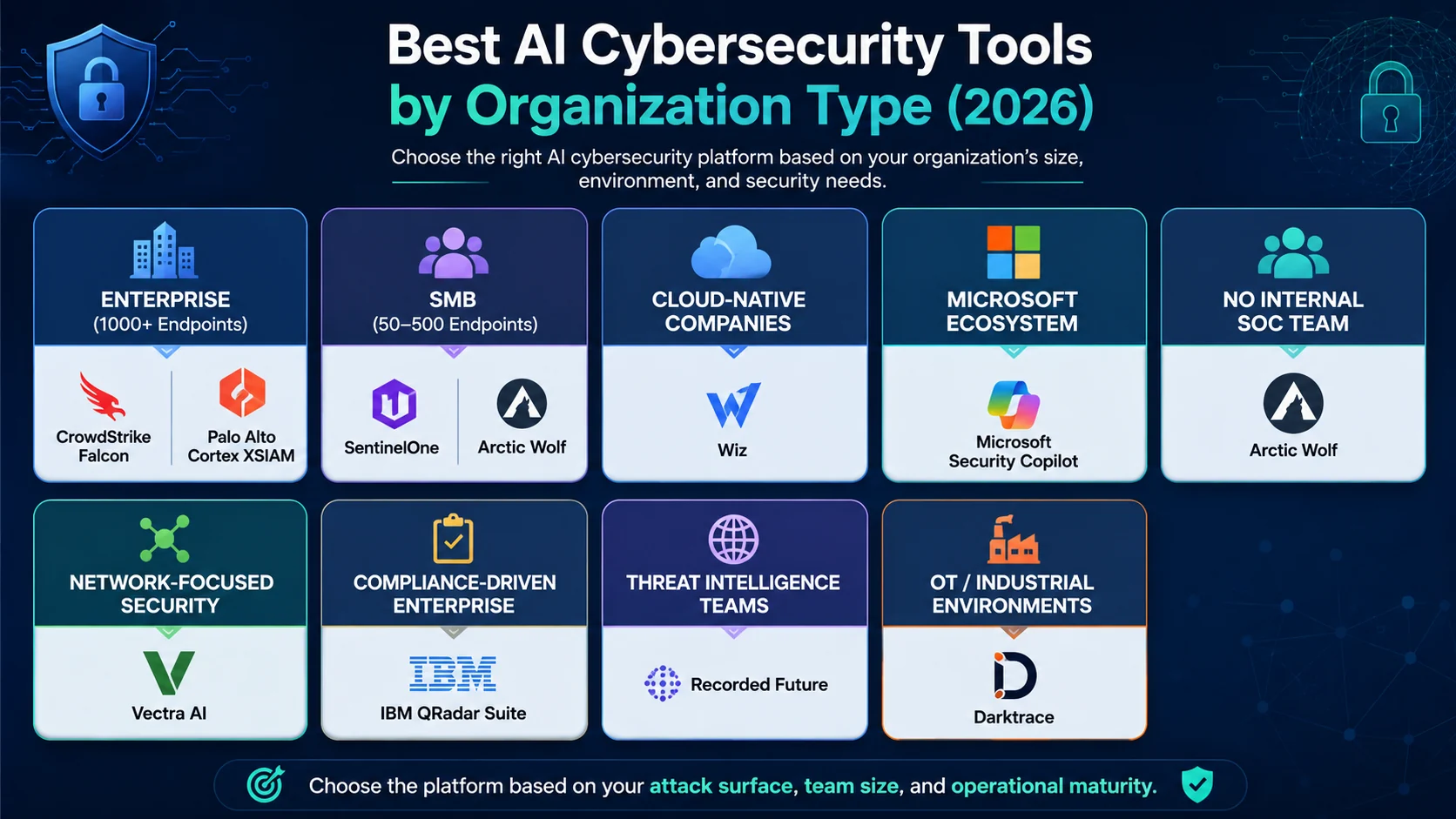
Different organizations require different AI cybersecurity platforms. Enterprise teams typically choose CrowdStrike or Cortex XSIAM, while cloud-native companies often prefer Wiz and SMBs benefit from SentinelOne or Arctic Wolf.
AI Cybersecurity Trends to Watch in 2026
The platforms on this list are already moving beyond reactive detection. The direction of travel in enterprise security is toward autonomous operations.
AI Security Copilots are becoming standard. CrowdStrike Charlotte AI, SentinelOne Purple AI, and Microsoft Security Copilot are normalising natural language security operations. Within two years, security analysts who can't work effectively with AI copilots will face a skill gap similar to analysts who couldn't query a SIEM.
Autonomous SOC is no longer theoretical. Palo Alto's Cortex XSIAM and Darktrace's RESPOND are already executing containment actions without human authorisation on specific response types. The shift from "AI suggests, human approves" to "AI acts, human reviews" is happening at the high end of the market.
Identity has become the primary attack surface. Verizon's DBIR 2025 attributes over 70% of breaches to compromised credentials or identity abuse. Every platform on this list has either acquired or built dedicated identity threat detection capabilities in the last 18 months. If your current security programme doesn't have AI-powered identity monitoring, that's the highest-priority gap to close.
Agentic security systems are emerging. Beyond copilots that answer questions, agentic security tools that autonomously investigate, contain, and remediate across multi-tool environments are in early enterprise deployment. CrowdStrike and Palo Alto are the furthest along here.
The rise of agentic security mirrors what's happening in software development, where AI agents can already plan, write, test, and refactor code with minimal supervision. See our guide to the best AI coding tools for developers in 2026 to understand how autonomous AI workflows are reshaping engineering teams.
Zero Trust and AI are converging. AI-powered continuous access evaluation — where authentication decisions are made in real time based on behavioural signals rather than static policies — is moving from architectural principle to operational reality.
Final Verdict
The $4.88 million average breach cost from IBM's 2025 research makes the ROI calculation straightforward. The question isn't whether AI cybersecurity tools deliver value — the evidence is clear. The question is which platform fits your actual environment, budget, and operational capacity.
CrowdStrike is the right choice for enterprises that need the deepest adversarial intelligence and proven breach prevention. SentinelOne delivers enterprise-grade AI at a price point that mid-market security budgets can sustain. Wiz has no serious competition in cloud security posture management. Microsoft Security Copilot is the strongest analyst productivity tool available — for organisations on the Microsoft stack. Arctic Wolf solves the staffing problem that makes most SMB security programmes more aspirational than operational.
No single platform covers every attack surface. The most resilient security programmes in 2026 combine a strong endpoint/XDR platform with cloud security coverage and external threat intelligence — and match the operational model (self-operated vs. managed) to the actual security staff they have, not the team they plan to hire.
Start with the attack surface that represents your highest risk. Buy the tool that covers it best. Build from there.