Best AI CRM Picks (Quick Selection)
- 🥇 Best Overall: HubSpot CRM
- 💰 Best Budget: Salesmate
- 🤖 Best AI Features: Zoho CRM
- 📊 Best for Sales Teams: Freshsales
- 🚀 Best for Scaling: Salesforce Essentials
Why AI CRM Is the Highest-ROI Software Decision for Small Businesses in 2026
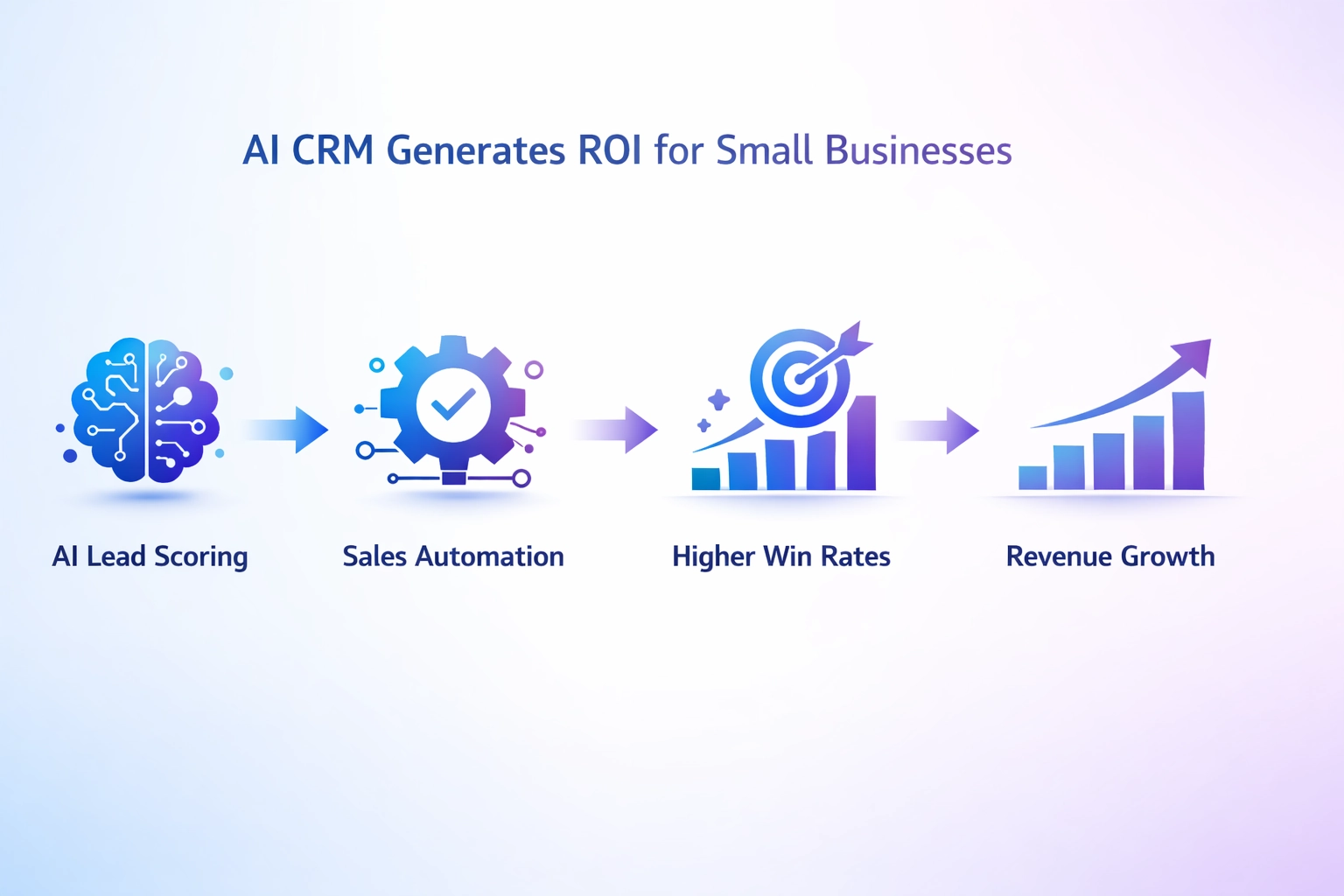
AI CRM adoption among small businesses reached 45% in 2025, up from 32% the year prior—and the acceleration is justified by results. CRM software delivers an average 8.71x ROI for small businesses Nucleus Research, and teams using AI-powered sales forecasting report 25% higher win rates. Add a 29% productivity gain from sales automation, and the case for AI CRM is no longer speculative.
The challenge for small business owners isn't whether to adopt AI CRM—it's which platform fits their team size, budget, sales process, and growth trajectory. The market is crowded, pricing models vary significantly, and AI capability depth ranges from basic email tracking to full predictive analytics and autonomous workflow execution.
This guide covers the ten strongest AI CRM tools for small businesses in 2026, with detailed breakdowns, a structured buying framework, and ROI context—so you can make a decision based on your actual business needs, not marketing claims.
For related tools that integrate with CRM, see:AI Data Analytics Platforms for Small Businesses (2026 Guide).
→ Not sure which CRM fits your business? Use our AI Tool Selector to get a personalized recommendation in under 30 seconds.
- Average ROI: CRM software delivers 8.71x ROI for small businesses on average.
- Win Rate Lift: Teams using AI sales forecasting report 25% higher win rates.
- Productivity Gain: Sales automation produces a 29% productivity improvement across sales teams.
- Adoption Rate: AI CRM adoption among SMBs reached 45% in 2025, up from 32% in 2024.
Quick Comparison: Best AI CRM Software for Small Businesses
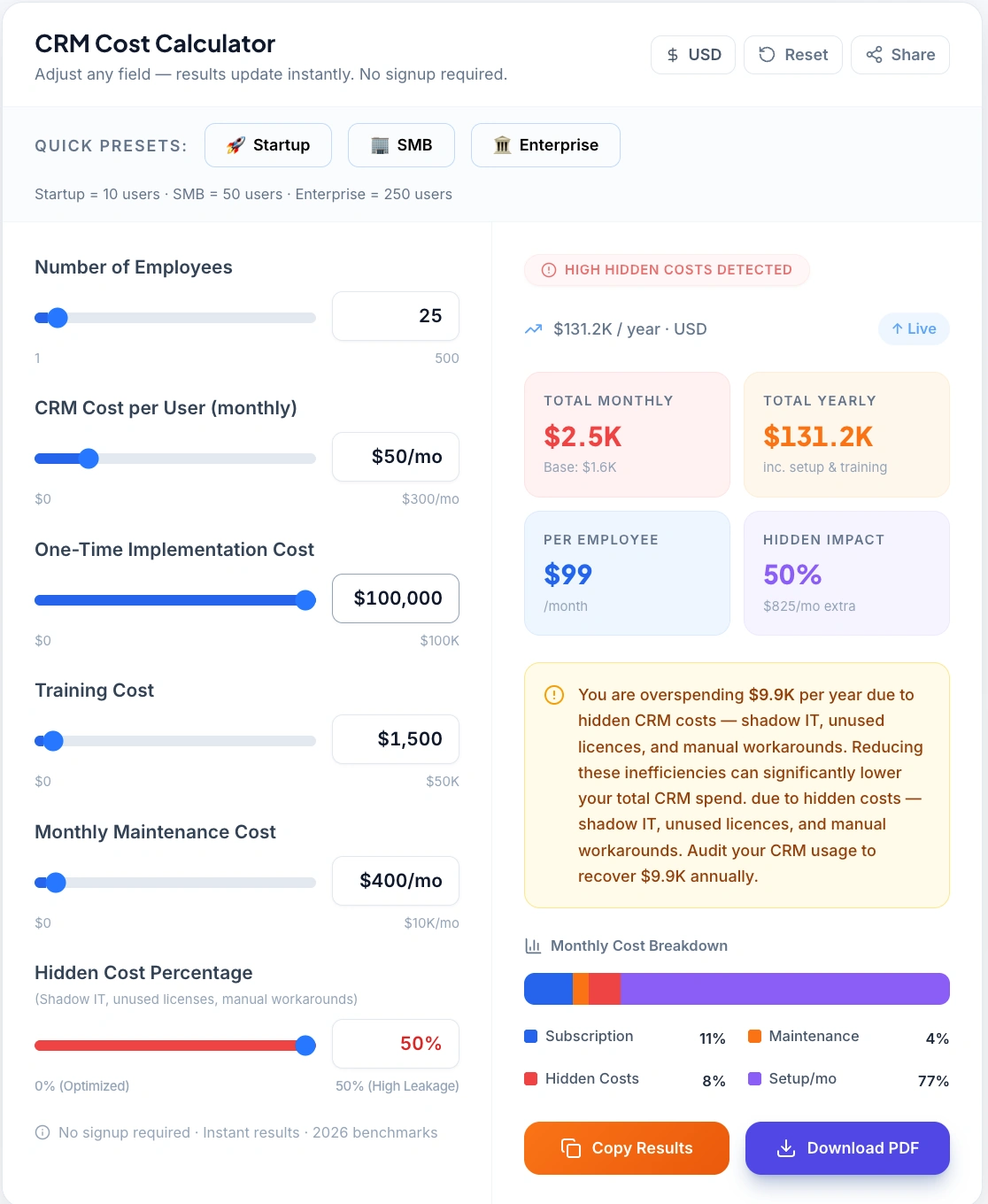
Identify hidden CRM costs and analyze total yearly spend with our interactive cost comparison tool.
| CRM Tool | Starting Price | Best For | Key AI Feature | Ease of Use |
|---|---|---|---|---|
| HubSpot CRM | Free / $45/mo | Beginners & solopreneurs | Chatbots, lead scoring | Very Easy |
| Zoho CRM | $14/user/mo | SMB all-in-one | Zia AI: sentiment, forecasting | Medium |
| Freshsales | Free / $15/user/mo | Data-driven sales teams | Freddy AI: predictive scoring | Easy |
| Pipedrive | $14/user/mo | Sales-focused SMBs | Pipeline forecasting, email AI | Easy |
| Salesforce Essentials | $25/user/mo | Scaling startups | Einstein predictions | Medium |
| Salesmate | $9/user/mo | Budget-conscious SMBs | Predictive insights, bots | Medium |
| Agile CRM | $9/user/mo | Startups & solopreneurs | Lead scoring, web tracking | Easy |
| Nutshell | $16/user/mo | Small sales teams | Workflow automation | Easy |
| Keap | $79/mo flat | Solopreneurs & service businesses | Campaign automation | Medium |
| Monday CRM | $9/user/mo | Flexible SMBs | Sidekick AI assistant | Easy |
The "Best CRM" is a myth. The right CRM is the one your team will actually use, connected to the tools you already have. A platform with superior AI that doesn't integrate with your email, billing, or ecommerce tools creates data silos that negate every analytical benefit.
My Testing Notes
Testing Period: June 2026
To evaluate these CRM platforms, I explored the available free plans, trial accounts, product demos, and publicly accessible AI features of HubSpot CRM, Zoho CRM, Freshsales, Pipedrive, Salesforce Essentials, Salesmate, Agile CRM, Nutshell, Keap, and Monday CRM during June 2026.
My evaluation focused on:
- Ease of setup and onboarding
- AI lead scoring capabilities
- Sales automation features
- Reporting and forecasting tools
- Integration flexibility
- Overall value for small businesses
During testing, HubSpot CRM provided the smoothest onboarding experience and the most useful free-tier functionality. Zoho CRM delivered the deepest AI feature set through Zia AI, although configuration required more time than most alternatives.
Freshsales stood out for sales-focused teams because Freddy AI provided actionable lead insights and next-step recommendations rather than simple reporting. Pipedrive offered the most intuitive visual pipeline management, while Salesforce Essentials showed the strongest long-term scalability for businesses expecting rapid growth.
Testing Methodology: Each platform was evaluated using publicly available free plans, free trials, product demonstrations, feature documentation, and hands-on exploration of core CRM workflows. The review focused on practical small-business use cases including lead management, sales automation, forecasting, customer communication, and workflow efficiency.
These observations reflect my evaluation process and practical product assessment rather than controlled benchmark testing.
HubSpot vs Zoho vs Freshsales: Which One Should You Choose?
If you're comparing the top 3:
- HubSpot → Best for beginners, free start
- Zoho CRM → Best AI depth + value
- Freshsales → Best for closing deals faster
👉 If you want simple → HubSpot
👉 If you want power → Zoho
👉 If you want sales performance → Freshsales
Detailed Breakdown: Top 10 AI CRM Tools for Small Businesses
1. HubSpot CRM — Best Free Entry Point
Starting Price: Free; premium AI plans from $45/month
Best For: Solopreneurs to businesses with up to 50 employees
Key AI Features:
- AI-powered chatbots for lead capture and qualification
- Predictive lead scoring to prioritize sales focus
- Email tracking with engagement analytics
- Content suggestions and AI writing tools in paid tiers
Integrations: 1,000+ apps including Gmail, Slack, Shopify, Zoom, and most major marketing platforms
Pros:
- Best free tier in the category—genuinely useful without paying
- Intuitive interface with minimal setup time
- Strong ecosystem of connected marketing and service tools
Cons:
- Advanced AI features locked behind significantly higher-priced plans
- Costs escalate quickly as contact lists and feature needs grow
Why Choose It: HubSpot is the lowest-risk entry point for small business CRM software. If you're new to CRM, have a limited budget, or want to validate workflows before investing, the free tier delivers immediate value. Upgrade paths are clear when you're ready to scale.
2. Zoho CRM (Zia AI) — Best All-in-One Value
Starting Price: $14/user/month
Best For: SMBs with up to 100 employees needing deep customization
Key AI Features:
- Zia AI assistant for predictive lead and deal scoring
- Sentiment analysis on customer communications
- Revenue forecasting and trend identification
- Anomaly detection that flags unusual pipeline changes automatically
Integrations: 50+ native Zoho apps (Books, Desk, Campaigns), Google Workspace, Microsoft 365
Pros:
- Strong AI depth at an affordable price point
- Highly customizable pipelines, fields, and workflows
- Anomaly detection is a standout feature not common at this price
Cons:
- Steeper learning curve than HubSpot or Freshsales
- Full value requires using the broader Zoho ecosystem
Why Choose It: Zoho CRM is the strongest AI CRM tool for SMBs that want serious capability without enterprise pricing. The Zia AI engine delivers predictive and diagnostic analytics—sentiment analysis, anomaly detection, forecasting—that most competitors charge significantly more to access. If you're willing to invest in setup, the return is substantial.
3. Freshsales (Freddy AI) — Best for AI Sales Intelligence
Starting Price: Free; AI features from $15/user/month
Best For: Data-driven SMBs prioritizing sales performance optimization
Key AI Features:
- Freddy AI lead scoring based on behavioral and engagement signals
- Predictive analytics identifying deals most likely to close
- Next-action suggestions to guide sales rep behavior
- AI-driven deal insights and pipeline health reporting
Integrations: Full Freshworks suite (Freshdesk, Freshchat), Zapier, and standard business tools
Pros:
- Built-in phone and email removes need for separate communication tools
- Freddy AI provides genuinely actionable sales guidance, not just data
- Clean interface with fast onboarding
Cons:
- Free tier AI capabilities are limited; meaningful AI requires paid plan
- Less flexibility for non-sales-focused use cases
Why Choose It: Freshsales is the best choice for small businesses whose primary CRM need is improving sales team performance. Freddy AI goes beyond reporting—it actively guides rep behavior with next-action recommendations, making it valuable for teams without experienced sales managers to provide that coaching.
4. Pipedrive — Best for Sales-Focused Teams
Starting Price: $14/user/month
Best For: Sales-focused SMBs with high-volume pipeline management needs
Key AI Features:
- AI-powered pipeline forecasting and revenue projections
- Email AI for writing assistance and follow-up optimization
- Lead scoring and deal prioritization
- Smart contact data enrichment
Integrations: Google Workspace, Mailchimp, Zapier, Slack, and 400+ marketplace apps
Pros:
- Visual pipeline interface is the most intuitive in the category
- Strong forecasting capability for sales-heavy operations
- Fast setup with minimal configuration required
Cons:
- Limited marketing automation compared to HubSpot or Keap
- Less suited for businesses with complex post-sale workflows
Why Choose It: Pipedrive is purpose-built for sales pipeline management. If your primary CRM use case is moving deals through a structured sales process efficiently, Pipedrive's visual interface and AI forecasting deliver faster adoption and cleaner pipeline visibility than most alternatives at this price point.
5. Salesforce Essentials — Best for Scaling Startups
Starting Price: $25/user/month
Best For: Startups planning significant growth within 12–24 months
Key AI Features:
- Einstein AI for lead and opportunity scoring
- Predictive deal insights and next-step recommendations
- Workflow automation across sales and service functions
- AI-powered reporting and trend analysis
Integrations: AppExchange with thousands of third-party apps; deepest integration ecosystem in the category
Pros:
- Platform scales to enterprise without requiring a migration
- AppExchange provides virtually unlimited extensibility
- Strong compliance and security for regulated industries
Cons:
- More expensive than alternatives at comparable feature levels
- Requires more configuration time than SMB-focused platforms
Why Choose It: Salesforce Essentials makes sense specifically for businesses that anticipate outgrowing SMB-tier CRMs within one to two years. The migration cost from a simpler platform to Salesforce later—in time, data transfer, and retraining—often exceeds the price difference. If growth is the goal, starting on Salesforce eliminates that future friction.
6. Salesmate — Best Budget AI CRM
Starting Price: $9/user/month
Best For: Cost-conscious SMB sales teams needing core AI automation
Key AI Features:
- Predictive deal insights and pipeline analytics
- Sentiment detection on customer communications
- AI-powered bots for lead engagement
- Automated follow-up sequencing
Integrations: Email platforms, calendar tools, Zapier for extended connectivity
Pros:
- Lowest per-user price point with meaningful AI capability
- Sales automation features strong relative to cost
- Suitable for teams needing to move fast with limited budget
Cons:
- UI less refined than premium competitors
- Integration depth shallower than HubSpot, Zoho, or Salesforce
Why Choose It: Salesmate delivers the best AI capability per dollar in the category. For SMBs with tight budgets that still need automated lead follow-up, pipeline forecasting, and sentiment detection, it provides a viable path without compromising on core AI sales automation.
7. Agile CRM — Best Budget Option for Solopreneurs
Starting Price: $9/user/month
Best For: Early-stage startups and solopreneurs needing basic AI marketing and sales tools
Key AI Features:
- Lead scoring based on engagement and behavioral signals
- Email intelligence and open/click tracking
- Web visitor tracking for intent identification
- Basic workflow automation
Integrations: Social media platforms, email tools, basic business apps
Pros:
- Affordable entry point with combined sales and marketing features
- Practical automation suitable for one-person or small teams
- Quick to deploy with minimal configuration
Cons:
- Forecasting capability is basic compared to Zoho or Freshsales
- Limited scalability beyond small team use
Why Choose It: Agile CRM suits solopreneurs and early-stage businesses that need marketing and sales tools in one place without paying for features they won't use. It's a practical starting point—not a long-term platform for growing teams, but effective for the stage it serves.
8. Nutshell — Best for Simplicity-First Teams
Starting Price: $16/user/month
Best For: Small sales teams that prioritize ease of use over feature depth
Key AI Features:
- Lead scoring and contact prioritization
- Automated workflow triggers based on pipeline stage
- Email sequence automation
- Basic reporting and pipeline analytics
Integrations: Gmail, Google Workspace, QuickBooks, Mailchimp, Zapier
Pros:
- Fastest setup and adoption curve in the category
- Clean interface reduces training time significantly
- QuickBooks integration valuable for service businesses
Cons:
- AI depth is limited compared to Zoho, Freshsales, or Salesforce
- Less suitable for businesses with complex, multi-stage sales processes
Why Choose It: Nutshell is the right choice when team adoption speed matters more than feature sophistication. If previous CRM implementations have failed due to complexity or resistance, Nutshell's simplicity-first approach gets teams using the system within days rather than weeks—and consistent use of a simpler CRM outperforms inconsistent use of a more powerful one.
9. Keap — Best for Service Business Automation
Starting Price: $79/month flat (not per-user)
Best For: Solopreneurs and small service businesses needing marketing-sales integration
Key AI Features:
- Smart audience segmentation for targeted campaigns
- Automated campaign sequences triggered by behavior
- Lead capture and follow-up automation
- E-commerce and payment integration with automation triggers
Integrations: E-commerce platforms, payment processors, appointment scheduling tools
Pros:
- Flat pricing is cost-effective for teams of three or more
- Strong marketing automation depth for service businesses
- Payment and e-commerce integration uncommon at this tier
Cons:
- Not designed for large sales teams or complex B2B pipelines
- Per-feature pricing model can create cost surprises
Why Choose It: Keap is the strongest option for solopreneurs and small service businesses—consultants, coaches, agencies, tradespeople—who need automated lead nurturing, appointment follow-up, and payment collection in one platform. The flat pricing model becomes economically attractive as soon as you have three or more users.
10. Monday CRM — Best for Modular Flexibility
Starting Price: $9/user/month
Best For: SMBs needing customizable workflows and flexible CRM structure
Key AI Features:
- Monday Sidekick AI assistant for workflow generation and data summarization
- Custom AI prompts for pipeline management tasks
- Automated bots for routine data entry and updates
- Modular AI blocks that adapt to different business processes
Integrations: Extensive modular app marketplace; connects with most standard business tools
Pros:
- Most flexible structure in the category—adapts to non-standard sales processes
- Sidekick AI reduces manual workflow setup significantly
- Strong visual project-and-sales hybrid capability
Cons:
- AI credits for advanced features add cost beyond base subscription
- Less purpose-built for pure sales management than Pipedrive or Freshsales
Why Choose It: Monday CRM suits businesses whose sales process doesn't fit a standard pipeline model—project-based sales, creative agencies, consultancies, or teams managing complex multi-stakeholder deals. The modular AI approach lets you build the system around your process rather than adapting your process to the system.
How to Choose the Right AI CRM for Your Small Business
Define Your Primary Use Case First
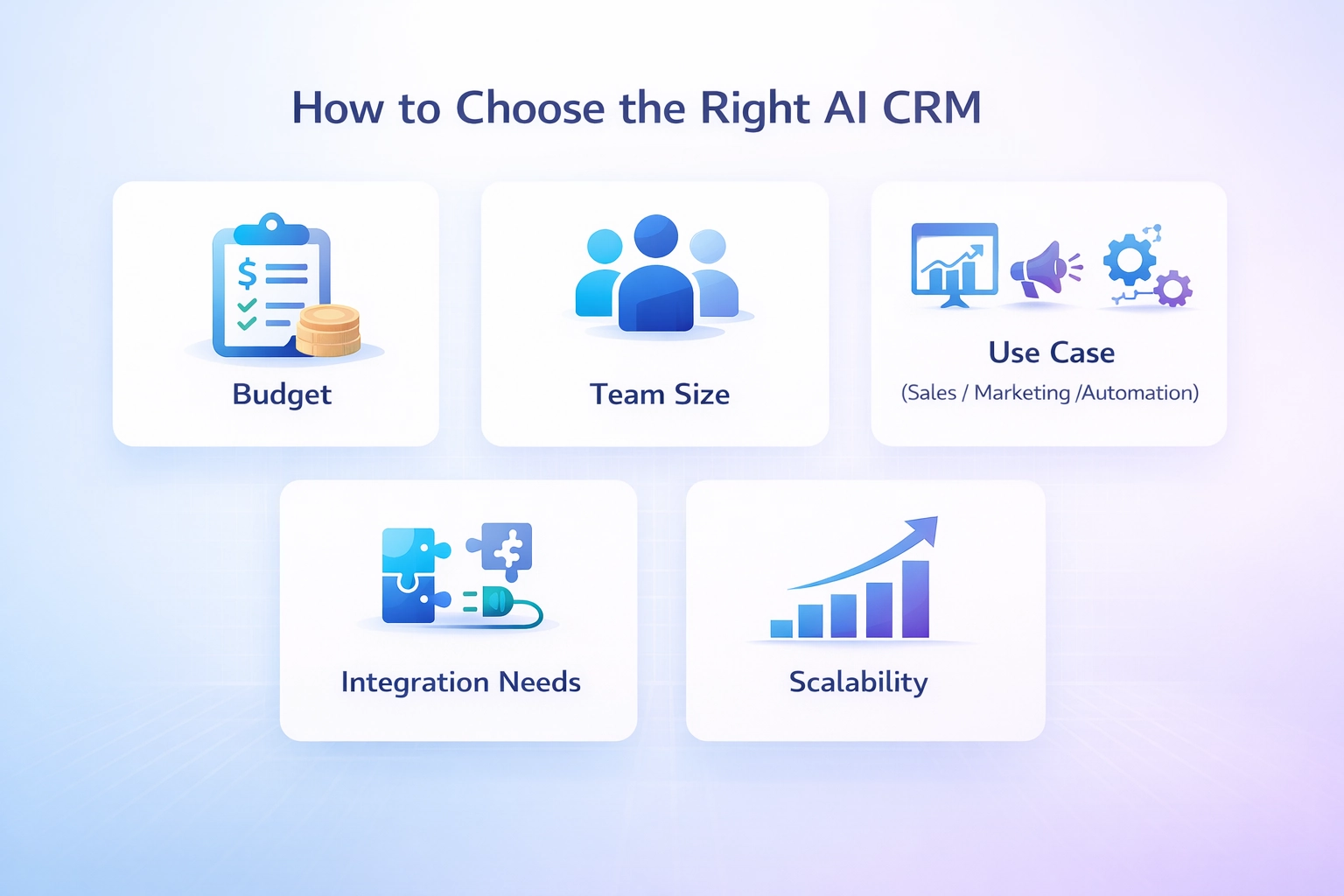
Before comparing pricing or features, identify which CRM function drives the most business value for you. Pure sales pipeline management points to Pipedrive or Freshsales. Combined marketing and sales automation points to HubSpot, Zoho, or Keap. Flexibility and customization points to Monday or Zoho. Budget constraint as the primary filter points to Salesmate or Agile CRM.
→ Use the CRM Cost Calculator to estimate your real total cost based on contacts and team size before committing.
Evaluate These Five Factors in Order
1. Integration with your existing stack. The best CRM is the one that connects cleanly to the tools your team already uses. A platform with superior AI that doesn't integrate with your email, billing, or ecommerce tools creates data silos that negate the analytical benefits. Confirm specific integrations—not total integration counts—before committing.
2. AI depth versus AI complexity. More AI capability is only valuable if your team can use it. Zoho CRM's Zia AI is more powerful than HubSpot's free tier, but if your team won't configure it, the simpler tool wins. Match AI sophistication to your team's willingness to engage with it.
3. Total cost of ownership, not just license cost. Factor in onboarding time, training, potential consultant fees for setup, and the cost of integrations. A $9/user/month platform that requires $2,000 in setup work may be more expensive than a $25/user/month platform that deploys in a day.
4. Scalability ceiling. Estimate your team size and data volume in 18–24 months. Platforms like Agile CRM and Nutshell have practical limits that will require migration. Salesforce and Zoho scale significantly further. Migrating CRM data is costly and complex—factor future growth into the initial decision what is data migration.
5. Trial with real data. Every platform on this list offers a free trial. Use it with actual contacts, real deal data, and your genuine sales process—not a simplified demo scenario. Adoption problems that will exist at full deployment always appear during honest trials.
→ Before you trial any platform, generate your rollout plan using the AI Implementation Checklist tailored to your business.
AI CRM ROI: What Small Businesses Actually Gain
⚠️ Hypothetical estimates only. The figures in this section are illustrative examples based on industry averages and publicly available data. Actual results vary significantly by business size, industry, tool configuration, and team adoption. These numbers are not guarantees of return.
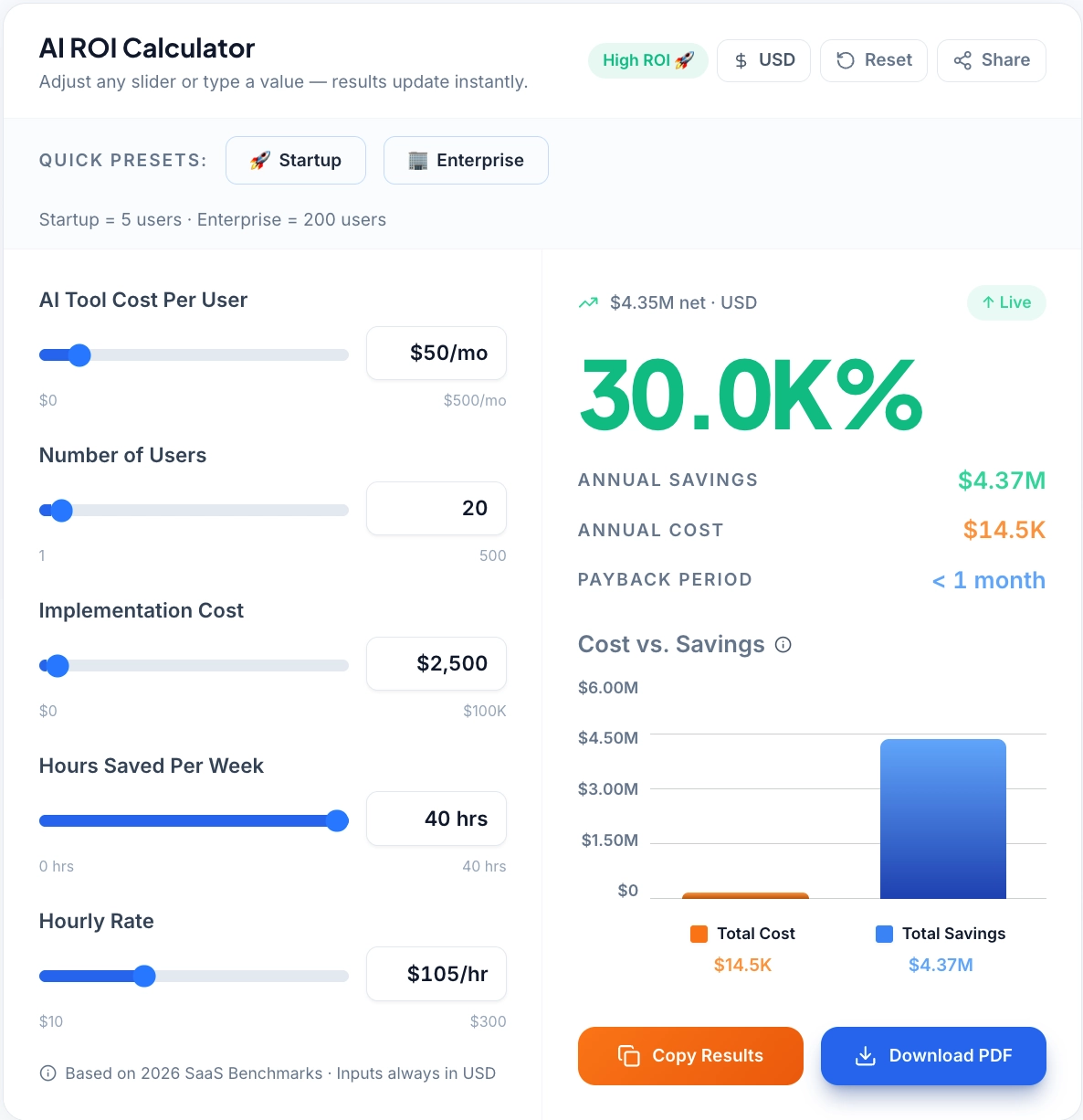
Our AI ROI Calculator helps you visualize potential annual savings and payback periods before you commit to a CRM.
The headline numbers are clear: CRM delivers strong ROI for small businesses, often exceeding multiple times the initial investment. AI-enhanced CRM pushes that further through three specific mechanisms CRM statistics.
Sales productivity improvement. AI lead scoring eliminates time spent on low-probability prospects. Teams using AI-prioritized lead lists report 29% higher productivity—not because they're working harder, but because they're working on the right deals. For a five-person sales team, that's equivalent to gaining 1.4 additional productive salespeople without hiring.
Win rate improvement. AI forecasting and next-action recommendations improve deal conversion. Sales teams using AI-driven pipeline management report 25% higher win rates. On a $500,000 annual pipeline with a 20% win rate, a 25% improvement represents $125,000 in additional closed revenue—against CRM costs typically running $5,000–$15,000 annually.
Revenue leakage prevention. The most underappreciated CRM ROI driver is the deals that don't fall through the cracks. Automated follow-up sequences, anomaly alerts on stalled deals, and AI-flagged at-risk accounts prevent the silent revenue loss that occurs when busy sales teams miss follow-ups manually. For most SMBs, this alone covers the platform cost.
To calculate your specific ROI before purchasing: estimate your current average deal size, monthly pipeline volume, and current win rate. Apply a conservative 15% win rate improvement from AI assistance. Compare that revenue delta against annual platform cost. For most small businesses with active pipelines, the math resolves clearly within 60–90 days of implementation.
→ Want real numbers for your business? Use the AI ROI Calculator to model your returns before investing.
Comparison Summary: AI CRM Selection by Business Profile
| Business Profile | Recommended CRM | Key Reason |
|---|---|---|
| Just starting out / free budget | HubSpot CRM | Best free tier; zero-risk entry |
| SMB wanting deepest AI value | Zoho CRM | Zia AI depth at affordable price |
| Sales team performance focus | Freshsales | Freddy AI coaching and scoring |
| Visual pipeline management | Pipedrive | Best pipeline UX in category |
| Planning significant scaling | Salesforce Essentials | No migration needed as you grow |
| Tightest budget constraint | Salesmate or Agile CRM | Strong AI at $9/user/month |
| Service business / solopreneur | Keap | Marketing-sales-payments in one |
| Non-standard sales process | Monday CRM | Modular flexibility |
| Simplicity-first adoption | Nutshell | Fastest team onboarding |
Common Selection Mistakes That Reduce CRM ROI
Selecting on price alone. The lowest-cost tool frequently produces the lowest deflection, automation rate, or output quality—meaning the underlying problem remains unsolved at a lower subscription cost.
Skipping the trial with real data. Demo environments are designed to impress, not reveal friction. Every platform here offers a free tier or trial. Use it with actual workflows and real contacts before any financial commitment.
Ignoring integration requirements. A powerful AI CRM that doesn't connect to your email platform or ecommerce stack creates manual bridging work that negates automation benefits. Verify specific integrations—not total integration counts.
No measurement framework before launch. Without baseline metrics established before implementation, ROI cannot be calculated and expansion cannot be justified. Define two or three KPIs before launch and update them weekly during the pilot.
Buying for future-state features, not current needs. A CRM with deep enterprise AI capability delivers zero ROI if your team doesn't have the data quality or process discipline to use it. Match your tool to where you are today, with a clear upgrade path for where you're going.
Final Recommendations by Use Case
Choose HubSpot CRM if you're starting from zero, have a tight budget, or want to validate CRM workflows before committing to paid features. The free tier is genuinely capable for small teams.
Choose Zoho CRM if you want the deepest AI capability at SMB pricing and are willing to invest one to two weeks in proper configuration. The Zia AI engine delivers enterprise-adjacent intelligence at $14/user/month.
Choose Freshsales if your primary goal is improving sales team performance. Freddy AI's next-action guidance and predictive scoring make it the strongest AI sales automation tool for SMBs focused on win rate improvement.
Choose Pipedrive if your team lives in the pipeline and needs the clearest, most intuitive visual sales management available. Strong forecasting, fast adoption.
Choose Salesforce Essentials if growth is the strategy and you want to avoid a painful platform migration in 18 months. Pay more now to avoid a larger cost later.
Choose Salesmate or Agile CRM if budget is the binding constraint and you need functional AI automation without premium pricing.
Choose Keap if you're a solopreneur or small service business needing marketing, sales, and payment automation in one platform at a flat monthly rate.
Choose Monday CRM if your sales process is non-standard and you need a flexible, modular system that adapts to how you work rather than requiring you to adapt to it.
The best AI CRM software for small businesses is the one your team will actually use, configured around your actual sales process, connected to your real data sources, and evaluated on measurable outcomes within 90 days of deployment. Start with a trial using real data. Measure what changes. Expand from there.
→ Calculate your total stack cost before committing: Use the SaaS Pricing Calculator to model your monthly spend based on team size and tool combination.
For a complete step-by-step deployment guide covering workflow redesign, pilot structure, ROI measurement, and expansion strategy, see: Complete Guide to Choosing AI Software for Your Business (2026 Edition).
Final Verdict
The businesses generating measurable returns from AI CRM software in 2026 treat tool selection as a business decision, not a technology purchase. They define the problem before evaluating the platform. They run pilots before full deployment. They measure before they scale.
The platforms covered above span every SMB profile—from solopreneurs on zero budget to scaling startups planning enterprise growth. The right choice depends on your specific problem, your team's current capability, and your commitment to proper implementation.
There is no shortcut between selecting a CRM and generating returns from it. The implementation discipline—workflow redesign, baseline measurement, pilot structure, and gradual expansion—determines whether AI CRM becomes a compounding sales advantage or an expensive subscription canceled at renewal.
Evaluate rigorously. Implement deliberately. Measure from day one.