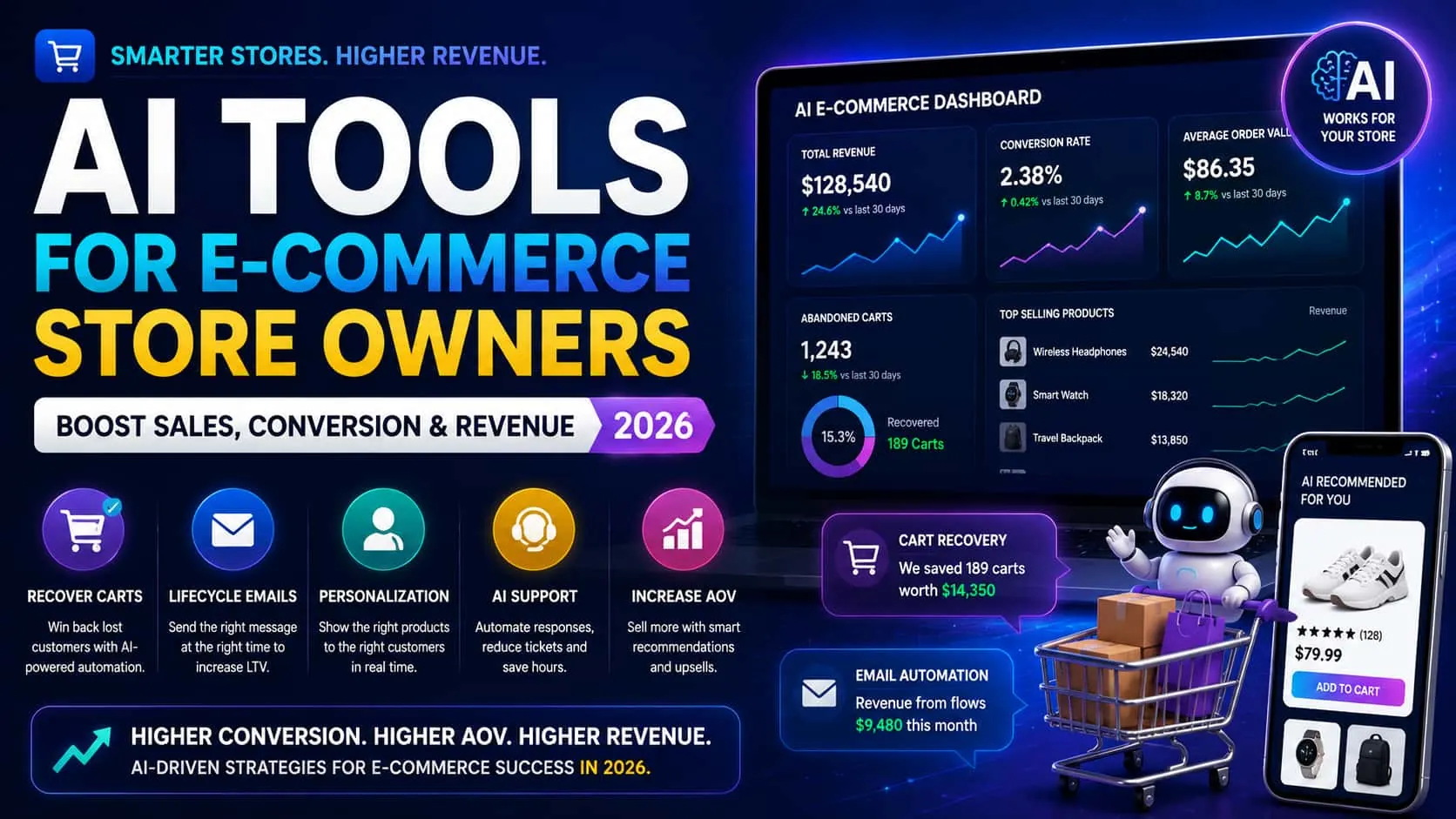
Why AI Is Becoming Mandatory for E-commerce in 2026
The e-commerce economics that worked in 2021 don't work in 2026. Customer acquisition costs have risen sharply across major paid channels over the last four years. Inventory carrying costs are up. Contribution margins are compressed. Stores that relied on volume growth to paper over operational inefficiency are facing their first real margin crisis.
Against this backdrop, AI has graduated from a feature to a structural necessity.According to Salesforce's State of Commerce report, commerce professionals now rank AI as their top priority — with high-performing teams deploying it across personalization, support automation, and predictive replenishment. IDC projects AI-driven e-commerce software spending to exceed $8 billion globally by 2026. The most consequential shift is toward agentic commerce — AI systems that autonomously execute tasks including pricing adjustments, replenishment orders, and re-engagement campaigns without human initiation.
For Shopify and WooCommerce operators, the question isn't whether to adopt AI tools. It's which ones move the metrics that matter, and in what sequence.
For a broader framework on AI software selection, see: Complete Guide to Choosing AI Software for Your Business (2026 Edition).
→ Not sure if this ROI applies to your store? Try the AI ROI Calculator to model your real numbers based on traffic, conversion rate, and AOV.
- High-performer adoption: 77% of high-performing e-commerce teams now use AI daily for personalization, support automation, and predictive replenishment, per Salesforce's State of Commerce report.
- Acquisition cost pressure: Customer acquisition costs have risen sharply across major paid channels over the last four years.
- Cart abandonment: The Baymard Institute puts average cart abandonment at 70.19% — the single highest-ROI automation opportunity at every store size.
Where E-commerce Stores Actually Lose Revenue
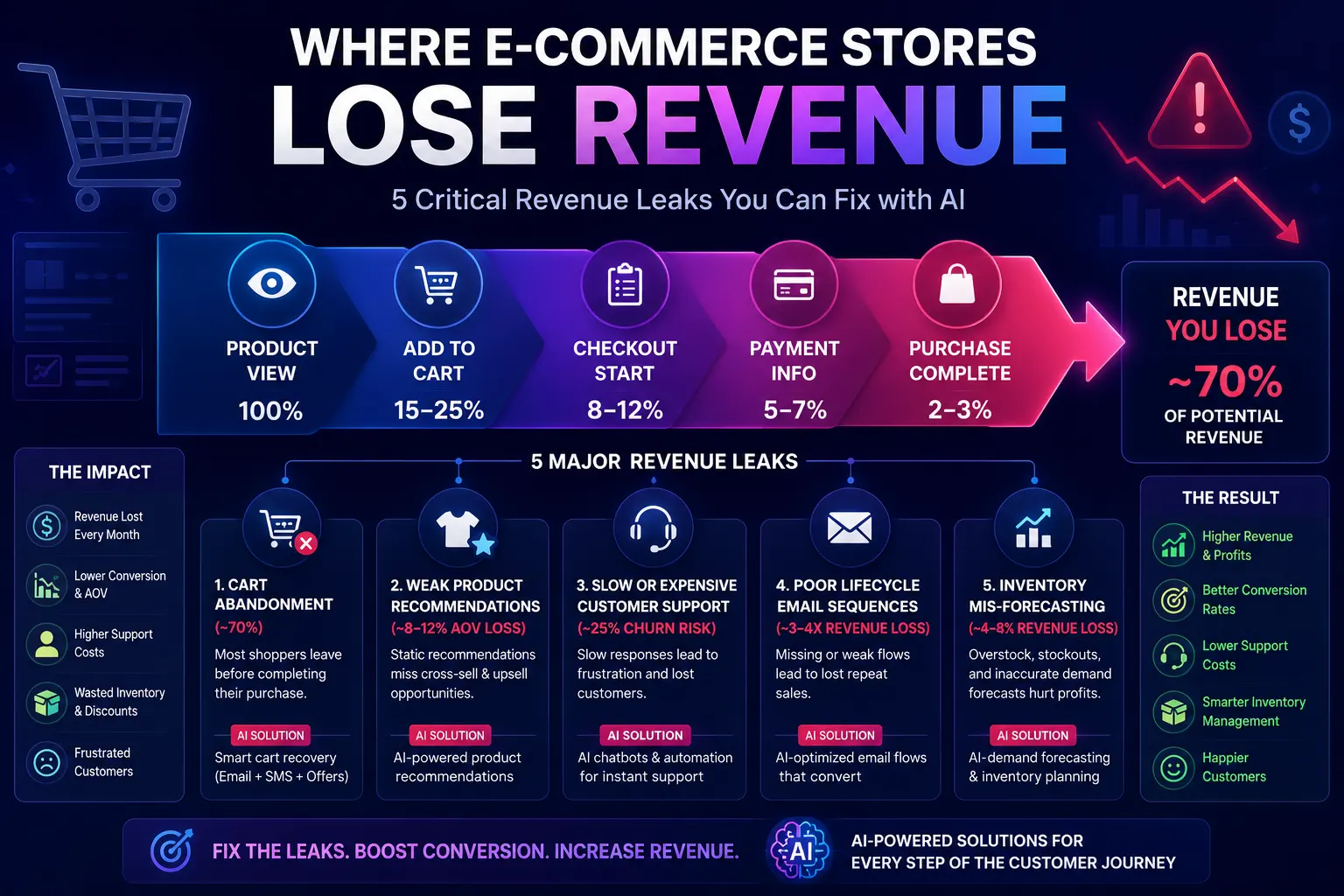
A visual breakdown of the five biggest revenue leaks in e-commerce stores and how AI-powered automation helps recover lost sales, improve conversions, and increase profitability.
Before selecting any tool, identify exactly where the bleeding happens. Five bottlenecks account for most unrealized e-commerce revenue:
1. Cart Abandonment (~70%) The Baymard Institute's aggregate data across 50+ studies puts average cart abandonment at 70.19%. For a store doing $50K/month with a 2% conversion rate, recovering even 10% of abandoned carts at $75 AOV represents $5,250/month in revenue currently left on the table. This is the single highest-ROI automation opportunity at every store size.
2. Weak Product Recommendations McKinsey's research on personalisation economics documents that product recommendations drive a significant share of revenue for large e-commerce operations. Most mid-market DTC stores run static "customers also bought" logic rather than dynamic recommendations — leaving a meaningful AOV lift unrealised. The exact figure varies by store type and average order value.
3. Slow or Expensive Customer Support Response speed in customer support has a direct impact on retention. Industry benchmarks consistently show that faster resolution correlates with higher repeat purchase rates and lower churn. At $8–15 per ticket (typical support labor cost benchmarks), a store handling 400 tickets/month spends $3,200–6,000 on support labor — 70–80% of which involves routine queries AI handles automatically.
4. Poor Lifecycle Email Sequences Klaviyo's internal data shows triggered flows generate 3–4x the revenue per email of broadcast campaigns. A store with 10,000 subscribers and no win-back sequence loses an estimated $500–1,200/month in recoverable repeat purchase revenue. Most stores below $200K/month have fewer than three active flows.
5. Inventory Mis-Forecasting Excess inventory erodes margin through discounting. Stockouts lose sales and damage retention. For $100K+/month stores, inventory mis-forecasting costs an estimated 4–8% of revenue annually in combined carrying costs and lost sales — $4,800–9,600/year for a $100K/month store — preventable with AI demand forecasting.
Cart recovery is the highest-ROI automation at every store size — deploy it first, before any other AI investment. A three-message abandoned cart sequence in Klaviyo (email at 1 hour, email at 24 hours, SMS at 48 hours) typically shows measurable results within 7–14 days.
ROI Math: What AI Can Actually Add
⚠️ Hypothetical estimates only. The figures in this section are illustrative examples based on industry averages and publicly available data. Actual results vary significantly by business size, industry, tool configuration, and team adoption. These numbers are not guarantees of return.
Scenario 1: Shopify DTC Brand ($50K/Month)
Baseline: 20,000 monthly visitors, 2.0% CVR, $75 AOV.
- 0.5% conversion lift from AI personalization: 20,000 × 2.5% × $75 = $37,500 vs $30,000 baseline → +$7,500/month
- 15% cart recovery via AI-triggered email + SMS sequence → +$3,150/month
- 10% AOV lift from dynamic recommendations: 400 orders × $7.50 average increase → +$3,000/month
Combined gross lift: ~$13,650/month | Stack cost: $178–250/month | Net impact: $13,400+
Scenario 2: WooCommerce Store ($120K/Month)
- Support automation: 600 tickets/month at $12 avg = $7,200/month. AI handles 70% of routine queries. New cost: $2,160/month → Savings: ~$4,200/month
- Reduced refund rate via proactive post-purchase flows: 1.5% improvement on $120K → +$1,800/month retained
- Cross-sell lift from AI recommendations: 6% AOV improvement on 1,600 orders at $75 → +$7,200/month
Combined gross lift: ~$13,200/month | Stack cost: $250–400/month | Net impact: $12,800+
Tool Stack Cost vs Revenue Lift
| Tool Category | Monthly Cost | Conservative Lift | Revenue Impact | Net Gain |
|---|---|---|---|---|
| AI Chatbot / Support | $29–99 | 25% support cost reduction | +$1,200–4,200/mo | High |
| Email Lifecycle (Klaviyo) | $45–150 | 15–20% LTV improvement | +$1,500–6,000/mo | High |
| Personalization Engine | $49–199 | 8–12% AOV lift | +$800–3,600/mo | Medium-High |
| Cart Recovery (SMS+Email) | Included above | 10–15% cart recovery | +$1,000–5,000/mo | Very High |
| AI Creative (AdCreative.ai) | $29–59 | 15–25% ad CTR improvement | Indirect — CAC reduction | Medium |
| Inventory Forecasting | $99–249 | 4–6% inventory cost reduction | +$400–800/mo | Medium ($100K+ only) |
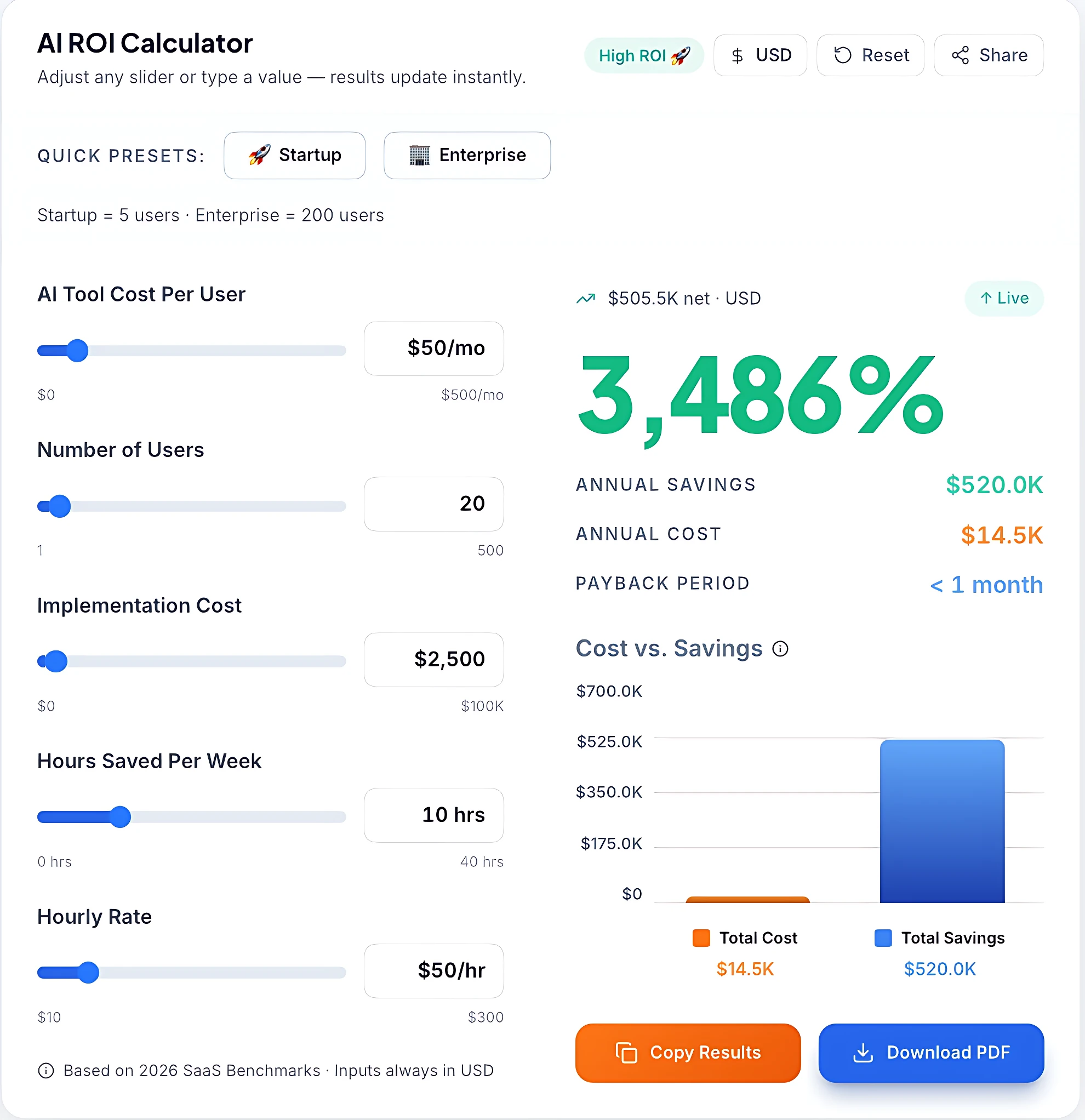
A data-driven AI ROI model demonstrating a 3,486% return on investment by automating 10 hours of manual labor per week at a $50/hour billable rate.
→ Not sure which AI tools fit your store? Use our AI Tool Selector to get a personalized recommendation based on your revenue stage and biggest bottleneck.
Core AI Stack for E-commerce Store Owners
AI Chatbots and Support Automation
Gorgias ($10–900/month, scales by ticket volume) is the dominant choice for Shopify stores above $30K/month, with native integrations for order management and returns. It deflects 60–70% of tickets without human involvement by handling WISMO queries, return initiations, and discount requests automatically. Tidio ($29–299/month) suits earlier-stage stores or WooCommerce operators needing a lower entry point with AI chat plus email automation in one platform. eDesk ($89–159/month) targets multi-channel sellers across Amazon, eBay, and Shopify.
Upgrade trigger: Support ticket volume exceeding 300/month, or first-response time consistently over 4 hours during peak periods.
Personalization and Product Recommendations
Clerk.io ($39–299/month) is the practical entry point for mid-market DTC, offering behavioral recommendation widgets, email personalization, and audience segmentation without enterprise pricing. It's appropriate for stores with 10,000–50,000 monthly sessions where search-driven and browse-driven conversion is a meaningful revenue driver. Klevu ($449+/month) is the step-up for stores above $80K/month. Dynamic Yield (custom, typically $10K+/year) is enterprise-grade, appropriate above $500K/month with a dedicated CRO team.
Traffic threshold: Below 10,000 monthly sessions, behavioral AI has insufficient data. Start with email automation before personalization at lower traffic volumes.
Email and Lifecycle Automation
Klaviyo ($45/month for 1,000 contacts) is the default standard for serious DTC brands — AI send-time optimization, predictive LTV scoring, and pre-built flows for cart abandonment, welcome, post-purchase, and win-back sequences. The predictive LTV layer is genuinely differentiated at the mid-market price point. Omnisend ($16–59/month) is the strongest WooCommerce alternative for stores needing integrated SMS and email at lower volumes.
Stores with all six core Klaviyo flows active generate 30–40% of revenue from email, per 2025 benchmarks. Stores with only a welcome sequence generate 8–12%. That gap is recoverable.
AI Content and Creative Optimization
AdCreative.ai ($29–149/month) generates ad creative variants using performance data to predict which combinations convert before spending budget — reducing creative testing cycles for stores running Meta and Google campaigns. Jasper ($39–125/month) handles product descriptions and email copy at scale. Shopify Magic (free) is sufficient for early-stage product description AI before paid content tools are justified. PDP copy improvement is the highest-leverage application: it lifts organic conversion without additional ad spend.
Predictive Inventory and Forecasting
Inventory Planner ($99–249/month) integrates directly with Shopify and WooCommerce to generate demand forecasts based on sales velocity, seasonality, and supplier lead times — eliminating spreadsheet forecasting that causes most inventory mis-forecasting at the $100K+ tier. Netstock (custom, typically $300+/month) is appropriate for stores managing multiple warehouses or complex SKU counts. Both tools are premature below $100K/month — the data volume required for accurate AI forecasting isn't present at lower revenue levels.
Shopify vs WooCommerce: AI Integration Differences
| Factor | Shopify | WooCommerce |
|---|---|---|
| Integration complexity | Low — app store, no-code | Medium-High — developer required |
| AI deployment speed | Hours to days | Days to weeks |
| Monthly platform cost | $39–299+/mo | $0 platform + hosting/dev |
| App ecosystem | 8,000+ native integrations | Plugins vary in quality |
| Best for | Non-technical founders, speed | Technical teams, cost control |
Shopify advantages: Shopify's 8,000+ app ecosystem makes most AI tools deployable in under an hour without developer involvement. Shopify Magic and Sidekick provide native AI for store management and product copy. Managed infrastructure means AI integrations deploy reliably without server configuration — the right choice for founders without technical resources.
WooCommerce strengths: WooCommerce's open-source architecture gives technically capable teams complete control over AI integration logic and cost optimization. Subscription costs are lower at equivalent feature sets when developer time is available. The tradeoff: connecting Klaviyo, a chatbot, and a recommendation engine on WooCommerce typically requires 2–4x more technical effort than on Shopify.
For a broader perspective on how AI automation drives ROI across industries, see: AI Automation Tools for Local Businesses (2026).
AI Stack Under $300/Month (Starter Plan)
A functional e-commerce AI stack for a $20K–60K/month store doesn't require enterprise investment. The four highest-ROI functions covered for under $250/month:
| Tool | Function | Monthly Cost |
|---|---|---|
| Tidio Starter | WISMO, FAQ automation, basic cart recovery | $29 |
| Klaviyo | All core flows for up to 2,500 subscribers | $45–80 |
| Clerk.io | Personalization for up to 25K monthly sessions | $39–79 |
| Zapier | Post-purchase triggers and CRM sync | $20 |
| Shopify Magic / AdCreative.ai | Product copy + ad creative | $0–29 |
| TOTAL | $133–237/mo |
A store spending $10,000/month on paid traffic at 1.8% CVR generates $13,500 in revenue. The same spend at 2.3% — a realistic AI-assisted lift — generates $17,250. That's $3,750/month in improved revenue from a $200 tool investment. The ROI math is not close.
→ Calculate your exact stack cost before committing: Use the SaaS Pricing Calculator to model your total monthly spend based on store revenue and tool combination.
The Ecommerce AI Growth Stack: What to Implement First
Many ecommerce brands fail because they deploy too many AI tools simultaneously. The highest-performing stores build their AI stack in layers, with each layer creating the foundation for the next.
Layer 1: Measurement & Data Foundation
Before introducing automation, ensure accurate tracking is in place. Configure GA4 ecommerce events, verify Klaviyo tracking, and document baseline metrics such as conversion rate, average order value, and email-attributed revenue. Reliable measurement is essential for evaluating future AI investments.
Layer 2: Revenue Recovery Systems
Once tracking is established, focus on recovering lost revenue. Implement abandoned cart automation in Klaviyo and deploy AI-powered customer support workflows using Tidio or Gorgias to handle common customer questions. These systems typically generate the fastest return on investment.
Layer 3: Customer Retention Automation
After recovery systems are performing consistently, expand into lifecycle marketing. Welcome sequences, post-purchase follow-ups, review requests, and win-back campaigns help increase repeat purchases and customer lifetime value.
Layer 4: Personalization & Upselling
With foundational automation in place, introduce recommendation engines such as Clerk.io. Personalized product suggestions across product pages, cart pages, and post-purchase experiences can improve average order value and overall customer engagement.
Layer 5: Predictive Growth Optimization
Advanced ecommerce businesses can extend their stack with predictive customer segmentation, inventory forecasting, and AI-powered advertising optimization. At this stage, the focus shifts from automation to forecasting, optimization, and scalable growth.
When AI Tools Are NOT Worth It
-
Under 1,000 monthly visitors: AI personalization and behavioral tools require data volume to function. Invest in traffic acquisition before optimization.
-
No product-market fit: AI amplifies existing conversion — it doesn't create demand. If your baseline CVR is below 0.5%, the problem is product-market alignment, not tooling.
-
Margins below 30%: A store with 25% gross margin adding $200/month in AI tools needs $800/month in incremental gross profit to break even. Thin unit economics make that bar hard to clear.
-
No tracking infrastructure: GA4, pixel tracking, and Klaviyo event data must be in place before AI tools have anything to optimize. Building on unmeasured traffic is building blind.
-
Pre-validation stage: If you're still testing whether customers want your product, no AI tool accelerates that discovery. Talk to customers. AI scales what works — it doesn't find what works.
E-commerce operators who implement AI in a phased sequence.consistently achieve stronger sustained revenue lift than those deploying all tools simultaneously without baseline measurement.
2026 Emerging Trends: Agentic and Predictive Commerce
Agentic AI Handling Operations
The next capability wave is autonomous execution. Agentic AI systems are beginning to handle reorder triggers, dynamic pricing adjustments, and customer segment migrations without human initiation. Shopify's Sidekick already manages routine operational tasks on instruction. By late 2026, the distinction between 'AI-assisted' and 'AI-operated' workflows will be material for operators.
Predictive Customer Lifetime Value Modeling
Klaviyo's predictive LTV feature is the accessible entry point, but dedicated CLV platforms are emerging that model purchase probability at the individual customer level. Stores using predictive CLV data to segment ad audiences are reporting 15–20% ROAS improvements on retention campaigns, per early 2026 performance data from Meta's Advantage+ ecosystem.
Hyper-Personalized PDP Experiences
Static product pages are giving way to dynamically assembled PDPs that adjust imagery, copy, and bundling based on the visitor's behavioral profile. This is nascent at the mid-market level in 2026 but will commoditize by 2027. Stores building personalization infrastructure now will have the behavioral data foundation required when these capabilities become table stakes.
AI-Native Shopify Infrastructure Evolution
Shopify's platform roadmap is explicitly AI-first: native checkout AI, Sidekick expansion, and deeper third-party integrations are confirmed for 2026. Some AI capabilities costing $50–100/month today will be absorbed into the platform within 12–18 months. Build strategy around durable revenue functions — support automation, lifecycle email, personalization — not point solutions at risk of commoditization.
Final Verdict: Is AI Worth It for E-commerce in 2026?
For stores above $20K/month with measurable traffic, established tracking, and margins above 30%, yes — the ROI math is clear. AI doesn't fix broken products or create demand. It does protect margin by recovering revenue you're already generating but currently losing to abandonment, slow support, and unoptimized lifecycle email.
Stores that implement AI automation with a defined measurement framework typically recover their tool costs within the first 30–45 days — with compounding returns as the tools accumulate behavioral data.
Start with the flow that addresses your biggest documented revenue leak. Measure at 30 days. Build from there.
What This Means for Your Business
AI tools for e-commerce aren't a growth hack — they're a margin protection and revenue recovery system. The stores that generate the highest returns from AI in 2026 aren't deploying the most tools. They're deploying the right tools in the right sequence, measuring before expanding, and cutting what doesn't perform.
A $133–237/month starter stack addressing cart abandonment, lifecycle email, and support automation can recover $10,000–13,000+/month in revenue that your store is currently generating but losing. That's not speculative — it's documented across thousands of deployments at the store size ranges covered in this breakdown.
Evaluate rigorously. Implement in sequence. Measure from day one.