Why Most Small Sales Teams Are Still Doing This the Hard Way
Most small sales teams lose hours every week on manual follow-ups, CRM updates, prospect research, and meeting notes instead of actual selling.
One rep is manually logging call notes, another is chasing follow-ups from last week, and the third is copy-pasting the same outreach email with a different name dropped in. That’s not really selling — it’s mostly admin work dressed up as sales.
AI sales tools exist to close that gap. Not to replace the rep — but to remove the 4–6 hours per day of non-selling activity so they actually have time to sell. The teams seeing results in 2026 aren’t the ones using the most tools. They're the ones who picked one or two tools, learned them properly, and applied them consistently.
The global AI in sales market is projected to reach $11.6 billion by 2026, and it's not being driven by enterprise players alone. Small and mid-sized businesses are the fastest-growing adoption segment because the cost-to-impact ratio has never been better for lean teams.
→ Before you buy anything, calculate your actual stack cost with the SaaS Pricing Calculator.
- 87% of sales organizations now use at least one AI tool — up from 56% in 2023.
- Companies using AI in sales report 50% more leads and appointments.
- AI-driven sales teams cut customer acquisition costs by up to 60%.
- Reps using AI tools are 3.7× more likely to hit quota than those without.
- Average time saved per rep: 4–8 hours per week on manual tasks.
What does that mean in practical terms for a 5-person sales team? Less time spent on admin, fewer dropped leads, more consistent follow-up — without hiring another person.
What Are AI Sales Tools, Really?
Skip the textbook definition. Here's what they actually do in practice:
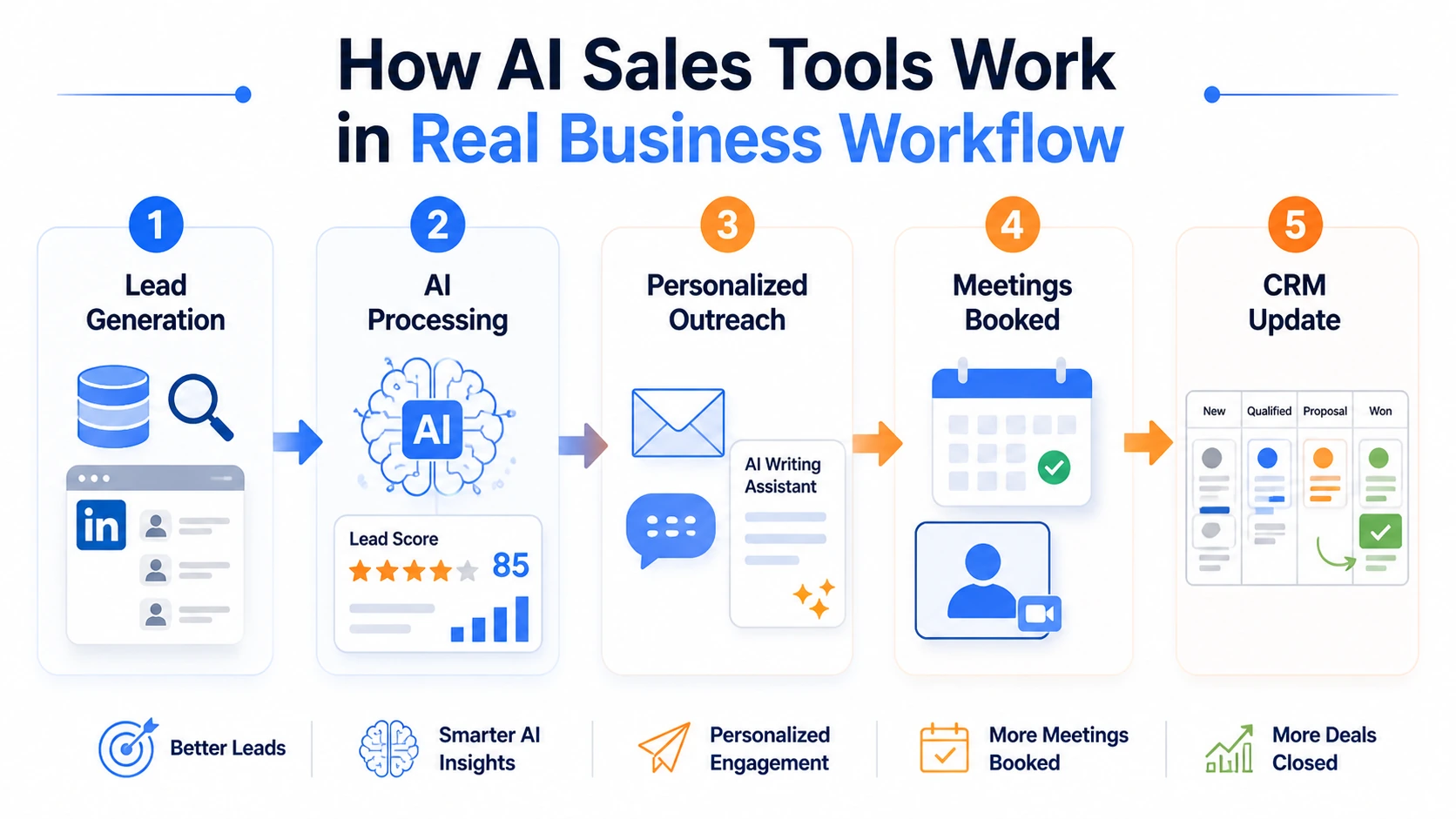
- Auto follow-ups — emails go out on a schedule without anyone hitting send
- AI email writing — first drafts generated from contact data, not from scratch
- Lead scoring — the tool tells you which leads are worth your time today
- Call summaries — meeting ends, summary and action items appear in your inbox
- Pipeline tracking — see where deals are stalling before they go cold
"AI doesn't replace sales reps — it removes manual work so they can sell more."
That's it. If a tool isn't doing at least one of those things meaningfully, it's not worth the subscription.
If you're still deciding how to evaluate and prioritize tools across categories, start here: Choosing AI Software for Business: Complete 2026 Guide.
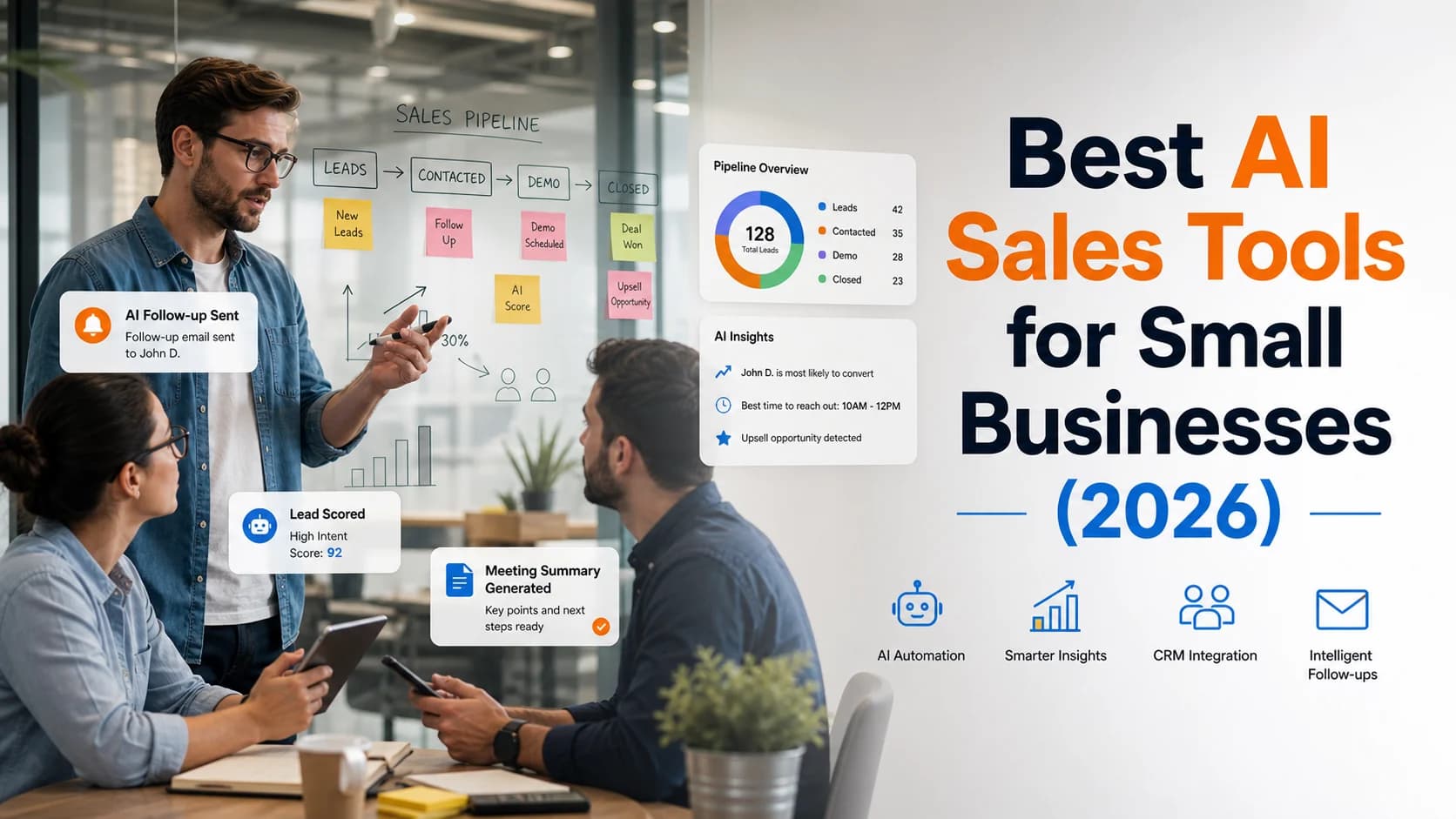
AI sales software helps businesses automate repetitive sales tasks like prospecting, CRM updates, follow-ups, lead scoring, and meeting summaries. Modern AI sales platforms are designed to improve pipeline visibility, reduce admin work, and help small teams close more deals without increasing headcount.
The Five Types of AI Sales Tools (Know This Before You Buy)
Selecting the right AI sales software based on common business challenges like lead volume or low reply rates.
This matters more than the brand. Picking the wrong type of tool for your problem is the most common and most expensive mistake small teams make.
1. AI CRM Platforms
HubSpot, Zoho CRM, Salesforce Essentials
Manages your pipeline, scores leads automatically, tracks email opens, and forecasts revenue. This is the foundation. If your team has no structured way to track deals, everything else is built on sand.
2. AI Prospecting Tools
Apollo.io, Clay
Finds the right contacts, enriches data, and builds targeted lead lists at scale. Ideal for teams doing outbound who are spending too much time building lists manually.
3. AI Outreach & Email Automation
Instantly.ai, Autobound
Writes and sends personalized cold emails across multiple inboxes, with AI-generated variants and automatic warmup. Reply rates usually come down to one thing: how well your message is personalized. That’s where these tools make a real difference.
4. Conversation Intelligence
Gong, Fireflies.ai
Records, transcribes, and summarizes every sales call. Automatically pulls action items, surfaces deal risks, and gives managers a way to coach without listening to every call.This is where most teams slip up — they assume they'll remember what was said. They don't.
5. AI Sales Assistants & Chatbots
Tidio AI
Captures and qualifies leads on your website 24/7. A visitor lands at 11pm — Tidio answers, qualifies, and books a demo. Without it, that lead was gone by morning.
Best AI Sales Tools for Small Businesses in 2026
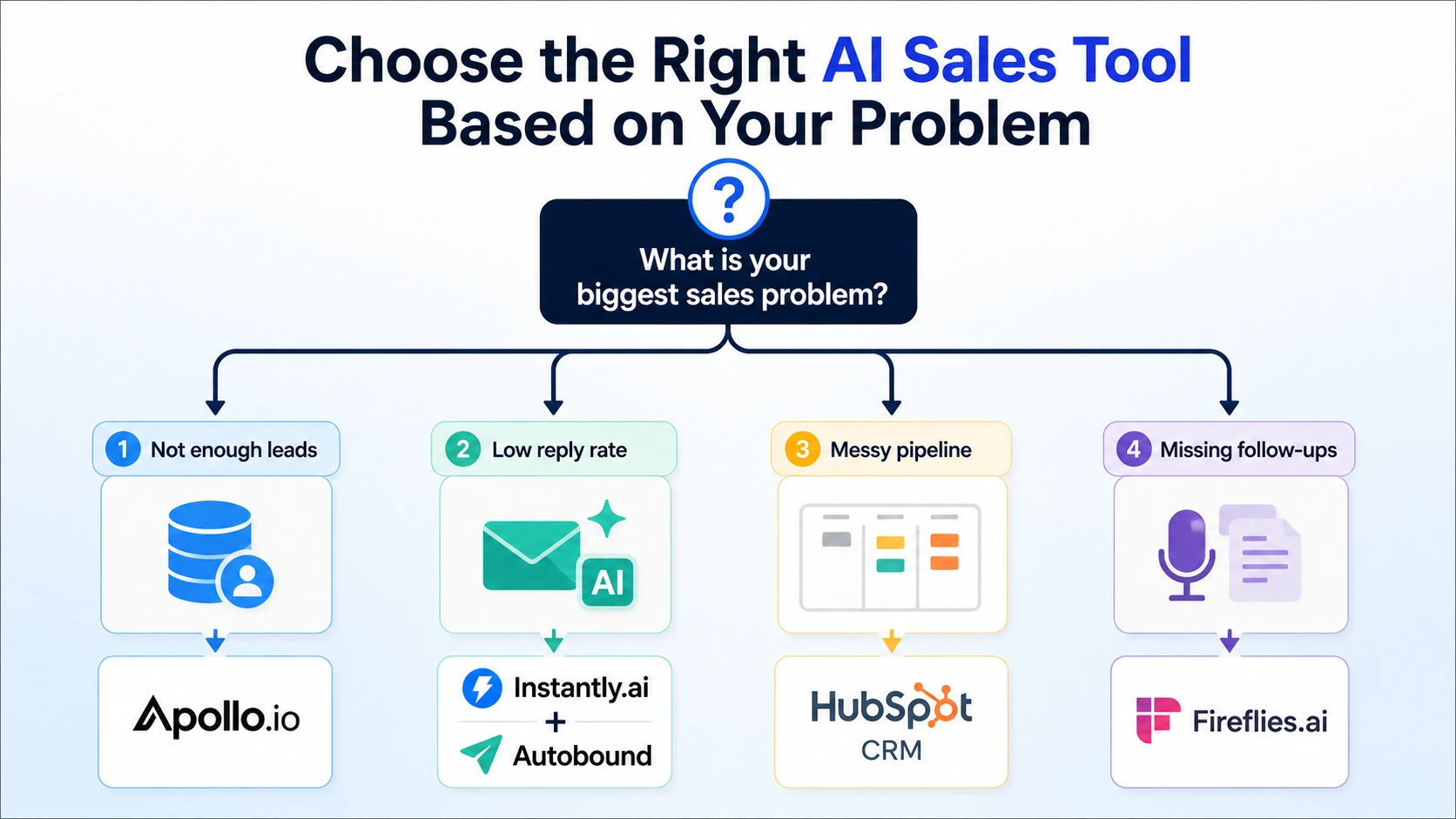
Selecting the right AI sales software based on common business challenges like lead volume or low reply rates.
1. HubSpot Sales Hub — Best Overall CRM + AI
Best for: Small teams that need CRM, email tracking, and AI in one place
HubSpot is still the most practical starting point for small businesses that don't have a formal sales process yet. The free tier is genuinely useful — not a stripped-down demo. You get pipeline management, email tracking, AI email writing, and a meeting scheduler without paying a cent.
Where it earns its cost: the paid tiers add predictive lead scoring, AI-assisted forecasting, and automated sequences. For a 5–15 person team, this is usually enough to replace three or four separate tools.
Core Features:
- AI email drafting and subject line suggestions
- Visual pipeline with deal tracking and alerts
- Revenue forecasting with AI-assisted accuracy
- Meeting scheduler with automatic follow-up
- Native integration with Gmail, Outlook, and 1,000+ apps
Pricing: Free plan available → Starter from $20/month → Professional from $100/month
SMB Fit: ⭐⭐⭐⭐⭐
Ideal Use Case: A small sales team managing inbound leads, tracking deals, and wanting follow-up automation without a complicated setup.
Start with HubSpot's free plan — no credit card required.
2. Apollo.io — Best for Prospecting + Outbound
Best for: Teams doing outbound who need both the contacts and the outreach in one tool
Apollo solves a specific problem: you need leads, and you need to reach them. It does both. The contact database has over 270 million B2B profiles, filterable by industry, job title, company size, tech stack, and more. Pull a list, drop them into a sequence, let the AI write the first draft.
Here's where most small teams get this wrong — they use Apollo to blast 500 generic emails and wonder why nobody replies. The tool works best when you use the filtering to build tight, targeted lists and let the AI personalize based on actual contact data.
Core Features:
- 270M+ B2B contact database with deep filtering
- AI-generated email sequences with personalization
- Intent signals to prioritize warm prospects
- Built-in dialer and LinkedIn integration
- CRM sync with HubSpot and Salesforce
Pricing: Free plan (limited) → Basic at $49/month → Professional at $99/month
SMB Fit: ⭐⭐⭐⭐⭐
Ideal Use Case: A founder or SDR doing outbound prospecting who needs a reliable data source and outreach automation in the same platform.
See Apollo.io pricing and features
3. Instantly.ai — Best for Cold Email at Scale
Best for: Startups and agencies running high-volume cold email campaigns
Instantly does one thing and does it well: cold email infrastructure. You can connect unlimited sending accounts, run AI-generated email variants, and keep your domains healthy through built-in warmup. If deliverability is your problem — emails landing in spam, open rates dropping — this is the fix.
It’s not a CRM replacement — it’s more like the engine behind your outbound. Pair it with Apollo for prospecting and HubSpot for managing replies, and you've got a complete outbound system under $150/month.
Core Features:
- Unlimited email account connections
- AI-generated email variants and A/B testing
- Automated email warmup (critical for deliverability)
- Campaign analytics by domain and sequence
- Unibox — unified inbox for all replies
Pricing: Growth at $37/month → Hypergrowth at $77/month
SMB Fit: ⭐⭐⭐⭐
Ideal Use Case: An early-stage B2B startup doing aggressive outbound who needs volume without burning their sending reputation.
Check Instantly.ai deliverability features
4. Fireflies.ai — Best for Meeting Intelligence
Best for: Any team that runs calls and wants to stop losing information after the call ends
This is the tool most small teams overlook until they've lost a deal because someone forgot to follow up on a key detail from a call three weeks ago. Fireflies joins your meetings automatically, transcribes everything in real time, generates a clean summary, and pulls out action items — all without anyone taking a single note.
The search feature alone is worth the subscription for teams doing 10+ calls a week. You can search across every call transcript for a keyword, a competitor mention, or a specific objection. That's not a minor feature. That's institutional sales knowledge that most small teams never build.
Core Features:
- Auto-join and transcription for Zoom, Meet, Teams, and Webex
- AI meeting summaries and action item extraction
- Keyword-searchable call library
- Deal sentiment analysis and talk-time tracking
- CRM integration for automatic note logging
Pricing: Free plan available → Pro at $10/month → Business at $18/month
SMB Fit: ⭐⭐⭐⭐⭐
Ideal Use Case: A sales team running discovery calls who wants automatic notes, consistent follow-up, and a searchable record of every conversation.
5. Autobound — Best for Personalized Outreach
Best for: Teams prioritizing reply quality over volume
If Instantly is about scale, Autobound is about quality. It generates hyper-personalized outreach emails based on public signals — a prospect's recent LinkedIn post, a company funding announcement, a role change. The kind of context that makes a cold email feel like it was actually written by someone who did their homework.
The result is simple — you get more replies than you would with generic sequences. This is where the tool actually earns its cost — one additional meeting booked per week from better personalization easily covers the monthly subscription.
Core Features:
- AI email personalization using real-time prospect signals
- LinkedIn activity and company news triggers
- Multi-channel outreach (email + LinkedIn)
- Team collaboration on outreach playbooks
- Analytics by industry, persona, and signal type
Pricing: Starter under $100/month (varies by usage)
SMB Fit: ⭐⭐⭐⭐
Ideal Use Case: An account executive doing targeted outbound to a defined ICP who wants higher reply rates without spending 30 minutes researching each prospect manually.
→ Explore Autobound's personalization engine
6. Tidio AI — Best for Website Sales Automation
Best for: E-commerce and service businesses capturing leads from website traffic
Most small business websites are passive. Someone visits, looks around, and leaves — and nobody ever knows they were there. Tidio changes that. The AI chatbot engages visitors proactively, qualifies them with a short conversation, and either books a meeting or passes them to a live agent.
You can usually set it up in under an hour. If you’re already running ads, you’ll notice the difference in conversions pretty quickly. That’s one of the simplest ROI wins here — more leads from the same traffic for about $40–80 a month.
Core Features:
- AI chatbot with pre-built sales conversation flows
- Live chat handoff to human agents
- Automation rules triggered by visitor behavior
- Shopify, WordPress, and WooCommerce integration
- Lead capture and email list growth
Pricing: Lyro AI Chatbot from $40/month → Growth plan from $59/month
SMB Fit: ⭐⭐⭐⭐
Ideal Use Case: An e-commerce store or service business with decent website traffic that wants to capture and qualify leads outside business hours.
7. Gong — Advanced Sales Coaching (Enterprise Note)
Best for: Larger sales teams with dedicated sales managers
Gong is the market leader in revenue intelligence. Call recording, conversation analytics, deal risk alerts, forecasting — it does all of it at a level of sophistication that's hard to match. But it's priced to match. At enterprise-level pricing, it's usually overkill for most small businesses.
Honest take: If your team is under 15 people, Fireflies will cover most of what Gong does — at a fraction of the cost.Come back to Gong when you have a dedicated sales ops function that can use its full reporting depth.
Side-by-Side Comparison Table
| Tool | Category | Best For | Starting Price | SMB Fit |
|---|---|---|---|---|
| HubSpot | CRM | All-in-one pipeline management | Free / $20/mo | ⭐⭐⭐⭐⭐ |
| Apollo.io | Prospecting | Lead database + outreach | $49/mo | ⭐⭐⭐⭐⭐ |
| Instantly.ai | Cold Email | High-volume outbound | $37/mo | ⭐⭐⭐⭐ |
| Fireflies.ai | Meeting AI | Call notes + intelligence | $10/mo | ⭐⭐⭐⭐⭐ |
| Autobound | Personalization | Signal-based outreach | ~$100/mo | ⭐⭐⭐⭐ |
| Tidio AI | Chatbot | Website lead capture | $40/mo | ⭐⭐⭐⭐ |
| Gong | Revenue Intel | Advanced sales coaching | $100+/user/mo | ⭐⭐ (SMB) |
The "best" tool is the one that fixes your actual bottleneck. A prospecting tool won't help if your problem is poor follow-up. A meeting recorder won't help if you're not getting meetings. Match the tool to the problem — not to what looks impressive in a demo.
Pricing Breakdown: USD and INR
For Indian small businesses especially, the math looks different once you convert. Here's the real picture:
| Tool | USD/Month | INR/Month (approx.) | Free Tier? |
|---|---|---|---|
| HubSpot Free | $0 | ₹0 | ✅ Yes |
| HubSpot Starter | $20 | ₹1,660 | — |
| Fireflies.ai Pro | $10 | ₹830 | ✅ Yes |
| Instantly.ai Growth | $37 | ₹3,080 | — |
| Apollo.io Basic | $49 | ₹4,080 | ✅ Limited |
| Tidio AI | $40 | ₹3,330 | ✅ Limited |
| Autobound | ~$100 | ~₹8,330 | — |
The real insight: A full starter stack — HubSpot Free + Fireflies Pro + Instantly Growth — costs under ₹4,000/month. A complete growth stack with Apollo added comes in under ₹10,000/month. For what these tools replace in manual hours, that's an easy ROI calculation for most teams.
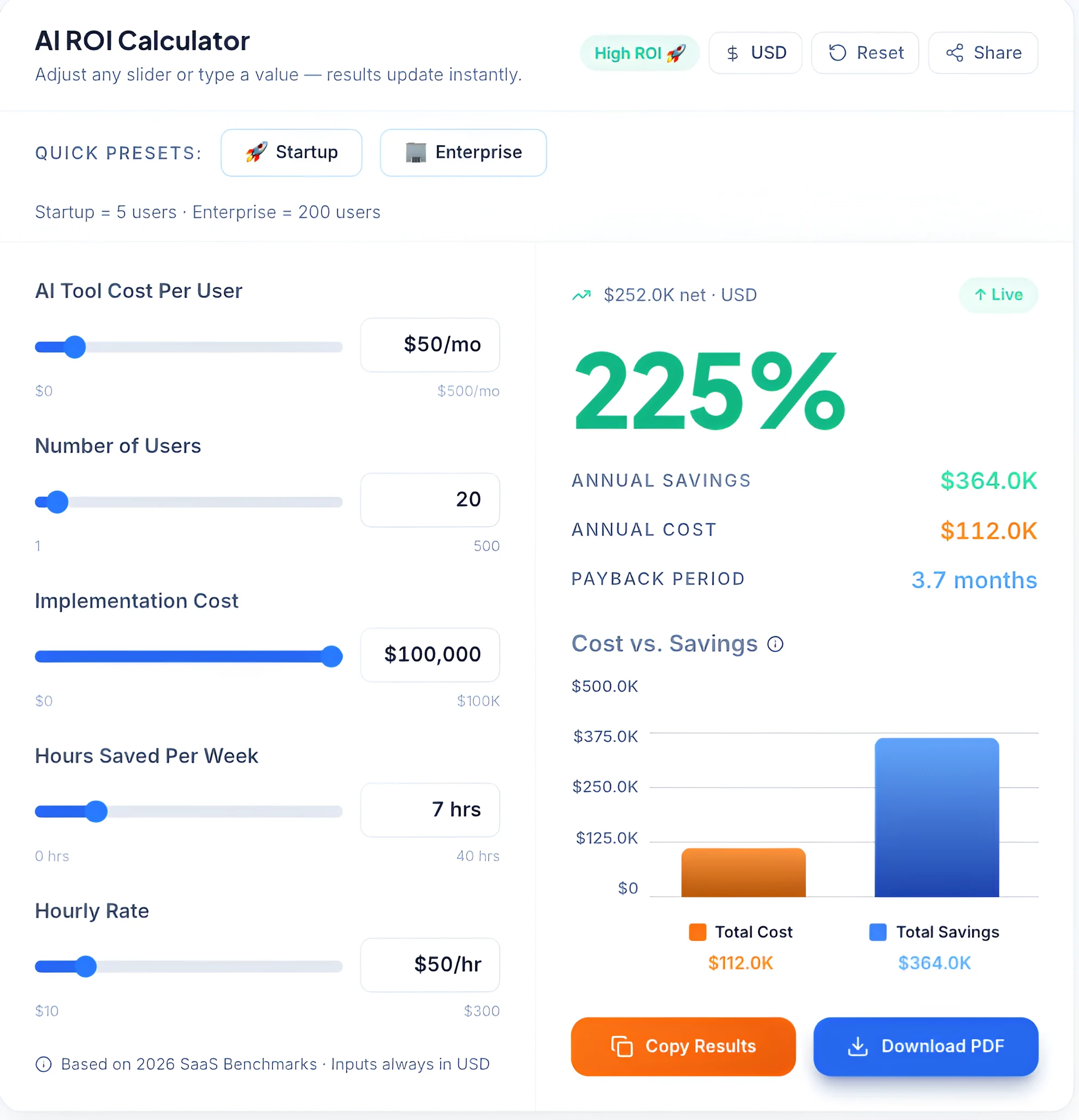
Calculating the potential return on investment (ROI) when implementing AI sales automation for small teams.
Best AI Sales Stacks for Small Teams
Don't start by buying everything. Start with the stack that matches where you are right now.
Starter Stack — Under $50/month
HubSpot Free + Fireflies.ai Pro + Instantly.ai Growth
- Total: ~$47/month (or ₹~3,900/month)
- Covers: CRM, meeting intelligence, and cold email automation
- Best for: A 1–5 person team doing its first structured outbound
This stack alone handles 80% of what most small sales teams actually need. Get this working before you add anything else.
Growth Stack — Under $150/month
HubSpot Starter + Apollo.io Basic + Fireflies.ai Pro + Autobound
- Total: ~$130–150/month
- Covers: Pipeline management, lead generation, outreach personalization, and meeting intelligence
- Best for: A 5–15 person team with an active outbound motion
This is the stack that most high-performing small sales teams are running in 2026. It's not cheap, but it covers the full cycle from finding leads to closing them.
Full System — Under $250/month
Add Tidio AI for website lead capture and Instantly.ai for email volume. At this point, you have inbound and outbound covered, every meeting documented, and every website visitor engaged.
How to Choose the Right Tool: Start With Your Bottleneck
Most people focus on features first — but it’s better to start with the problem you’re trying to solve.
| Your Biggest Problem | Tool to Start With |
|---|---|
| Not enough leads coming in | Apollo.io — build and work a targeted list |
| Low reply rates on outreach | Instantly.ai + Autobound — improve volume and personalization |
| Messy pipeline, dropped deals | HubSpot CRM — get everything in one place |
| Losing info from sales calls | Fireflies.ai — automatic notes and summaries |
| Website traffic not converting | Tidio AI — capture and qualify visitors 24/7 |
Three rules before you buy:
- Keep your initial spend under $100/month. Prove ROI on one tool before stacking more.
- Avoid tool overload. Three tools used well beat seven tools used poorly. Every time.
- Start with a 30-day trial on real data. Demos are designed to impress. Real workflows reveal the friction.
→ Use our AI Implementation Checklist to structure your rollout before you start.
Common Mistakes That Kill AI Sales Tool ROI
Here's where most small teams get this wrong — and they usually get it wrong in the same few ways.
Buying multiple tools at once. Three tools purchased simultaneously means three half-implementations and no clear picture of what's working. Buy one. Run it for 30 days. See what actually changes. Then decide if you even need the next tool.
Using generic outreach. Copy-paste emails with a different name dropped in aren't personalized — AI or otherwise. The tools that help most here (Autobound, Apollo's AI sequences) only work if you're giving them something real to personalize with. A LinkedIn activity trigger beats a generic pain point every time.
No follow-up system. A lead captured with no follow-up sequence is a lead lost. If you're using Tidio or Apollo to generate leads but have no structured response process in HubSpot, the top of the funnel is pointless.
Ignoring the data the tool generates. Apollo shows you which email subjects perform. Fireflies shows you which talk patterns correlate with closed deals. Instantly shows you which domains are getting flagged. Most small teams collect this data and never look at it.
Measuring the wrong things. Number of emails sent is not a KPI. Reply rate, meeting booked rate, and pipeline influenced are. Define two or three metrics before you start and track them weekly.
If you're also using AI for marketing or content alongside sales, this breakdown helps you avoid tool overlap: Best AI Content Creation Tools for Businesses (2026 Guide).
ROI Modeling: What This Actually Costs vs. Returns
Most small businesses underestimate the return because they measure tool cost but not recovered time, improved conversion, or prevented revenue leakage.
Worked Example
| Business | 8-person B2B SaaS team |
|---|---|
| Stack | HubSpot Starter + Apollo Basic + Fireflies Pro |
| Total Monthly Cost | $79/month |
| Labour Recovered | 6 hours/rep/week × 3 reps × $30/hour = $2,160/month |
| Reply Rate Improvement | From 1.5% to 4% on 500 emails/week = 6+ extra meetings/month |
| Revenue Impact | 6 meetings × 20% close × $1,500 ACV = $1,800/month pipeline added |
| Total Monthly Return | ~$3,960 |
| ROI | ((3,960 − 79) / 79) × 100 = 4,913% |
If you're deciding between free vs paid tools, this analysis breaks down where ROI actually comes from: Paid vs Free AI Tools: ROI Breakdown (2026).
Conservative assumptions throughout. Results depend heavily on your current process baseline and how consistently the tools are actually used.
→ Run your own numbers with the AI ROI Calculator before committing to any stack.
Your 2026 AI Sales Tool Action Plan
The sales teams generating real results from AI aren't running the most tools. They're running the right ones, with discipline, and measuring what changes.
Implementation Roadmap
| Timeframe | Action |
|---|---|
| This week | Identify your single biggest sales bottleneck (leads, replies, pipeline, or follow-up) |
| This month | Set up one tool that directly addresses it. Run it with real data, not a demo environment. |
| 60 days | Measure against two or three baseline KPIs you defined before launch |
| Quarter 2 | Add a second tool only after the first shows measurable improvement |
Start focused. Measure obsessively. Expand deliberately.
Tool selection is 20% of the outcome. How you implement, what you measure, and whether your team actually uses the tool consistently — that's the other 80%.
Which AI Sales Tool Should You Start With?
If you're overwhelmed by options, start with the bottleneck — not the brand.
- Choose HubSpot if you need a CRM and pipeline management system first.
- Choose Apollo.io if your biggest issue is finding qualified leads.
- Choose Instantly.ai if you're already doing outbound and want better cold email deliverability.
- Choose Fireflies.ai if your team runs frequent sales calls and loses follow-up details.
- Choose Tidio AI if your website gets traffic but visitors aren't converting into leads.
For most small teams, the best starting combination is:
HubSpot Free + Fireflies.ai Pro
That setup alone solves CRM organization, follow-ups, and meeting documentation for under $15/month.