The Margin Problem Most Growing Agencies Reach Too Late
Most digital marketing agencies hit a wall between 20 and 40 clients — where delivery costs compound faster than fee increases and net margin compresses despite revenue growth. Agency Analytics' 2025 State of Agency Report places the average US agency net margin at 18–22%; top-quartile agencies average 32–38%. That gap is not explained by pricing or service mix. It is explained almost entirely by delivery efficiency: how much billable output is produced per internal labor dollar.
The agencies closing that gap are doing it with a structured marketing agency AI stack: AI tools for client reporting, content production, AI media buying optimization, and competitive intelligence — applied systematically to the highest-cost, lowest-leverage functions in the delivery stack.
For a broader framework on AI software selection and ROI measurement, see: Complete Guide to Choosing AI Software for Your Business (2026 Edition).
- Average net margin: US digital marketing agencies average 18–22% net margin, per Agency Analytics' 2025 State of Agency Report.
- Top-quartile margin: Top-quartile agencies average 32–38% — the gap explained almost entirely by delivery efficiency, not pricing.
- Reporting overhead: Manual report assembly consumes 8–12 hours per client per month — generating zero billable revenue and no strategic value.
- Content labor ratio: Agencies routinely produce 3 hours of internal labor for every 1 billable hour on content service lines — directly compressible with AI workflow tools.
Four Places Agency Margin Leaks Before AI Gets Involved
The benchmarks below are drawn from HubSpot's Agency Impact Report, Databox's State of Agency Reporting study, and Agency Analytics' published benchmark data. These are industry-wide averages; individual results vary by service mix, client complexity, and team structure.
1. Client Reporting: 8–12 Hours Per Client Per Month
Manual report assembly — pulling data from GA4, Meta Ads Manager, Google Ads, LinkedIn, and SEO platforms, formatting it into branded decks, and writing performance commentary — consumes 8–12 hours per client monthly in agencies managing 15–30 accounts. At a fully loaded cost of $35–50/hour for a mid-level analyst, that is $280–600 per client per month in pure overhead. For a 20-client agency, monthly AI-replaceable reporting labor runs $5,600–12,000 — a line item that generates no billable revenue and no strategic value.
Operationally, reporting tends to absorb the largest single block of analyst time in the week before delivery — the most schedulable, highest-frequency function in the delivery stack, and the most directly automatable.
2. Paid Media Management: 30–40% Is Non-Strategic Execution
Roughly 30–40% of a media buyer's time is spent on bid adjustment reviews, audience segment analysis, budget pacing checks, and performance status reports — tasks requiring data access, not creative judgment. At $60–80/hour fully loaded, that fraction represents $3,600–6,400/month per media buyer in labor that AI media buying optimization tools can substantially reduce.
3. Content Production: The 3:1 Internal-to-Billable Labor Ratio
In SEO, social, and email service lines, agencies routinely produce 3 hours of internal labor for every 1 billable hour. That gap between finished output cost and what clients pay is structural — and AI content workflow tools can narrow it to 1.5:1 or below, expanding margin on every deliverable without a rate change.
4. Proposal and Strategy Preparation Time
New business proposals average 8–15 hours of strategist and account director time. Competitive audits, channel recommendations, and pricing tables are largely templatable by vertical and budget tier. Agencies using AI competitive intelligence and proposal tools report 40–60% proposal time reductions — freeing senior capacity for revenue-generating work.
These four leakage points typically total 15–25+ hours of non-billable labor per client per month — directly calculable from current time logs.
Reporting is the highest-payback first automation target at every agency size. Configuration per client averages 3–4 hours; ROI breakeven typically occurs within the second reporting cycle. Fix tracking infrastructure before deploying any reporting AI — agencies that skip this step report 30–50% higher setup friction and lower output quality.
AI-driven automation is delivering documented results across other service industries as well. For example, real estate agencies using AI for lead qualification, follow-up automation, and predictive targeting are seeing significant commission growth — see our detailed breakdown in AI Software for Real Estate Agencies (2026)..
Margin Math: What AI Tools Can Realistically Recover
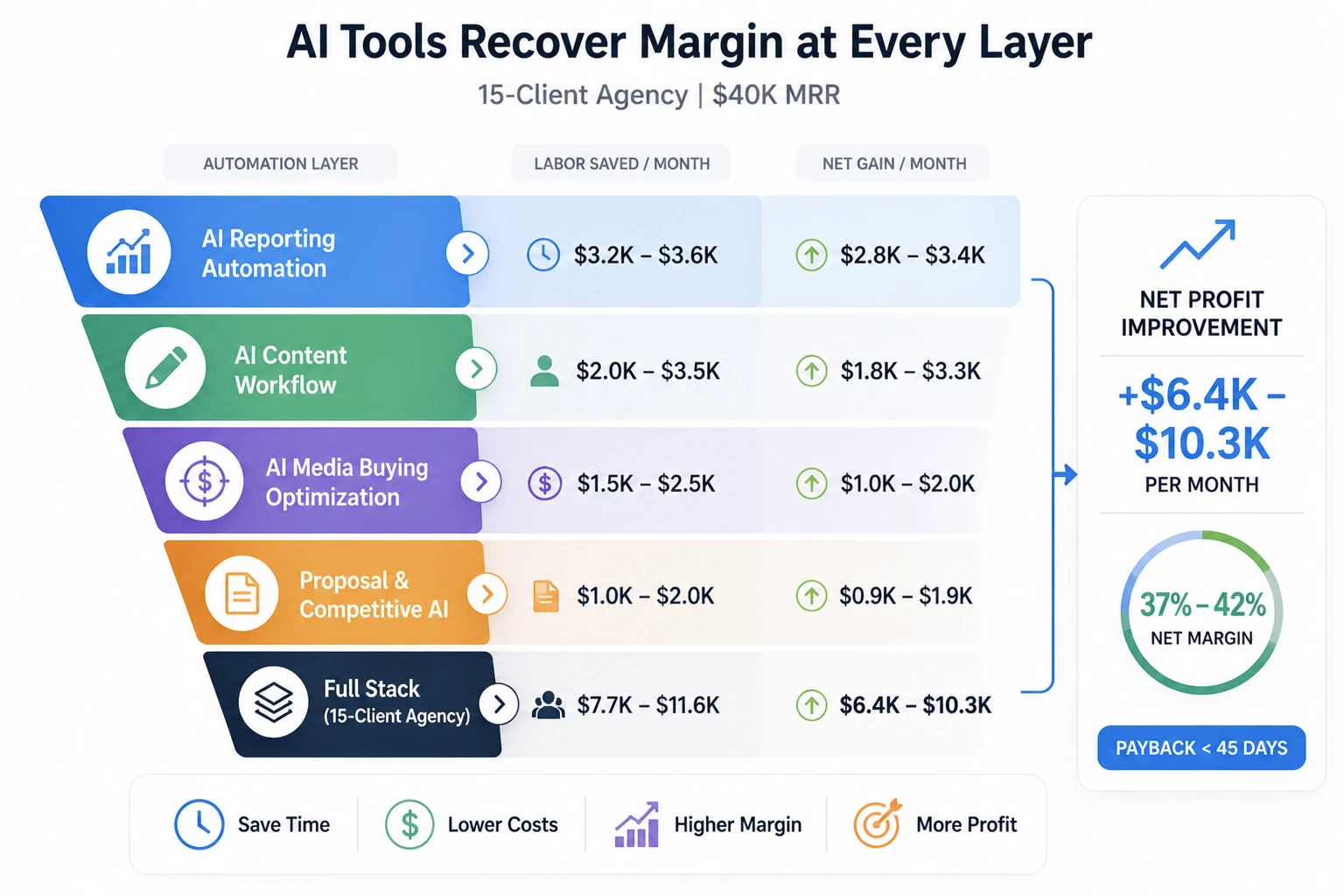
How AI tools recover lost margins in a 15-client agency by reducing reporting, content, and media execution costs to increase net profit.
The scenario below uses conservative assumptions based on published agency benchmarks. Actual results depend on service mix, team adoption discipline, client tracking quality, and implementation thoroughness. These figures are planning models, not performance guarantees.Apply the formula to your own time logs for a more precise projection.
Scenario: 15-Client Agency at $40K MRR
Baseline: $40K MRR, 22% net margin = $8,800/month net profit. Fully loaded delivery team cost: ~$28,000/month.
- Reporting automation (AgencyAnalytics or DashThis): 8 hrs/client reduced to 2 hrs. Saved: 6 hrs × $40 avg cost × 15 clients = $3,600/month. Tool cost: $200–400/month → Net gain: +$3,200–3,400/month
- AI content workflow (Jasper, Copy.ai with editorial guidelines): 3:1 ratio to 1.8:1 on 5 content accounts. Estimated labor saving: $2,000–3,500/month. Tool cost: $100–250/month → Net gain: +$1,750–3,250/month
- AI media buying optimization (Optmyzr, Madgicx): Non-strategic execution time cut 25–35%. Savings per media buyer: $1,200–2,000/month. Tool cost: $250–500/month → Net gain: +$950–1,500/month
Combined conservative net lift: $5,900–8,150/month. Net profit improves from $8,800 to an estimated $14,700–16,950/month — moving margin rate from 22% to approximately 37–42% without acquiring a new client.
Calculation model: (Hours saved per function × Average hourly cost) − Tool subscription cost = Net monthly margin lift per layer. Sum across all deployed layers to estimate full stack impact.
The Compounding Logic
The leverage is in the stack running simultaneously: reporting labor, content labor, and media execution time all drop in parallel. At $40K MRR, recovering $8,000/month is not growth — it is reclaiming profit already embedded in current revenue that overhead has been consuming.
Automation Layer ROI Summary
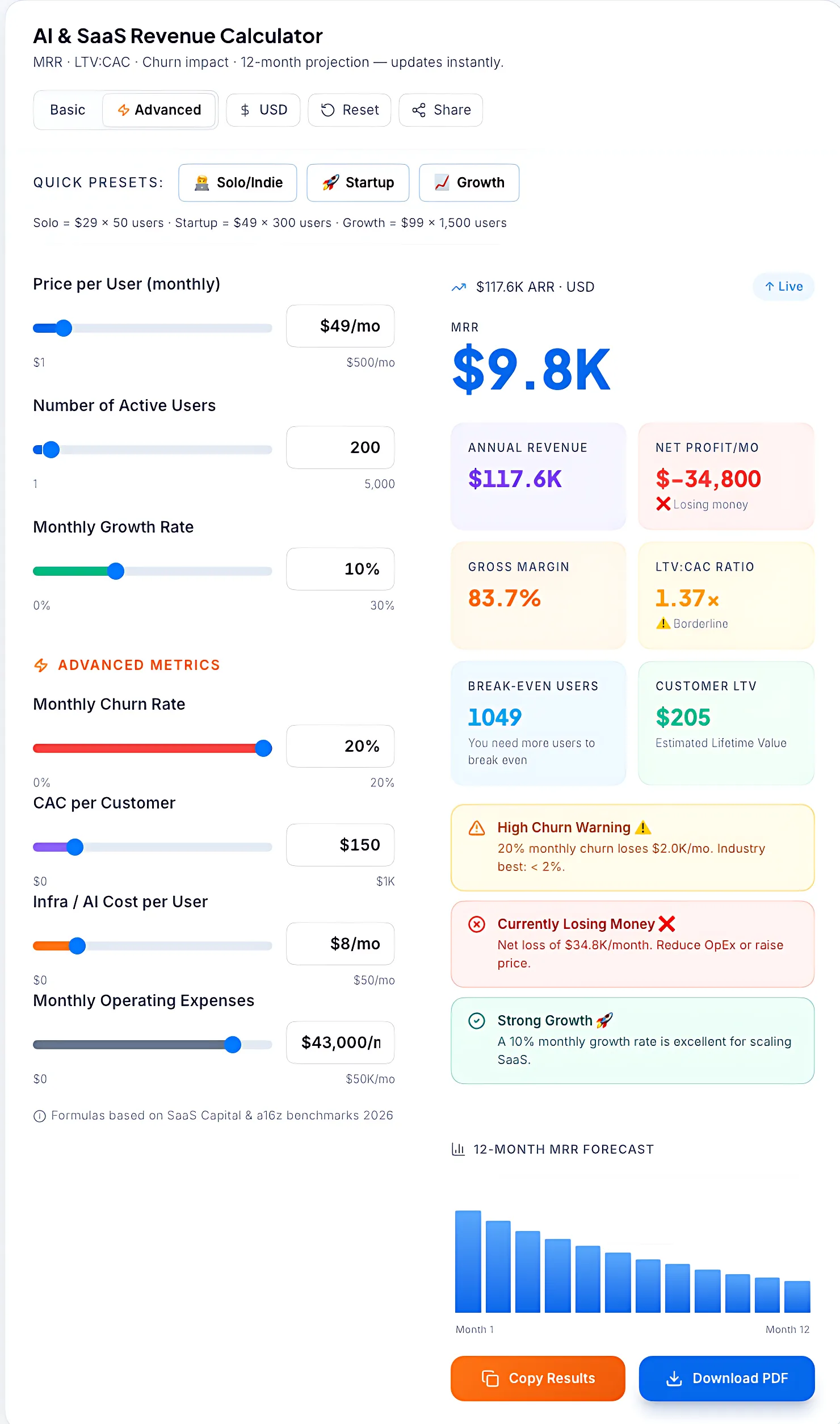
Our proprietary AI ROI Calculator modeling a 3,000%+ return for agencies by automating high-frequency delivery tasks like reporting and content workflows.
| Automation Layer | Monthly Tool Cost | Labor Saved (Conservative) | Net Monthly Gain | Payback |
|---|---|---|---|---|
| Client reporting (AI) | $200–400 | $3,200–3,600/mo | +$2,800–3,400 | < 30 days |
| AI content workflow | $100–250 | $2,000–3,500/mo | +$1,750–3,250 | < 30 days |
| Paid media AI optimization | $250–500 | $1,500–2,500/mo | +$1,000–2,000 | 30–60 days |
| Proposal & competitive AI | $50–150 | $1,000–2,000/mo | +$850–1,850 | 30–45 days |
| Full stack (15-client agency) | $600–1,300 | $7,700–11,600/mo | +$6,400–10,300/mo | < 45 days avg |
→ Want exact margin recovery numbers for your agency? Use the AI ROI Calculator to model your specific labor cost savings and net margin improvement before investing.
Core AI Stack for Digital Marketing Agencies
Tools are organized below by the margin function they address. Pricing reflects starter to mid-tier plans as publicly documented in 2026, named for specificity rather than as endorsements. Fit depends on agency size, service mix, and existing infrastructure.
AI Client Reporting and Dashboard Automation
AgencyAnalytics ($12–15/client/month) and DashThis ($39–149/month flat) are the dominant platforms for automated client reporting — pulling live data from 70+ marketing platform integrations and generating white-labeled dashboards that update in real time. Both eliminate the manual data-pull and formatting cycle that drives the majority of analyst reporting time.
Setup note: initial configuration per client averages 3–4 hours; ROI breakeven typically occurs within the second reporting cycle. Agencies that automate reporting without first cleaning GA4 and ad platform tracking configurations report higher setup friction and lower output quality.
AI Content Production and Workflow Automation
Jasper ($49–125/month) and Copy.ai ($49–186/month) provide the most mature content workflow environments for agency teams — brand voice training, multi-client workspace management, and multi-channel output. Surfer SEO ($89–219/month) adds real-time NLP content optimization for agencies with significant SEO delivery volume. Zapier ($20–69/month) or Make ($9–29/month) connects these tools to editorial queues and CMS platforms.
Critical setup step: AI content quality becomes consistent only after a brand voice document and editorial guidelines are configured per client. Agencies skipping this step report revision rates that negate 30–50% of the efficiency gain. Budget 90–120 minutes per client before calculating ROI.
AI Media Buying and Paid Campaign Optimization
Optmyzr ($208–498/month) automates bid management, budget pacing, and quality score maintenance across Google, Microsoft, and Meta. Madgicx ($49–499/month) adds AI audience intelligence and creative scoring for Meta-heavy portfolios. Albert.ai ($1,000+/month custom) handles autonomous media buying for agencies managing $500K+/month in combined ad spend.
Important framing: these tools reduce time spent on repetitive tactical execution — not on strategy, creative judgment, or client communication. Agencies representing AI media tools as 'fully automated' consistently encounter expectation management problems when human intervention is still required.
AI Competitive Intelligence and Proposal Automation
Semrush ($119–449/month), Ahrefs ($129–449/month), and Similarweb ($125+/month) all include AI-augmented competitive intelligence as of 2026 — gap analysis, keyword mapping, and market share modeling. Combined with proposal tools (Proposify $49–99/month, Pitch $8–40/month), the research-to-proposal pipeline can drop from 10–15 hours to 4–6 hours.
AI Analytics and Performance Interpretation
Google Gemini in Looker Studio and GA4, alongside ChatGPT-based analysis interfaces, enables natural-language querying of client performance data — flagging anomalies and generating commentary without manual pivot table work. For multi-platform reporting agencies, this reduces interpretation time by an estimated 40–60% per cycle.
Marketing Agency AI Stack by Business Size
Boutique Agency (Under 10 Clients, $15–25K MRR)
DashThis ($39–99/month) + Jasper Starter ($49/month) + Zapier ($20/month). Total: $108–168/month. ROI threshold: automating reporting for 5+ clients at 4 hours each recovers the full stack cost within the first reporting cycle.
Mid-Size Agency (10–30 Clients, $40–120K MRR)
AgencyAnalytics + Jasper Teams + Surfer SEO + Optmyzr + Semrush + Make: $707–907/month. Net margin improvement at this tier: $6,000–10,000/month, based on documented labor reduction across reporting, content, and media layers.
Growth Agency (30–60 Clients, $150K+ MRR)
Enterprise AgencyAnalytics + Madgicx or Albert.ai + Surfer SEO + AI analytics: $2,000–5,000/month depending on ad spend volume. One percentage point of margin improvement on $150K+ MRR = $1,500+/month — full stack payback typically within 30–45 days.
Agency Stack Cost vs Margin Lift
| Agency Size | Monthly AI Cost | Labor Saved/Mo | Net Margin Gain | Payback |
|---|---|---|---|---|
| Boutique (< 10 clients) | $108–168 | $1,200–2,400 | +$1,000–2,200/mo | < 30 days |
| Mid-Size (10–30 clients) | $707–907 | $7,700–11,600 | +$6,400–10,300/mo | < 45 days |
| Growth (30–60 clients) | $2,000–5,000 | $15,000–25,000+ | +$10,000–20,000+/mo | 30–45 days |
When AI Tools Are NOT the Right Investment
-
Under 5 active clients: Configuration overhead exceeds savings at this volume. The investment priority is lead generation, not delivery optimization.
-
No standardized delivery process: AI automates defined, repeatable workflows. Without them, AI produces inconsistently structured outputs that require more human correction than the manual process they are meant to replace.
-
Unclean tracking infrastructure: Reporting automation requires properly configured GA4, ad platform, and CRM data. Agencies inheriting poorly structured client accounts will spend more time fixing data inputs than benefiting from automated outputs.
-
Expecting AI to fix a strategic problem: AI optimizes delivery efficiency. It does not fix a commoditized service offering, a pricing problem, or weak client retention. Deploying AI automation into a strategically weak agency produces efficient execution of the wrong strategy.
-
No committed operating budget: Fixed AI subscription costs require a committed monthly line item. On-off tool cycling from budget instability eliminates the compounding benefit of integration and system learning.
2026 Emerging Trends in Agency AI Automation
Agentic Campaign Management
The 2026 frontier is not AI-assisted optimization but autonomous campaign agents that monitor performance, reallocate budget, flag creative fatigue, and generate summaries without human initiation. Google Performance Max and Meta Advantage+ are current infrastructure expressions of this shift. For agencies, it changes the media buyer role from tactical execution to strategic oversight and exception management.
Predictive Client Retention and Scope Intelligence
Churn is the primary margin destroyer in agency businesses. Emerging AI tools model client health scores from engagement data and performance trends, flagging at-risk accounts before formal contract conversations begin. One prevented churn per quarter on a $5,000–8,000 MRR account protects $60,000–96,000 in annualized revenue. Scope creep — the second major destroyer — is addressable with AI trained on project history to flag expansion in real time and auto-generate change order language.
According to HubSpot's Agency Impact Report, agencies that deploy AI across their three highest-cost delivery functions simultaneously recover their full stack cost within the first 30-day cycle in the majority of documented cases — with compounding margin improvement as processes standardize.
AI Adoption Framework for Agencies
Start With Operational Bottlenecks
Before selecting any platform, map where your team spends the most time. Review client reporting, content production, campaign management, proposal creation, and recurring administrative work. The strongest automation opportunities are usually repetitive tasks that consume significant hours but require limited strategic judgment.
Implement Reporting Automation First
Client reporting is often the fastest path to proven time savings. Platforms such as AgencyAnalytics or DashThis can consolidate marketing data into standardized dashboards, reducing manual reporting effort while improving consistency. Evaluate success based on reporting efficiency, turnaround time, and team workload reduction.
Standardize Content Production Processes
AI content tools perform best when clear brand guidelines already exist. Create documented voice, tone, messaging, and approval standards before introducing automation into content workflows. Human review remains essential for maintaining quality, accuracy, and client-specific positioning.
Use AI to Support Media Management
Campaign optimization tools can help monitor performance, identify anomalies, and automate repetitive adjustments. However, budget allocation, audience strategy, offer development, and creative direction should remain under human control. Automation works best as a support layer rather than a replacement for strategic decision-making.
Scale Based on Proven Results
As AI systems mature, regularly review efficiency gains, delivery costs, client satisfaction, and profit margins. Expand the automation initiatives that demonstrate consistent business value, and refine or remove those that fail to generate meaningful results. Sustainable adoption comes from incremental optimization rather than full-scale automation from day one.
→ Build your phased rollout plan before going live: Use the AI Implementation Checklist to generate a step-by-step deployment plan tailored to your agency size and service mix.
Final Verdict: Build the Margin Stack Before You Need It
The agencies winning on margin in 2026 are not outgrowing their competitors — they are out-engineering them. They have mapped the 15–25 hours of low-leverage delivery labor per client per month, identified which AI tools address each category, and implemented them in sequence. The math is not complex. The execution discipline is what separates the 22% margin agency from the 38% one.
For a $40K MRR agency, recovering $8,000/month is $96,000 in annual profit already embedded in current revenue — consumed by automatable overhead. For a $150K MRR agency, the same logic scales to $180,000–360,000 per year without a new client.
According to McKinsey Global Institute research on AI in professional services, knowledge workers in professional services who adopt AI-assisted workflows recover 40–60% of time previously spent on data assembly and formatting — the precise functions that drive agency margin compression at scale.
Audit actual time by function. Deploy reporting automation first. Add content workflow second. Layer paid media optimization third. Measure against real time-log baselines. The agencies that treat this as a one-time implementation project will see modest gains. Those that treat it as permanent margin infrastructure will build a structural cost advantage that compounds over time.
Key Takeaways
AI tools for digital marketing agencies aren't a growth strategy — they are a margin recovery system. The agencies generating the highest returns from AI in 2026 have mapped exactly where non-billable labor is consumed, deployed AI tools against those specific functions in sequence, and measured margin improvement against a documented baseline.
A boutique agency at $108–168/month recovering $1,000–2,200/month. A mid-size agency at $707–907/month recovering $6,400–10,300/month. A growth agency at $2,000–5,000/month recovering $10,000–20,000+/month. At every level, the ROI case is built on labor that already exists in your cost structure — not on projected new revenue.
Start with your time logs:
- Identify the function consuming the most non-billable hours per client
- Deploy reporting automation first — it has the fastest payback at every agency size
- Add content workflow second, media optimization third
- Measure margin improvement at 60 days before expanding to the full stack
Audit first. Automate deliberately. Measure from day one.