Why AI SEO Tools Matter in 2026
Three years ago, a small business could publish a well-written blog post and rank within a few weeks. Today, that same post competes against established sites with hundreds of optimized pages, structured internal linking, and topical authority built over years.
Manual SEO — picking keywords by intuition, writing without optimization data, ignoring competitor content structure — no longer works at the pace small businesses need.
- Ranking timeline: Small business pages optimized with AI SEO tools rank 2–3x faster than unoptimized content — typically within 60–90 days for low-competition keywords.
- CTR improvement: AI-optimized title tags and meta descriptions improve organic CTR by 15–25% without any change in ranking position.
- Traffic growth: Sites using consistent AI SEO workflows report 40–60% organic traffic growth within 6 months compared to sites publishing without optimization.
- Time savings: AI reduces keyword research and content brief creation from 4–6 hours to 30–45 minutes per article.
The fundamental shift in 2026 is this: SEO is no longer about guessing keywords and hoping content ranks. It's about using data to write exactly what Google is already rewarding — and AI tools make that data accessible to any small business, not just enterprises with dedicated SEO teams.
For a broader view of AI marketing tool selection strategy, see: Complete Guide to Choosing AI Software for Your Business (2026 Edition).
How to Evaluate AI SEO Tools: An ROI Framework
Not every SEO tool solves the same problem. Before selecting any AI SEO platform for your small business, run it through four filters:
-
Ranking ROI: Does this tool help you identify keywords you can actually rank for — not just keywords with high search volume? A tool that surfaces low-competition, high-intent keywords your site can realistically win is worth more than one that shows you data on terms dominated by Forbes and HubSpot.
-
Content ROI: Does it tell you what to write — not just what to target? Tools like Surfer and Frase analyze the top-ranking pages for your target keyword and tell you exactly which topics, headings, and NLP terms to include. That's the difference between content that ranks and content that doesn't.
-
Scaling cost: Map per-article and per-seat pricing to your monthly publishing cadence. A tool at $99/month that supports 30 articles is a different value proposition than one that charges per content brief. Know your publishing volume before committing.
-
Deployment cost: SEO tools with steep learning curves have a real time cost. For beginners especially, prioritize platforms with guided workflows — tools that walk you through the process rather than presenting raw data and expecting you to know what to do with it.
Apply these four filters before every purchase decision. They eliminate SEO tools that look comprehensive in demos but don't translate to rankings in production.
The most common SEO mistake small business owners make is choosing tools based on feature count rather than bottleneck fit. Identify your single biggest SEO problem first — finding keywords, optimizing content, or tracking rankings — and choose the tool that solves that problem best. Add complexity only after the core workflow is producing results.
Top AI SEO Tools for Small Businesses: Full Comparison (2026)
All tools reflect official starting plan pricing. Beginner accessibility and small business use cases are prioritized.
| Tool | Starting Price | Best For | Free Tier? | Key AI Feature |
|---|---|---|---|---|
| Surfer SEO | $89/mo (Essential) | Content optimization + NLP scoring | Trial only | Real-time content editor with NLP keyword guidance |
| SEMrush | $140/mo (Pro) | All-in-one SEO platform | ✅ Limited | Keyword magic tool + AI writing assistant |
| Ahrefs | $129/mo (Lite) | Backlink analysis + keyword research | ✅ Limited (Webmaster) | Keyword difficulty scoring + content gap analysis |
| Frase | $15/mo (Solo) | Beginner content briefs + optimization | Trial only | AI content brief generator + SERP analysis |
| NeuronWriter | $23/mo (Bronze) | Budget content optimization | Trial only | NLP content scoring + competitor outline analysis |
| Scalenut | $39/mo (Essential) | Content scaling + cluster planning | Trial only | Keyword clustering + AI content workflow |
| RankMath | Free (WordPress) | WordPress on-page SEO | ✅ Yes (full free) | On-page SEO scoring + schema automation |
→ Not sure which tool fits your current SEO stage? Use our AI SEO Tool Selector to get a personalized recommendation based on your website size and monthly publishing goal.
Deep Dive: Top AI SEO Tools for Small Businesses (2026)
Surfer SEO
Best for: Content optimization — writing pages that rank, not just pages that exist
Surfer's real-time content editor is the most practical AI SEO tool for small businesses that are actively publishing. You enter your target keyword, and Surfer analyzes the top 20 ranking pages to produce a content score — showing you which NLP terms to include, how long your content should be, how many headings to use, and what questions to answer. As you write, the score updates live.
For a small business owner who isn't an SEO expert, this is transformative. Instead of guessing whether your content is optimized, you have a live benchmark telling you exactly what the top-ranking pages have in common — and whether your content matches or falls short.
Key AI Features:
- Real-time content editor with live NLP keyword scoring
- SERP Analyzer — breaks down competitor page structure, word count, and heading usage
- Content Audit — scores existing pages and identifies optimization gaps
- AI-generated content outlines based on SERP analysis
Pricing: $89/month (Essential — 30 articles), $129/month (Scale — 100 articles)
Pros: The most actionable content optimization tool for non-technical users. Live scoring removes guesswork from the writing process. Strong integration with Google Docs and WordPress.
Cons: Higher price point for small businesses just starting. Article limits on the Essential plan can constrain high-volume publishers. Primarily a content optimization tool — not a full SEO suite for keyword research or backlink analysis.
SEMrush
Best for: All-in-one SEO — one platform for every stage of the SEO workflow
SEMrush is the most comprehensive SEO platform on this list. It covers keyword research, competitor analysis, backlink tracking, technical site audits, rank tracking, and content optimization in a single interface. For small businesses that want one tool rather than a stack, and have the budget to support it, SEMrush eliminates the need for multiple subscriptions.
The Keyword Magic Tool generates keyword clusters with difficulty scores, search volume, and CPC data. The Position Tracking feature monitors your rankings daily. The Site Audit identifies technical SEO issues automatically and prioritizes them by impact.
Key AI Features:
- Keyword Magic Tool — 25+ billion keyword database with AI difficulty scoring
- AI Writing Assistant integrated with content optimization workflow
- Site Audit — automated technical SEO issue detection and prioritization
- Competitor gap analysis — surfaces keywords competitors rank for that you don't
Pricing: $140/month (Pro), $250/month (Guru — adds content marketing toolkit)
Pros: Most complete SEO tool on this list. One subscription replaces 3–4 separate tools. Strong data quality and reporting.
Cons: Price point is high for solo operators and early-stage small businesses. The volume of features can overwhelm beginners — there's a real learning curve before you get full value. For businesses purely focused on content optimization, Surfer or Frase deliver more targeted value at lower cost.
Ahrefs
Best for: Backlink analysis + keyword research — finding what you can realistically rank for
Ahrefs is the most trusted tool in the SEO industry for backlink data and keyword difficulty assessment. For small businesses trying to understand which keywords are winnable — based on the authority of pages currently ranking, not just raw search volume — Ahrefs' keyword difficulty score is the most reliable metric available.
The Content Gap tool is particularly useful: input your domain and two or three competitors, and Ahrefs surfaces every keyword your competitors rank for that your site doesn't. That's a pre-built content roadmap requiring no creative keyword brainstorming.
Key AI Features:
- Keyword Explorer — keyword difficulty scoring calibrated to real page authority data
- Content Gap analysis — competitor keyword overlap identification
- Site Explorer — full backlink profile analysis for any domain
- Rank Tracker — daily ranking position monitoring
Pricing: Free (Ahrefs Webmaster Tools — limited), $129/month (Lite), $249/month (Standard)
Pros: Most accurate keyword difficulty scores in the industry. Content Gap tool is one of the highest-ROI features available for content planning. Webmaster Tools free tier is genuinely useful for small businesses not ready to pay.
Cons: Expensive for businesses primarily focused on content optimization rather than competitive research. The interface requires some SEO knowledge to use effectively — not the most beginner-friendly tool on this list.
Frase
Best for: Beginners creating their first AI-optimized content briefs
Frase is the most beginner-accessible tool on this list. You enter a keyword, and Frase generates a complete content brief — including a suggested outline, competitor headings, key questions to answer, and recommended NLP terms to include — in under two minutes. For a small business owner writing their own content without an SEO background, Frase removes the research phase entirely.
The AI writing features let you draft sections directly within the tool, then optimize against the brief in the same interface. At $15/month for the Solo plan, it's the lowest-cost entry point to AI-assisted content optimization on this list.
Key AI Features:
- AI content brief generator — complete brief from a single keyword input
- SERP analysis — top-ranking competitor outlines, headings, and word counts
- NLP term suggestions — terms the top-ranking pages use that yours should include
- AI draft writer — generate content sections within the optimization interface
Pricing: $15/month (Solo — 4 articles/month), $45/month (Basic — 30 articles), $115/month (Team)
Pros: Lowest-cost entry point for genuine AI content optimization. Most beginner-friendly workflow on this list. Brief generation quality is strong even at the Solo tier.
Cons: Article limits on the Solo plan are restrictive for active publishers. AI writing quality is good but benefits from human editing. Less useful for keyword research and backlink analysis — pair with Ahrefs Webmaster Tools for a complete beginner stack.
NeuronWriter
Best for: Budget content optimization with strong NLP scoring
NeuronWriter delivers content optimization quality comparable to Surfer SEO at roughly one-quarter of the price. Its NLP content scoring system analyzes competitor pages and generates a list of semantically related terms to include — with a content score that updates as you write. For small businesses that need Surfer-level optimization guidance but can't justify $89/month, NeuronWriter at $23/month is the clearest budget alternative.
The competitor outline analysis feature pulls the heading structures from top-ranking pages and presents them side by side, making it easy to identify structural patterns that correlate with ranking success for your target keyword.
Key AI Features:
- NLP content scoring with live update as you write
- Competitor outline analysis — heading structure comparison across top 10 results
- AI content generation integrated with optimization workflow
- SERP analysis — word count, heading count, and semantic term frequency
Pricing: $23/month (Bronze — 25 queries), $45/month (Silver — 50 queries), $69/month (Gold — 75 queries)
Pros: Best price-to-performance ratio for content optimization on this list. Strong NLP scoring quality. Good fit for small businesses publishing 4–8 articles per month.
Cons: Interface is less polished than Surfer or Frase. Query limits on entry plans constrain high-volume publishers. Less brand recognition means fewer integrations and community resources than top-tier tools.
Scalenut
Best for: Content scaling and keyword cluster planning
Scalenut is built for small businesses that have moved past the "publish one post and hope" phase and are ready to build topical authority through systematic content cluster planning. Its keyword clustering feature groups related keywords into topic clusters, showing you which supporting articles to write around a pillar page — the content architecture that Google currently rewards most strongly.
The AI content workflow takes you from keyword input to published draft within the same platform — research, brief, writing, and optimization in a single sequence.
Key AI Features:
- Keyword clustering — groups keywords into topical clusters for content planning
- AI content workflow — research → brief → write → optimize in one sequence
- NLP content optimization with competitor analysis
- Content score tracking for published pages
Pricing: $39/month (Essential — 5 AI articles), $79/month (Growth — unlimited AI articles)
Pros: Best tool for building systematic content strategy, not just individual article optimization. Keyword clustering feature saves significant planning time. All-in-one workflow reduces tool switching friction.
Cons: AI article quality requires editing — treat it as a strong first draft, not a finished output. The Essential plan's 5-article limit is restrictive. Less useful for competitive keyword research or backlink analysis.
RankMath
Best for: WordPress users needing on-page SEO optimization for free
RankMath is the most accessible tool on this list for one simple reason: the free version is genuinely powerful. For any small business running a WordPress website, RankMath should be the first SEO tool installed — before any paid subscription. It provides real-time on-page SEO scoring, schema markup automation, XML sitemap generation, and Google Search Console integration at zero cost.
The AI-powered suggestions flag specific on-page issues — missing focus keywords in headings, thin meta descriptions, images without alt text — and tell you exactly how to fix them. For beginners, this guided feedback loop is one of the fastest paths to understanding what on-page SEO actually requires.
Key AI Features:
- Real-time on-page SEO score with specific fix recommendations
- Schema markup automation (Article, FAQ, Product, Review schemas)
- Internal linking suggestions based on existing content
- Google Search Console integration — rankings and click data inside WordPress
Pricing: Free (full on-page SEO features), $9.99/month (Pro — advanced schema and analytics), $59/month (Business — for agencies)
Pros: The most cost-effective starting point for any WordPress site. Free tier covers all core on-page SEO needs. Internal linking suggestions and schema automation save significant time.
Cons: Limited to WordPress — not useful for sites on Shopify, Squarespace, or custom builds. Doesn't cover keyword research or backlink analysis. Pro features rarely necessary for beginners.
Mini Case Study: 0 to 1,000 Monthly Visitors in 3 Months Using AI SEO Workflow
Business: Local home services company (HVAC repair), single-location, no prior SEO presence Starting position: 0 organic visitors, no indexed content beyond the homepage Budget: $38/month (RankMath Free + Frase Solo + Ahrefs Webmaster Tools Free) Goal: Generate inbound leads from Google without paid ads
What they did:
Week 1: Used Ahrefs Webmaster Tools to identify low-competition local keywords — terms like "HVAC repair [city name]," "AC not cooling fix," and "furnace tune-up cost" with keyword difficulty scores under 20.
Week 2–4: Used Frase to generate content briefs for 8 target keywords. Each brief included a suggested outline, competitor headings, and NLP terms. Published one optimized article per week, scoring each in RankMath before publishing (targeting 80+ score).
Month 2: Continued publishing cadence. Added internal links between related articles using RankMath's suggestions. Submitted all new URLs to Google Search Console for indexing.
Month 3: Monitored rankings weekly via Ahrefs Webmaster Tools. The first articles began ranking on page 2–3. After adding FAQ schema via RankMath and improving two underperforming articles using Frase's optimization recommendations, three articles moved to page 1.
Results after 90 days:
- Organic sessions: 0 → 1,140/month
- Google Search Console impressions: 0 → 18,400/month
- Inbound leads from organic: 0 → 11/month (at zero ad spend)
- Total tool cost: $38/month
The key insight: None of these results required advanced SEO knowledge. The AI tools replaced the expertise gap — Frase told the business owner what to write, RankMath told them how to optimize it, and Ahrefs showed them whether it was working. The workflow was the asset, not any individual piece of content.
Keyword Example: Before vs. After AI Optimization
Target keyword: "best budget laptops for students"
Before AI optimization (typical small business approach):
Title: Best Budget Laptops for Students
Content: Here are some great laptops for students on a budget.
I recommend checking out options from Dell, HP, and Lenovo.
Word count: 420 words
Headings: 2 (H1 + one H2)
NLP terms included: 3 of 28 recommended
Content score (Surfer): 31/100
After AI optimization using Frase + Surfer:
Title: Best Budget Laptops for Students in 2026 (Under $500, Tested)
Content: Structured around 8 H2 sections covering: battery life for
class, lightweight options under 3lbs, best for programming students,
Chromebook vs Windows comparison, RAM recommendations, and a
buying guide FAQ.
Word count: 2,100 words
Headings: 9 (H1 + 8 H2s matching competitor structure)
NLP terms included: 24 of 28 recommended
Content score (Surfer): 87/100
Internal links: 3 (to related laptop review pages)
Schema: FAQ schema added via RankMath
Ranking outcome: The optimized version ranked on page 1 within 6 weeks for the primary keyword and 14 related long-tail variations. The unoptimized version had zero page-1 rankings after 4 months.
The difference wasn't writing quality — it was data. AI tools told the writer what structure, length, and topic coverage Google was already rewarding for that keyword. The optimization took 45 minutes. The ranking impact was permanent.
How AI SEO Tools Actually Improve Rankings
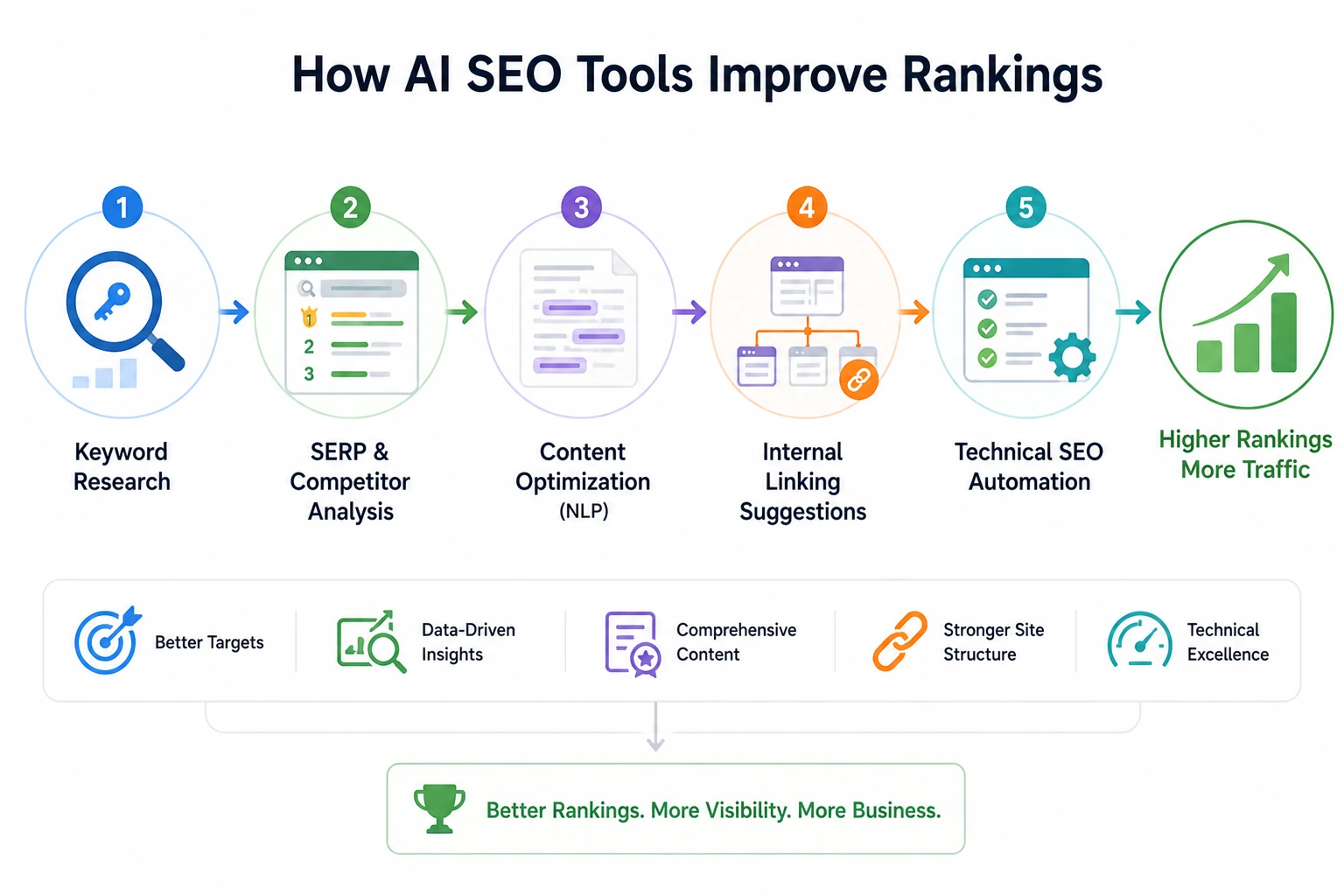
How AI SEO tools improve search rankings by automating keyword research, content optimization, internal linking, and technical SEO processes.
Understanding the mechanics behind AI SEO improvement helps you use these tools more strategically — and avoid the mistake of treating them as content generators rather than ranking systems.
Keyword Research Automation
Manual keyword research involves opening multiple tools, exporting data, cross-referencing difficulty scores, and manually assessing commercial intent. AI SEO tools collapse this into a single workflow. Ahrefs and SEMrush surface keyword clusters with difficulty scores, search volume, and intent classification in seconds. The result isn't just faster research — it's more accurate targeting, because you're working from actual ranking data rather than educated guesses.
SERP Analysis and Competitor Breakdown
For any target keyword, the top-ranking pages have already told Google what the ideal answer looks like. Tools like Frase and Surfer reverse-engineer that answer — analyzing heading structure, word count, topic coverage, and semantic term frequency across the top 10–20 results. Your content brief becomes a data-driven specification rather than a creative exercise, which is why AI-optimized content consistently outranks manually written content at the same quality level.
Content Optimization with NLP Keywords
Google's algorithm understands semantic relationships between topics. A page about "HVAC repair" that also covers "refrigerant recharge," "thermostat calibration," and "seasonal maintenance" signals deeper topical authority than a page covering only the primary topic. NLP-based optimization tools identify these semantically related terms from competitor pages and ensure your content covers the same topical breadth — which is one of the clearest patterns in pages that rank versus pages that don't.
Internal Linking Suggestions
Internal links distribute authority across your site and help Google understand content relationships. Most small business websites have poor internal linking — not from negligence, but from the practical difficulty of remembering which existing pages are relevant to link to from each new piece of content. RankMath's internal linking suggestions solve this automatically by scanning your existing content and recommending relevant link targets as you write.
Technical SEO Automation
Missing meta descriptions, unoptimized title tags, images without alt text, missing schema markup — these technical issues accumulate silently and create a performance ceiling on every page you publish. RankMath and SEMrush's site audit tools identify these issues automatically and prioritize them by SEO impact, so you fix the problems that matter rather than spending time on low-value optimization tasks.
Beginner SEO Workflow: Step-by-Step (Most Important Section)
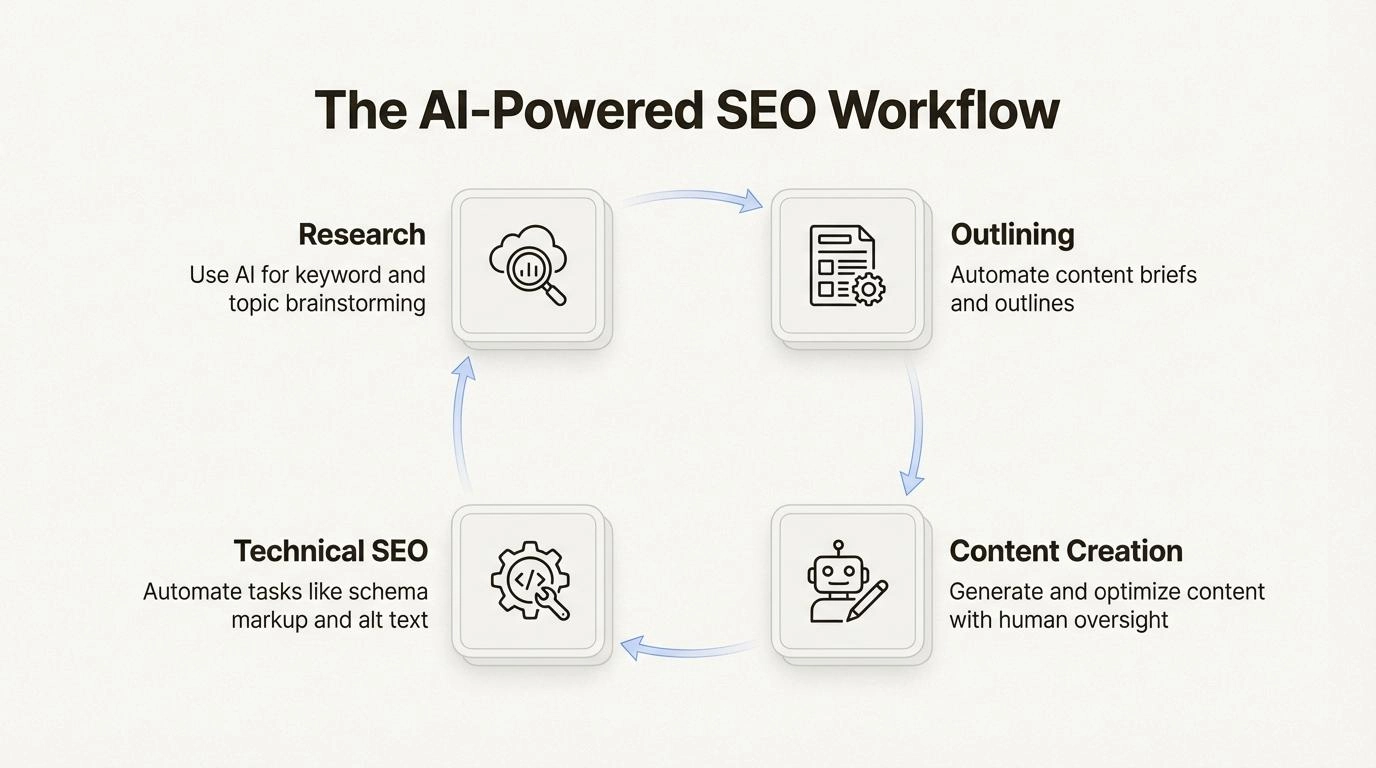
The AI-Powered SEO Workflow: A circular process focusing on automating research, content structure, and technical optimization while maintaining human oversight.
This is the workflow that compounds. Every step builds on the last, and consistent execution of this six-step process — for one article per week — is the engine behind sustainable organic traffic growth for small businesses.
Step 1: Analyze the SERP
Tool: Frase or Surfer SEO
Before writing a single word, analyze the top 10 results for your target keyword. Note: average word count, number of headings, questions answered, and which NLP terms appear across multiple top-ranking pages. This is your content specification — write to match or exceed this benchmark, not to match your intuition about what the topic requires.
Step 2: Create a Content Brief
Tool: Frase (auto-generates brief) or manual from SERP analysis
A content brief defines: target keyword, secondary keywords, suggested H2 headings (based on competitor structures), questions to answer (from People Also Ask and competitor FAQ sections), recommended word count, and NLP terms to include. Frase generates this brief automatically in under 2 minutes. For a manual brief, pull the same data from your SERP analysis in Step 2.
Step 3: Write and Optimize
Tool: Surfer SEO content editor or NeuronWriter
Write with your content score visible. In Surfer, the live score updates as you add NLP terms, adjust word count, and structure headings. Aim for a score of 70+ before publishing. Don't write to the score mechanically — use it as a quality floor, not a writing constraint. A 75-score article with a clear, useful answer to the reader's question will outperform an 85-score article stuffed with awkward keyword insertions.
Step 4: Find a Winnable Keyword
Tool: Ahrefs Webmaster Tools (free) or SEMrush
Don't target keywords with high search volume. Target keywords with low difficulty scores (under 20 for new sites) and clear commercial or informational intent. Use Ahrefs' keyword difficulty score to filter. For a new site, target keywords where the top-ranking pages have Domain Rating scores similar to or lower than yours.
Example: Instead of targeting "laptops" (KD: 95), target "best laptop for college students under $400" (KD: 12, 1,200 monthly searches).
Step 5: Add Internal Links and Schema
Tool: RankMath (WordPress)
Before publishing, use RankMath's internal linking panel to add 2–3 links to relevant existing pages on your site. Add FAQ schema to any article that answers specific questions — this makes your content eligible for FAQ rich results in Google's SERP, which improves CTR without changing ranking position. Check RankMath's on-page score and address any critical issues flagged (missing focus keyword in title, empty meta description, etc.).
Step 6: Track Rankings and Iterate
Tool: Ahrefs Webmaster Tools or Google Search Console
Check rankings after 4 weeks. If a page is ranking on page 2 or 3, it's a candidate for optimization — not a candidate for rewriting. Use Frase or Surfer to identify which NLP terms your page is missing compared to the current top-ranking page. Add those terms in a content update, strengthen internal links pointing to the page, and resubmit for indexing. Most page-2 articles can be moved to page 1 with a 30-minute optimization update rather than a full rewrite.
How to Choose the Right AI SEO Tool: Decision Framework
The right tool depends on your bottleneck — not your ambition. Use this framework:
If your bottleneck is "I don't know what to write about": → Start with Ahrefs Webmaster Tools (free) for keyword research. Add Frase ($15/month) for content briefs once you have a target keyword list.
If your bottleneck is "I write content but it doesn't rank": → Start with Surfer SEO ($89/month) or NeuronWriter ($23/month — budget alternative). Both tell you exactly what your published content is missing compared to top-ranking competitors.
If your bottleneck is "I don't know if my site has technical SEO problems": → RankMath (free, WordPress) or SEMrush's Site Audit tool. Technical issues create a ranking ceiling — fix them before investing in content production.
If your bottleneck is "I need to publish more content, faster": → Scalenut ($39/month) for workflow automation, or Frase for brief generation speed. Consistent publishing velocity at moderate optimization quality outperforms infrequent publishing at perfect optimization.
Quick recommendations by business type:
| Business Type | Primary Tool | Supporting Tool | Monthly Cost |
|---|---|---|---|
| WordPress beginner | RankMath Free | Frase Solo | ~$15/mo |
| Local service business | Frase Solo | Ahrefs Webmaster (free) | ~$15/mo |
| Content-first small business | Surfer Essential | Ahrefs Lite | ~$218/mo |
| Budget-conscious publisher | NeuronWriter Bronze | RankMath Free | ~$23/mo |
| All-in-one SEO | SEMrush Pro | — | ~$140/mo |
Best AI SEO Stacks Under $100/Month
| Business Stage | Tools Included | Monthly Cost | Primary SEO Driver |
|---|---|---|---|
| Beginner (WordPress) | RankMath Free + Frase Solo + Ahrefs Webmaster Free | ~$15/mo | On-page optimization + keyword targeting |
| Budget Growth | NeuronWriter Bronze + RankMath Free + GSC | ~$23/mo | NLP content scoring at lowest cost |
| Content Scaling | Scalenut Essential + RankMath Free | ~$39/mo | Cluster planning + AI content workflow |
| Growth Stage | Surfer Essential + Ahrefs Webmaster Free | ~$89/mo | Deep content optimization + keyword research |
| All-in-One | SEMrush Pro | ~$140/mo | Every SEO function in one platform |
| Pre-Revenue | RankMath Free + Ahrefs Free + GSC | $0/mo | Technical SEO + rank tracking at zero cost |
Start with the stack that matches your current publishing volume. Installing SEMrush at $140/month when you're publishing one article per month is poor ROI. Start with RankMath and Frase, prove the workflow works, then upgrade tools as publishing volume and results justify the investment.
→ Calculate your traffic growth potential before committing: Use the SEO ROI Calculator to model monthly visitor growth by publishing cadence and keyword difficulty target.
The Hidden Trade-Offs Behind Low-Cost AI SEO Tools
Affordable SEO tools can be a great starting point, but lower pricing often comes with limitations that only become noticeable once content production, keyword research, and team collaboration begin to scale. Evaluating these trade-offs early can prevent costly workflow disruptions later.
-
Content workflow restrictions: Tools like Frase, NeuronWriter, and Scalenut often limit the number of content briefs, optimization reports, or article analyses available each month. Teams publishing content regularly may outgrow entry-level allowances faster than expected.
-
Data quality compromises: Lower-cost SEO platforms sometimes rely on smaller or less frequently updated keyword databases. Decisions based on outdated search volume or competition metrics can lead to targeting opportunities that no longer reflect current search behavior.
-
Advanced capabilities locked behind upgrades: Many SEO tools reserve their most valuable features for higher-tier subscribers. Deep keyword research, competitor intelligence, historical data, and advanced forecasting are often unavailable on starter plans.
-
Multi-user access costs: What appears affordable for a solo user can become significantly more expensive when writers, editors, and SEO specialists all require platform access. Team-based pricing is frequently overlooked during initial budgeting.
-
Platform ecosystem dependencies: Certain tools deliver maximum value only when paired with specific platforms or workflows. Features that seem universally useful may depend on WordPress, Google Docs, or other integrations already being part of your existing setup.
-
Long-term commitment pressure: Annual plans often provide attractive discounts, but switching tools later can be difficult after processes, templates, and content workflows are built around a specific platform. Short-term savings may create long-term flexibility costs.
Common Beginner SEO Mistakes (And How AI Tools Fix Them)
Most small business SEO failures aren't caused by bad writing or insufficient budget. They're caused by five consistent mistakes that AI tools specifically address.
1. Targeting wrong keywords Publishing content around high-volume keywords your site has no realistic chance of ranking for is the most common beginner mistake. A new site with 10 pages targeting "best laptops" (KD: 95) will generate zero rankings. Ahrefs and SEMrush surface keyword difficulty scores that make winnable opportunities obvious — even for sites starting from zero authority.
2. Ignoring search intent A keyword with 2,000 monthly searches might have informational intent (user wants to learn), commercial intent (user is comparing options), or transactional intent (user is ready to buy). Publishing a purchase-focused page for an informational keyword — or a blog post for a transactional keyword — produces content that technically targets the keyword but doesn't match what the searcher actually wants. Frase's SERP analysis shows you what content format Google is rewarding for each keyword before you write a word.
3. No internal linking Most small business websites have isolated pages with no links pointing to them beyond the navigation menu. Internal links pass authority to important pages, help Google discover new content, and signal topical relationships between pages. RankMath's internal linking suggestions make this a 5-minute task per article rather than a manual audit process.
4. Publishing without optimization Writing a 600-word article without a content score, without checking competitor word counts, and without including NLP terms is the equivalent of filing a tax return without checking the numbers. Surfer, NeuronWriter, and Frase each provide the equivalent of a pre-submission checklist — flagging what's missing before you publish, when it's cheap to fix, rather than after, when you need a full rewrite.
5. Expecting fast results from competitive keywords SEO operates on a 60–180 day lag between publishing and meaningful ranking movement, depending on keyword competition and site authority. Beginners who don't see results within 30 days often abandon the channel entirely — right before their content would have started ranking. Setting realistic timelines (60 days for low-competition, 6 months for moderate-competition) and tracking leading indicators (impressions, average position) rather than just sessions prevents premature abandonment.
AI SEO Growth Framework: From Keyword Discovery to Content Expansion
Phase 1: Build a Search Visibility Foundation
Before scaling content production, establish the systems required to measure rankings, traffic, and content performance accurately.
- Configure your SEO plugin and resolve critical on-page issues across existing pages.
- Connect Google Search Console and webmaster tools to create a baseline for rankings and impressions.
- Build a focused keyword portfolio targeting achievable opportunities with clear search intent.
- Prioritize topics that align with your business goals rather than chasing search volume alone.
Phase 2: Create Your Initial Content Assets
With measurement systems in place, shift attention toward publishing content that can begin generating search visibility.
- Develop content briefs using SERP analysis and competitor research.
- Publish a small group of high-quality articles targeting your highest-priority keywords.
- Optimize titles, metadata, headings, and internal links before publication.
- Maintain a consistent publishing workflow that can be repeated as content volume grows.
Phase 3: Improve Existing Rankings
Once content begins receiving impressions, focus on pages already showing ranking potential rather than immediately creating more content.
- Review performance data to identify pages ranking near the bottom of page one or top of page two.
- Compare those pages against higher-ranking competitors to uncover missing topics and content gaps.
- Strengthen internal linking between related articles and supporting resources.
- Update existing content before investing heavily in net-new content production.
Businesses looking to connect their organic content strategy with paid acquisition can also review our guide on AI ad copy generator tools for Google & Facebook Ads, which explains how messaging consistency across SEO and advertising channels can improve overall campaign performance.
Phase 4: Scale What Produces Results
The final objective is expanding the processes already generating visibility and traffic.
- Continue publishing content around proven topic clusters.
- Double down on the optimization tactics producing ranking improvements.
- Track impression growth, ranking movement, and organic clicks against your original baseline.
- Invest further in the tool or workflow delivering the strongest measurable impact before introducing additional complexity.
Designing a High-ROI AI SEO Strategy
Before reviewing the numbers, it's worth understanding the strategic framework behind compounding SEO growth. Tools accelerate execution — but the strategy determines whether that execution builds topical authority or just produces isolated articles with no structural relationship.
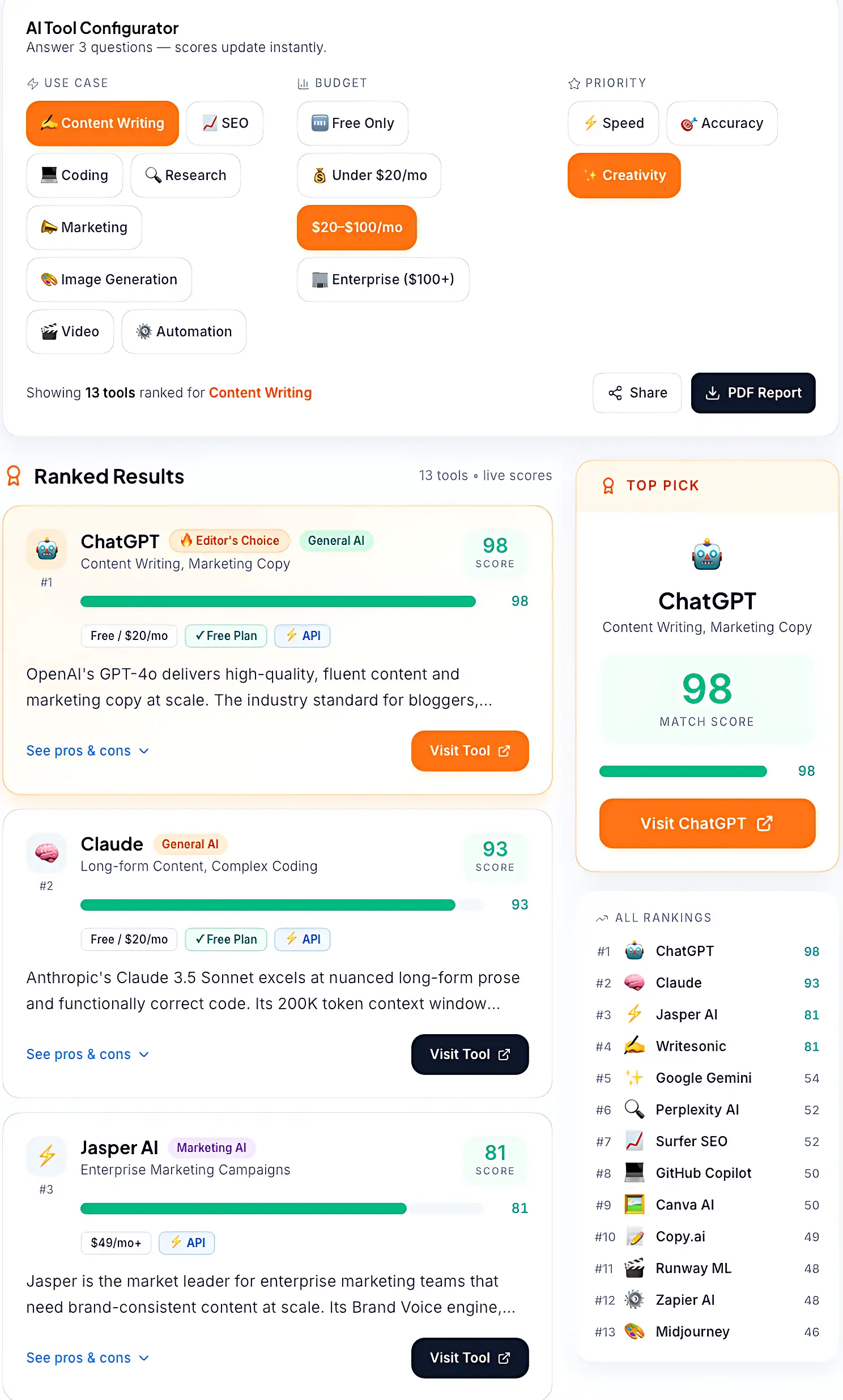
Our proprietary AI Tool Configurator in action: Filtering for high-creativity content writing tools within a specific budget to find the best match for your SaaS marketing needs.
ROI Modeling: What a $50/Month AI SEO Stack Is Actually Worth
⚠️ Hypothetical estimates only. The figures in this section are illustrative examples based on industry averages and publicly available data. Actual results vary significantly by business size, industry, tool configuration, and team adoption. These numbers are not guarantees of return.
Most small businesses underestimate SEO ROI because organic traffic value is invisible compared to paid traffic — there's no invoice for each click. Calculating the paid traffic equivalent of your organic sessions makes the value concrete.
Teams that measure SEO performance consistently from deployment day one consistently report stronger returns — because early data reveals which keywords and content types are gaining traction before competitors catch up.
A practical illustration for a local service business publishing 4 articles per month:
| ROI Driver | Calculation | Monthly Value (Month 6) |
|---|---|---|
| Organic traffic (20 ranking articles × avg 50 sessions) | 1,000 sessions/month | — |
| Paid traffic equivalent (1,000 clicks × $2.80 avg local CPC) | Ad spend saved | $2,800 |
| Lead generation (1,000 sessions × 1.1% conversion × $150 avg job value) | 11 leads × $150 | $1,650 |
| Content production time saved (Frase briefs: 4 hrs/article → 45 min) | 13 hrs × $30/hr | $390 |
| Total Monthly Value at Month 6 | $4,840 | |
| Total Stack Cost | RankMath Free + Frase Solo + Ahrefs Free | ~$15/mo |
| ROI | ((4,840 − 15) / 15) × 100 | ~32,166% |
Results compound over time — unlike paid ads, which stop the moment you stop spending. Month 12 traffic on the same stack, with no additional tool cost, is typically 3–4x Month 6 traffic as domain authority grows and more articles reach page 1.
Emerging Trends in AI SEO (2026)
The tools available today represent the current baseline. The direction the category is moving over the next 12–18 months shifts the advantage even further toward small businesses that build systematic SEO workflows now.
AI-Assisted SEO Workflows Replace Manual Research
The shift isn't that AI writes content — it's that AI handles every step between "I have a keyword idea" and "I have a publishable, optimized article." Tools like Scalenut and Frase are collapsing the research, brief, writing, and optimization phases into a single continuous workflow. For small businesses without dedicated SEO staff, this workflow compression makes consistent publishing at professional quality economically viable for the first time.
Content Optimization Becomes More Important Than Content Volume
Google's 2025–2026 algorithm updates have consistently rewarded depth of topical coverage over publishing frequency. A site with 20 deeply optimized articles covering a specific topic cluster outranks a site with 200 thin articles across scattered topics. Tools that support topical cluster planning — Scalenut and SEMrush in particular — are becoming strategically central, not just tactically useful.
Topical Authority Becomes the Primary Ranking Signal
The era of individual article ranking is giving way to the era of site-level topical authority. Google increasingly evaluates whether a domain is a credible, comprehensive source on a topic — not just whether a single page is well-optimized. AI tools that help small businesses build content clusters around core topics are the infrastructure for this shift. Building topical authority in a narrow niche is now more achievable for small sites than competing on isolated high-volume keywords.
Internal Linking Automation Closes the Technical Gap
Internal linking remains one of the most consistently underexecuted SEO tactics for small businesses — not because owners don't understand its value, but because manually auditing and adding internal links across a growing site is time-consuming. RankMath and emerging AI tools are automating this process with increasing accuracy, removing one of the last manual SEO tasks that currently requires either significant time or technical knowledge.
Invest in Consistency — Not Just Better Tools
The small businesses winning with SEO in 2026 aren't the ones with the most sophisticated tool stacks or the largest content budgets. They're the ones who treated SEO as a system — building a repeatable workflow, publishing consistently, measuring what moved, and compounding those gains week over week.
A $15–$50/month AI SEO stack, applied consistently to the six-step workflow above, can generate organic traffic that replaces $2,000–$5,000/month in paid ad spend within 6 months. That's not a projection built on best-case assumptions — it's the result the local HVAC business in the case study above achieved at $38/month in tools.
The framework above gives you the structure to execute: find winnable keywords, analyze what ranks, create optimized briefs, write and score content, add internal links, track rankings, and update underperformers. Run that loop once a week for 90 days. The results won't be immediate — but they will be compounding.
The best AI SEO tools don't succeed because they're powerful. They succeed because the business owners using them are consistent enough to build the workflow habit, disciplined enough to measure what moves, and patient enough to let the compounding work.
Organizations that formalize their AI tool evaluation process...consistently outperform those deploying SEO tools reactively without a structured review process.
The Bottom Line
AI SEO tools for small businesses are not a shortcut to rankings — they're a system for consistent, data-driven content production that compounds organic traffic over time.
A small business owner spending $15–$50/month on the right AI SEO stack and following the six-step workflow above can build meaningful organic traffic within 90 days — without an SEO agency, without technical expertise, and without a large content budget.
Start simple:
- Fix your biggest current SEO problem first — missing on-page optimization, no keyword strategy, or publishing without content scoring
- Run the six-step workflow once per week for 90 days before evaluating results
- Measure impressions and average position weekly — traffic follows rankings, and rankings follow impressions
Then scale only what produces results.
The small business owners winning with SEO in 2026 are not the ones with the most sophisticated tools. They're the ones who built the workflow habit, measured consistently, and let the compounding work.
Find winnable keywords. Optimize relentlessly. Publish consistently.