Why AI Ad Copy Tools Are Exploding in 2026
The core problem in paid advertising right now isn't budget — it's creative throughput.
Google Ads average CPCs have climbed 15–25% year-over-year in most competitive categories. Meta ad costs followed the same trajectory. The brands absorbing those increases and still growing ROAS aren't spending more — they're testing faster.
AI ad copy tools address four compounding problems that manual creative teams can't solve at scale:
- CTR improvement: AI-generated ad copy delivers 14–30% higher CTR compared to manually written ads in controlled split tests.
- ROAS lift: Brands running AI-assisted creative testing report 20–40% ROAS improvement within 60 days of consistent variant deployment.
- Time savings: AI reduces ad copy production time by 80–90% — from hours per campaign to minutes per variant set.
- Testing velocity: AI tools enable 5–10x more variant tests per month than manual creative teams — the single biggest driver of long-term performance gains.
The core shift in 2026 is this: AI ad tools are no longer about writing faster. They're about testing smarter.
For a broader view of AI marketing tool selection strategy, see: Complete Guide to Choosing AI Software for Your Business (2026 Edition).
How to Evaluate AI Ad Copy Tools: An ROI Framework
Feature lists don't improve ROAS. Before selecting any AI ad copy platform, run it through four performance filters:
-
CTR ROI: Does the tool's output demonstrably improve click-through rate? Platforms with predictive performance scoring — Anyword in particular — let you see projected CTR before you spend a dollar. A tool that adds even 1.5% absolute CTR improvement on a $5,000/month Google Ads budget compounds into significant revenue recovery.
-
Testing velocity ROI: How many variants can you generate, deploy, and rotate per week? A tool that produces 20 headline variants in 10 minutes versus 2 hours changes your entire optimization cadence. Testing velocity is the primary driver of long-term ROAS improvement — not individual copy quality.
-
Scaling cost: Map per-seat and per-word or per-generation pricing to your monthly campaign volume. Some tools charge per output; others are flat subscription. Agencies managing 20+ ad accounts need to model this carefully before committing.
-
Deployment cost: A tool with a steep prompt-engineering learning curve has a real time cost. Prioritize platforms that integrate directly with Google Ads or Meta Ads Manager — or produce output in ready-to-paste RSA and ad set format — so copy moves from generation to deployment without a manual reformatting step.
Apply these four filters before every purchase decision. They eliminate tools that look impressive in demos but don't move performance metrics in production.
The marketers seeing the highest ROAS improvement from AI tools aren't using them to write one great ad. They're using them to generate 15–20 variants per week, identify what the algorithm rewards, and systematically eliminate underperformers. Testing velocity beats copywriting skill at scale. Choose tools that make variant generation fast — not just copy that sounds good.
Top AI Ad Copy Generator Tools: Full Comparison (2026)
All tools reflect official starting plan pricing. Performance-specific AI features and ad platform integrations are prioritized.
| Tool | Starting Price | Best For | Free Tier? | Key AI Feature |
|---|---|---|---|---|
| Jasper AI | $49/mo (Creator) | Google Ads + agency teams | Trial only | Brand voice + multi-platform ad templates |
| Copy.ai | $36/mo (Starter) | Budget ad copy at scale | ✅ Yes | Automated workflows + multi-variant output |
| Writesonic | $20/mo (Individual) | Google + Meta copy fast | ✅ Limited | Chatsonic AI + Surfer SEO integration |
| AdCreative.ai | $29/mo (Starter) | Facebook + display creatives | Trial only | AI image + copy generation + score ranking |
| Anyword | $49/mo (Starter) | Google Ads CTR optimization | Trial only | Predictive performance scoring per variant |
| Pencil | $99/mo (Growth) | Meta video + static ads | Trial only | AI creative testing + spend-based learning |
→ Not sure which tool fits your ad platform? Use our AI Ad Tool Selector to get a personalized recommendation based on your monthly ad spend and platform mix.
Deep Dive: Top AI Ad Copy Generator Tools (2026)
Jasper AI
Best for: Google Ads RSA copy + agency multi-brand management
Jasper's ad copy output quality is consistently strong for search campaigns. The Google Ads template generates RSA-ready headlines and descriptions in bulk — structured within Google's 30/90 character limits by default — which eliminates the reformatting step that wastes time in manual workflows.
For agencies, Jasper's brand voice feature is the differentiator. You can store separate voice profiles for each client, so copy generated for a luxury e-commerce brand doesn't bleed the same tone as a B2B SaaS client. Campaign Briefs let you input offer details, target audience, and competitive angles once — and generate 15–20 ad variants in a single output.
Key AI Features:
- Google Ads RSA headline and description generator (character-limit aware)
- Brand voice storage for multi-client agency workflows
- Campaign Brief input → bulk variant output
- Integration with Surfer SEO for search-intent alignment
Pricing: $49/month (Creator), $125/month (Pro with collaboration features)
Pros: Best output consistency for search ad copy. Agency-grade team and brand management. Strong template library for Google, Meta, and LinkedIn ads.
Cons: Higher price point than budget alternatives. No predictive performance scoring — you're relying on human judgment or external testing to evaluate variant quality before spend.
Real ad copy example (Jasper output — Google Ads RSA headline set):
Headline 1: AI Tools That Cut Ad Costs Fast
Headline 2: 30% Lower CPC in 60 Days
Headline 3: Trusted by 10,000+ Marketers
Description 1: Stop guessing which ad copy converts. Generate 20 tested variants
in minutes and find your winner before wasting budget.
Description 2: Built for Google Ads. Character-limit ready. Start your free trial today.
Copy.ai
Best for: High-volume budget ad copy across Google and Meta
Copy.ai's strength is throughput. The automated workflow feature lets you build a repeatable ad copy pipeline — input product details, target audience, and offer once, and the system produces variant sets on demand without re-entering the brief each time. For solo marketers and small businesses running multiple campaigns simultaneously, that workflow automation is worth more than marginally better copy quality.
The free tier is genuinely useful for validation — you can test output quality against your existing ads before spending anything.
Key AI Features:
- Automated workflow builder for repeatable ad copy pipelines
- Multi-variant output per brief (headlines, primary text, CTAs)
- Facebook ad and Google Ads specific templates
- Brand voice and tone customization
Pricing: Free tier (limited), $36/month (Starter), $186/month (Advanced with workflows)
Pros: Best workflow automation for high-volume copy needs. Strong free tier for evaluation. Good output quality across both search and social ad formats.
Cons: No predictive performance scoring. Less specialized for pure ad performance than Anyword or Pencil. Advanced workflow features require the higher-tier plan.
Writesonic
Best for: Fast Google Ads and Meta copy at the lowest price point
Writesonic at $20/month is the strongest value option on this list for solo marketers and small businesses that need professional-quality ad copy without an agency budget. The Google Ads copy generator produces RSA-formatted output quickly, and the Chatsonic integration lets you iterate on variants conversationally — which speeds up the refinement process significantly.
The Surfer SEO integration is worth noting for search campaigns: it aligns ad copy with the same keyword intent signals that perform well organically, which improves Quality Score alignment over time.
Key AI Features:
- Google Ads and Facebook ad copy generators (RSA-format aware)
- Chatsonic for conversational copy iteration
- Surfer SEO integration for search-intent alignment
- Landing page copy generation (ad-to-page message matching)
Pricing: Free tier (limited), $20/month (Individual), $99/month (Teams)
Pros: Best price-to-output ratio on this list. Fast generation. Good for marketers who need both ad copy and landing page copy from the same tool.
Cons: Output consistency varies more than Jasper at scale. No predictive scoring. Team collaboration features require the higher-tier plan.
Real ad copy example (Writesonic output — Facebook Ad primary text):
Primary Text: Most ad budgets don't have a spending problem. They have a testing problem.
Writesonic generates 20 ad variants in 3 minutes — so you find your winner
before burning through your monthly budget.

Headline: Stop Guessing. Start Testing.
CTA: Try Free Today
AdCreative.ai
Best for: Facebook and display ad creative — image + copy in one workflow
AdCreative.ai solves the specific bottleneck that kills Meta ad performance at scale: producing enough visual + copy combinations to feed the algorithm without exhausting a design team. The platform generates complete ad creatives — image, headline, primary text, and CTA — scored by a proprietary AI model that ranks each variant by predicted performance before you spend anything.
For e-commerce brands running dynamic product ads or prospecting campaigns, the ability to generate 50+ scored creative variants from a product feed in under an hour changes the economics of creative testing entirely.
Key AI Features:
- AI image + copy generation in a single workflow
- Creative scoring — ranks variants by predicted CTR before deployment
- Direct Meta Ads Manager integration
- Product feed input for e-commerce dynamic creative
Pricing: $29/month (Starter — 10 credits), $59/month (Professional — 50 credits), $149/month (Ultimate)
Pros: The only tool on this list that handles image and copy together. Creative scoring feature removes guesswork from variant selection. Strong e-commerce and D2C fit.
Cons: Credit-based pricing limits volume on entry plans. Image quality is good but not pixel-perfect — brands with strict creative standards may need design review. Less suitable for text-only Google Search campaigns.
Real ad copy example (AdCreative.ai output — Facebook Ad):
Primary Text: Your competitors are testing 30 ad creatives a week. Are you?
AdCreative.ai builds and scores your next 50 Meta ad variants — images included —
before you spend a single dollar finding the winner.

Headline: 10x Your Creative Output
Sub-headline: AI-Scored. Ready to Launch.
CTA: Start Free Trial
Anyword
Best for: Google Ads CTR optimization with predictive performance scoring
Anyword is the most analytically rigorous tool on this list. Its core differentiator — predictive performance scoring — assigns a projected CTR score to each copy variant before deployment, based on a training dataset of real ad performance across industries. For Google Ads specifically, this removes the guesswork from RSA headline selection: instead of publishing 15 headlines and waiting for Google's rotation data, you can prioritize your highest-scored variants from the start.
The Data-Driven Mode connects to your existing Google Ads account and learns from your historical campaign performance to calibrate scores specifically to your audience — making predictions more accurate over time.
Key AI Features:
- Predictive performance score per copy variant (projected CTR)
- Data-Driven Mode — learns from your historical Google Ads data
- RSA headline and description generator with character-limit enforcement
- Audience persona targeting — generates copy variants for different demographic segments
Pricing: $49/month (Starter), $99/month (Data-Driven — includes Google Ads integration)
Pros: The most performance-oriented tool on this list. Predictive scoring genuinely changes decision-making speed. Data-Driven Mode compounds value over time as it learns your audience.
Cons: Full value requires the $99/month Data-Driven plan. Less useful for Meta ad creatives compared to AdCreative.ai. Predictive scores are directional, not deterministic — still requires real-world validation.
Pencil
Best for: Meta video and static ad creative testing at scale
Pencil operates at the intersection of creative production and performance data in a way no other tool on this list does. It connects to your Meta Ads account, ingests your historical creative performance data, and generates new ad concepts — including video scripts, static copy, and hook variations — based on what has actually converted for your specific brand.
For D2C e-commerce brands running Meta video ads, Pencil's spend-based learning model means the tool gets materially better the longer you use it. Brands that have connected accounts with 6+ months of spend history see significantly stronger creative recommendations than new accounts.
Key AI Features:
- Meta Ads Manager integration — learns from live spend data
- Video script + static ad copy generation
- Creative performance prediction based on brand-specific historical data
- Hook variation generator (critical for scroll-stopping Meta video ads)
Pricing: $99/month (Growth), $299/month (Scale), enterprise pricing above
Pros: Best tool for Meta video ad creative. Spend-based learning model compounds value over time. Hook generator is genuinely useful for short-form video (Reels, Stories, TikTok).
Cons: Highest price point on this list. Requires meaningful Meta ad spend history to unlock full prediction value. Overkill for small budgets or Google-only campaigns.
Mini Case Study: How an E-commerce Brand Cut CPC by 28% in 45 Days
Brand: Mid-size D2C skincare brand, $40,000/month Google Ads spend Problem: CPCs had risen 22% year-over-year. CTR on search campaigns had plateaued at 3.1%. The team was manually writing 4–6 RSA headline sets per month — not enough variant volume to meaningfully test. Tool deployed: Anyword (Data-Driven Mode, connected to Google Ads)
What they did:
- Used Anyword to generate 40 RSA headline variants per ad group (previously generating 8–10 manually)
- Prioritized the top 15 by predictive score for each ad group
- Rotated lowest-scoring headlines out after 14 days based on actual CTR data
- Ran this cycle for 6 weeks across their top 12 ad groups
Results after 45 days:
- CTR improved from 3.1% to 4.3% (+38.7% relative improvement)
- CPC dropped from $2.84 to $2.04 (−28.2%) as Quality Score improved
- Conversion rate held steady, so the CPC reduction flowed directly to ROAS
- Monthly ad savings at equivalent volume: approximately $9,600
The key insight: The performance improvement wasn't from any single great headline. It was from testing 5x more variants in the same timeframe — finding combinations the algorithm rewarded and eliminating the ones it didn't. The AI didn't replace the marketer's judgment; it gave the marketer enough data to make better judgments faster.
How AI Improves Ad Performance: The Mechanics
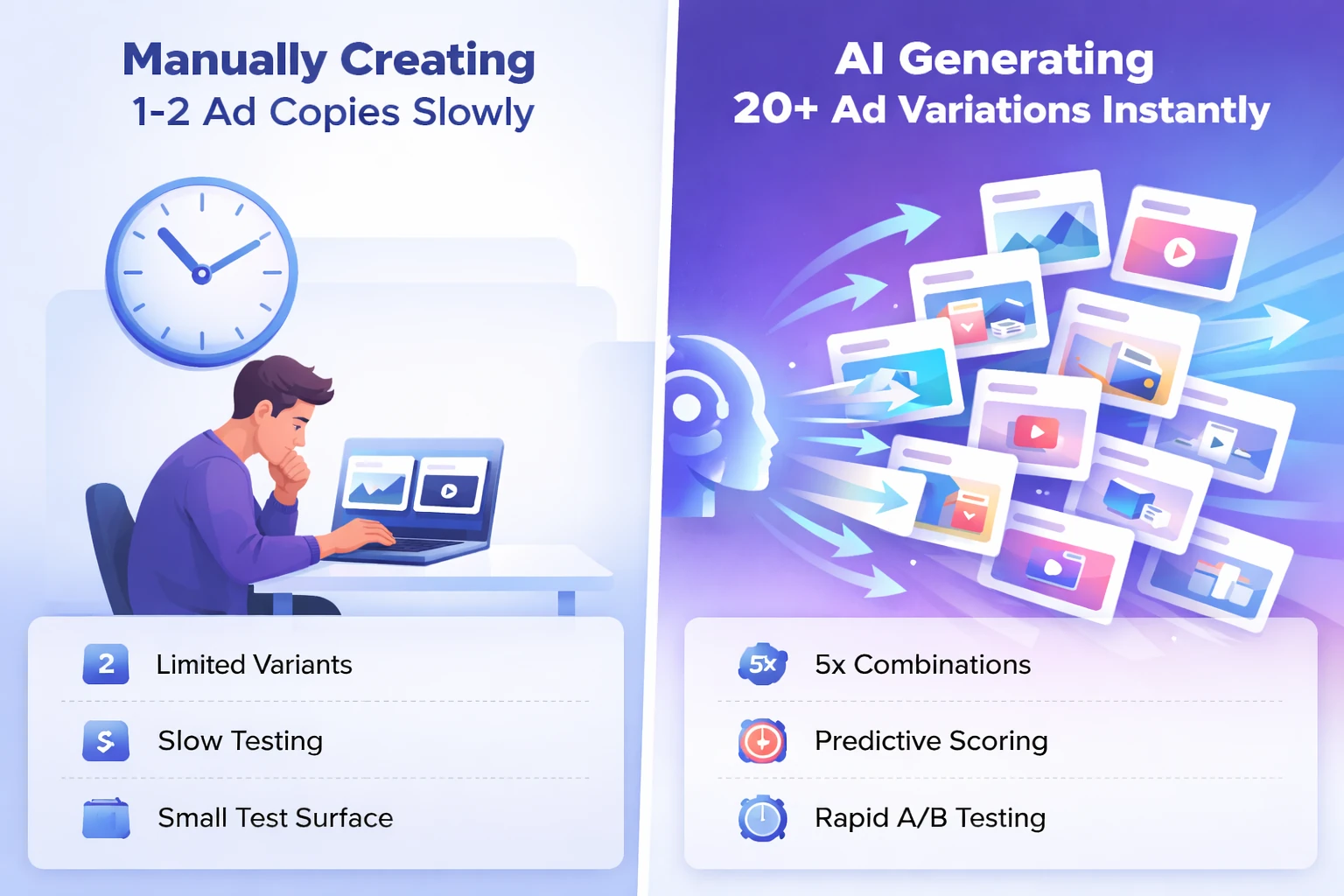
Manual creation limits testing surfaces, while AI-powered ad copy generation allows for 5x more combinations and instant predictive scoring for better ROAS.
Understanding why AI copy tools improve CTR and ROAS helps you use them more effectively — and avoid the mistake of treating them as simple writing assistants.
AI-Generated Headlines and Descriptions at Scale
The mathematical advantage is straightforward. Google's RSA format supports up to 15 headlines and 4 descriptions. The algorithm tests combinations and weights the highest-performing ones over time. A marketer generating 8 headlines manually is giving Google a limited test surface. A marketer generating 20 with AI is giving the algorithm 5x more combinations to discover — and statistically, the probability of finding a high-performing combination increases with every additional variant.
The same logic applies to Meta ad sets. More copy variants entering the auction means more surface area for the algorithm to find what resonates with different audience segments.
Predictive Performance Scoring
Tools like Anyword use training data from millions of real ad impressions to score copy variants before they go live. The score isn't perfect — no predictive model is — but it's directionally accurate enough to de-prioritize weak variants before you waste impressions on them. Over a 60-day campaign, this systematically shifts your active copy pool toward higher performers faster than manual judgment alone.
Automated A/B Testing Velocity
The bottleneck in most paid media programs isn't budget or strategy — it's creative production speed. A team that can test one new creative concept per week is working at a fraction of the optimization speed of a team testing five. AI copy tools collapse the production time for each variant from 45–90 minutes to 5–10 minutes, which directly multiplies testing velocity without increasing headcount.
Creative Optimization for Meta Ads
Meta's algorithm rewards creative diversity. Running the same ad copy across different audience segments is one of the most common performance killers in Facebook campaign management. AI tools like AdCreative.ai and Pencil generate audience-specific copy variations automatically — matching the language, tone, and offer framing to different demographic or interest segments — which improves relevance scores and reduces CPM over time.
How to Choose the Right AI Ad Copy Tool: Decision Framework
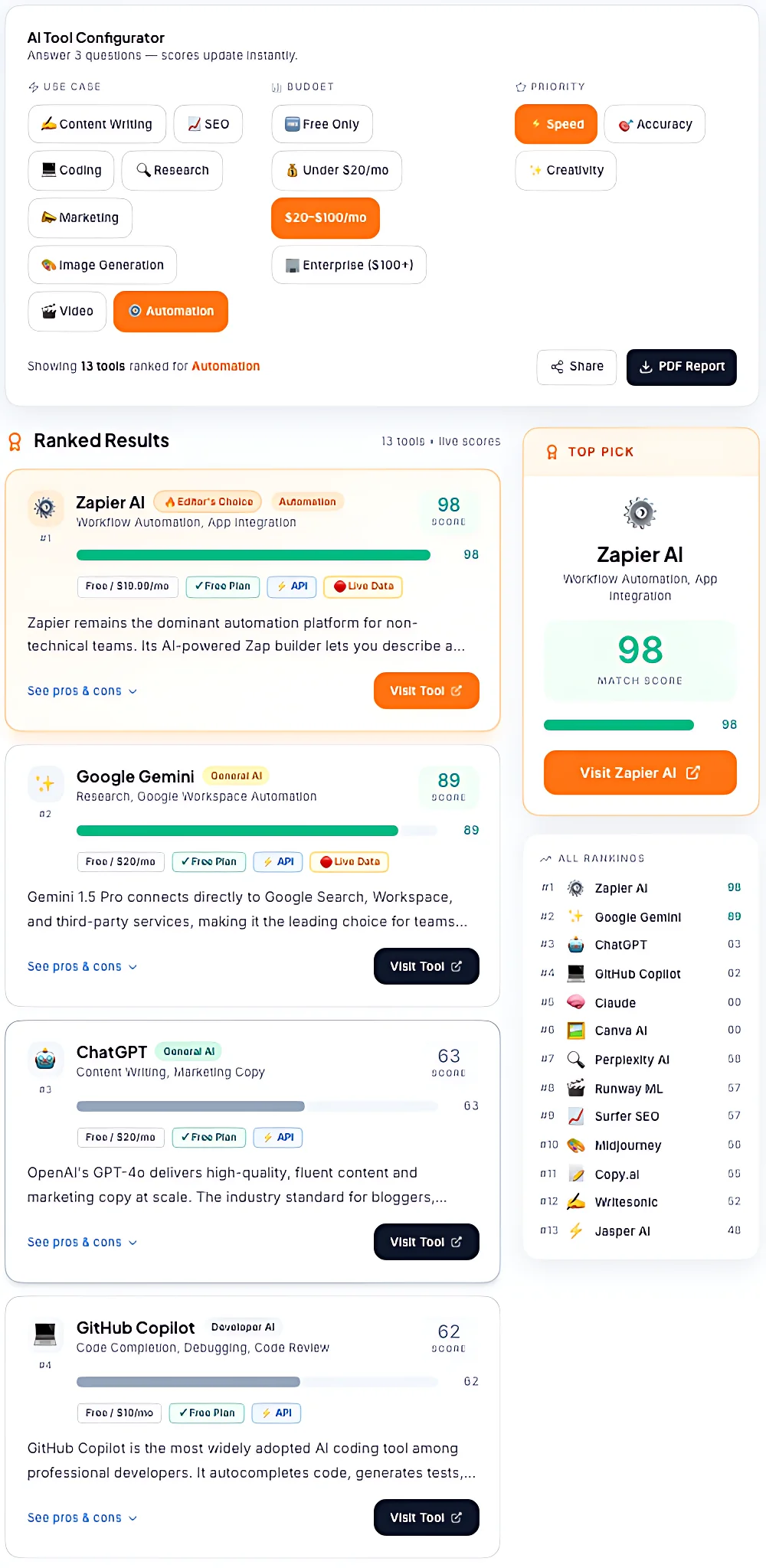
The Techaigoz AI Tool Configurator: Our interactive ranking system that evaluates AI software based on specific use cases, budget constraints, and performance priorities.
With six strong tools on this list, the decision comes down to one question: which tool improves your specific performance metric fastest, given your platform and budget?
Use this framework:
If your primary goal is Google Ads CTR improvement: → Start with Anyword ($49–$99/month). The predictive scoring feature is the fastest path to higher Quality Scores and lower CPCs. Connect Data-Driven Mode to your existing account for calibrated predictions.
If your primary goal is Meta Ads ROAS improvement: → Start with AdCreative.ai ($29–$59/month) for image + copy creative testing, or Pencil ($99/month) if you're running video ads at meaningful spend levels and want spend-based learning.
If you're running both Google and Meta Ads for multiple clients: → Jasper AI ($49–$125/month) is the best agency tool — brand voice management, team collaboration, and strong output across both ad platforms.
If budget is the primary constraint: → Writesonic ($20/month) or Copy.ai ($36/month) deliver professional-quality output at the lowest price points. Neither has predictive scoring, but both generate enough variant volume to meaningfully improve testing velocity.
Quick recommendations by use case:
| Use Case | Primary Tool | Supporting Tool | Monthly Cost |
|---|---|---|---|
| Solo Google Ads marketer | Anyword | ChatGPT Plus | ~$69/mo |
| Solo Meta Ads marketer | AdCreative.ai | Copy.ai | ~$65/mo |
| Ecommerce brand (both platforms) | AdCreative.ai | Anyword | ~$78/mo |
| Agency (multi-client) | Jasper AI | AdCreative.ai | ~$78/mo |
| Budget / small business | Writesonic | Copy.ai Free | ~$20/mo |
Best AI Ad Copy Stacks Under $150/Month
| Marketer Type | Tools Included | Monthly Cost | Primary Performance Driver |
|---|---|---|---|
| Solo Google Ads Marketer | Anyword Starter + ChatGPT Plus | ~$69/mo | Predictive CTR scoring + RSA headline scale |
| Solo Meta Ads Marketer | AdCreative.ai Pro + Copy.ai | ~$95/mo | Image + copy creative testing at volume |
| Ecommerce Brand | AdCreative.ai + Anyword Starter | ~$78/mo | Cross-platform variant testing + ROAS optimization |
| Agency (Multi-Client) | Jasper Pro + AdCreative.ai Starter | ~$154/mo | Brand voice management + creative production |
| Budget / Small Business | Writesonic Individual + Copy.ai Free | ~$20/mo | Fast copy production at lowest cost |
| Pre-Revenue / Testing | Copy.ai Free + Writesonic Free | $0–$20/mo | Validate copy concepts before launch spend |
Start with the stack that matches your current ad spend level and platform mix. Spending $99/month on Pencil when you're running $500/month in Meta ads is poor ROI. Spending $29/month on AdCreative.ai when you're running $20,000/month is undersized for the problem.
→ Calculate your exact performance impact before committing: Use the Ad Copy ROI Calculator to model CTR lift and monthly savings by ad spend level and tool combination.
Why AI Ad Copy Tools Can Cost More Than Expected
AI ad copy platforms often look affordable when comparing monthly subscription prices, but the real expense is usually tied to campaign scale, testing volume, and team usage. Before choosing a plan, it's worth understanding how these tools become more expensive as advertising operations grow.
-
Creative production limits: Tools such as AdCreative.ai often allocate a fixed number of creative generations rather than unlimited usage. Teams running continuous A/B testing campaigns can consume these allowances much faster than expected.
-
Premium feature paywalls: Some of the most valuable optimization capabilities are reserved for higher-tier plans. Advanced performance insights, predictive scoring, and data-driven recommendations may require a significant upgrade beyond the advertised entry price.
-
Collaboration cost growth: Many AI copywriting platforms price access on a per-user basis. As more marketers, media buyers, and account managers need access, software costs increase alongside team expansion.
-
Client and brand management restrictions: Agencies frequently discover that lower-tier plans support only a limited number of brand profiles or workspaces. Managing multiple clients often requires moving to more expensive plans sooner than anticipated.
-
Monthly generation thresholds: Starter plans commonly place limits on how much content can be created within a billing cycle. High-volume ad testing programs can reach these thresholds quickly, especially across multiple campaigns and channels.
-
Advertising ecosystem dependencies: Connecting AI tools with platforms such as Google Ads, Meta Ads, or other marketing systems may require premium integrations, higher subscription tiers, or additional third-party services that increase the overall operating cost.
AI Ad Copy Rollout Framework: From Testing to Scale
Phase 1: Expand Your Testing Capacity
Most advertisers don't struggle because of poor ideas—they struggle because they aren't testing enough variations. The first objective is to increase the volume of ad copy entering your campaigns.
- Connect your preferred AI copy platform and enable available performance integrations.
- Generate multiple headline and description variations for your highest-priority campaigns.
- Label AI-generated assets separately so results can be evaluated independently.
- Create a recurring review process to replace underperforming variants with new AI-generated tests.
Phase 2: Identify Winning Messaging Patterns
After collecting sufficient performance data, focus on understanding why certain messages outperform others. Businesses looking to improve customer retention alongside acquisition should also explore our guide on AI email marketing tools for small businesses, which covers automated sequence optimization and cross-channel marketing consistency.
- Analyze your best-performing headlines and group them by angle (offer-led, urgency, social proof, benefit-driven, question-based, etc.).
- Generate new variations based on proven patterns rather than assumptions.
- Document recurring themes that consistently drive clicks and engagement.
- Build a reusable messaging library for future campaigns and seasonal promotions.
Phase 3: Scale Across Channels and Audience Segments
Once a repeatable testing process exists, expand successful messaging into additional campaigns and audience groups.
- Adapt winning ad concepts for other advertising platforms.
- Create audience-specific variants for prospecting, retargeting, and customer retention campaigns.
- Test messaging tailored to different stages of the buyer journey.
- Use AI to accelerate segmentation without significantly increasing production time.
Phase 4: Measure Business Impact
The final step is validating whether AI-generated copy improves business outcomes—not just click metrics.
- Compare CTR, CPC, conversion rate, and ROAS against your original baseline.
- Identify which AI-assisted campaigns delivered the strongest performance lift.
- Remove tools or workflows that fail to create measurable impact.
- Double down on the highest-performing process before introducing additional automation layers.
Designing a High-ROAS AI Ad Copy Strategy
Before running the ROI numbers, it's important to understand the strategic framework behind AI-driven ad performance. The tools are the execution layer — the strategy determines whether that execution compounds into ROAS improvement or just produces more mediocre copy faster.
ROI Modeling: What a $100/Month AI Ad Copy Stack Is Actually Worth
⚠️ Hypothetical estimates only. The figures in this section are illustrative examples based on industry averages and publicly available data. Actual results vary significantly by business size, industry, tool configuration, and team adoption. These numbers are not guarantees of return.
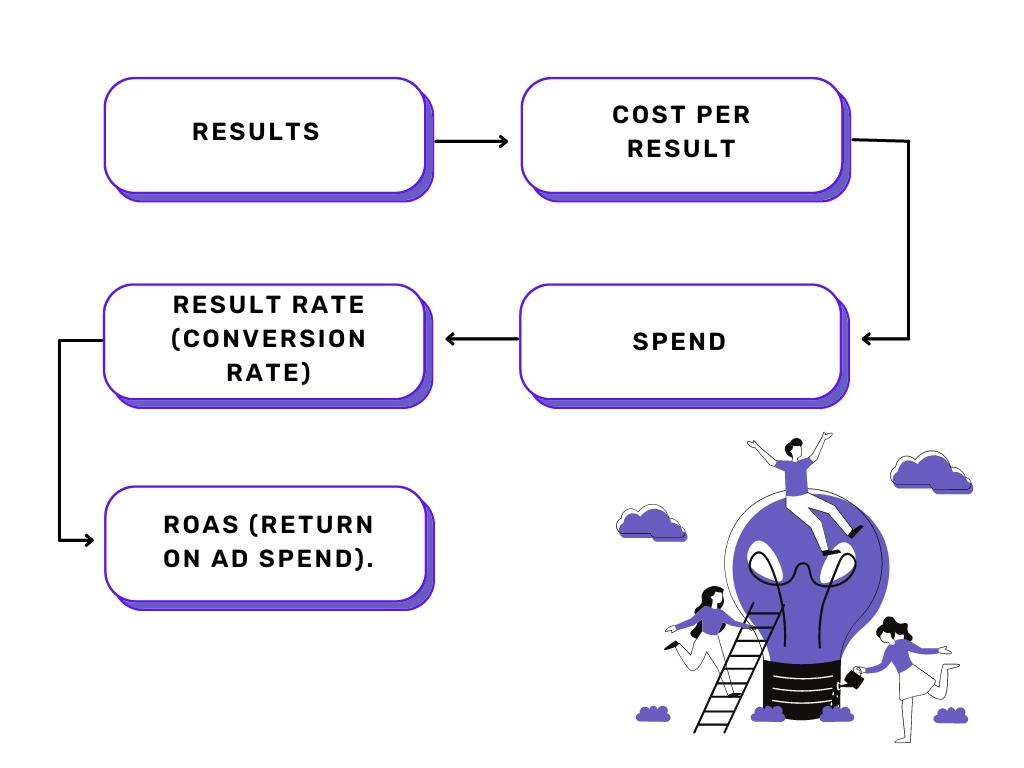
Visualizing the digital marketing performance tracking loop: Mapping how core campaign metrics interact to determine final Return on Ad Spend (ROAS).
Most performance marketers underestimate the ROI of AI copy tools because they calculate the tool cost against writing time saved — and miss the much larger impact of systematic CTR improvement on campaign economics.
Teams that define performance KPIs before deployment and measure consistently within the first 60 days see the highest returns from AI ad tools — turning upfront investment into compounding efficiency gains.
A practical illustration for a performance marketer managing $15,000/month in Google Ads spend:
| ROI Driver | Calculation | Monthly Value |
|---|---|---|
| CTR improvement (Anyword: +1.8% absolute on 50,000 impressions) | 900 additional clicks × $2.40 avg CPC saved | $2,160 |
| CPC reduction via Quality Score lift (+0.4 QS on top 5 ad groups) | 15% CPC reduction × $15,000 spend | $2,250 |
| Copy production time saved (8 hrs/week → 1 hr/week) | 28 hrs × $40/hr equivalent | $1,120 |
| Conversion lift (better message-match: +12% on 200 monthly conversions) | 24 additional conversions × $35 avg margin | $840 |
| Total Monthly Return | $6,370 | |
| Total Stack Cost | Anyword Data-Driven + ChatGPT Plus | ~$119/mo |
| ROI | ((6,370 − 119) / 119) × 100 | ~5,253% |
Conservative assumptions throughout. Actual returns depend on current baseline CTR, campaign structure quality, and testing cadence discipline — not tool selection alone.
Emerging Trends in AI Ad Copy (2026)
The current generation of tools is impressive. The direction the category is moving over the next 12–18 months shifts the advantage even further toward marketers who adopt early.
AI Testing Replaces AI Writing as the Core Value Proposition
The early narrative around AI ad tools was "write faster." The 2026 reality is different: the most valuable AI capability in paid media is systematic variant testing at a velocity no human creative team can match. Tools that score, rotate, and eliminate underperforming copy automatically — without waiting for a human to pull the data and make the decision — are becoming the performance standard, not the exception.
Predictive Scoring Systems Mature Into Real-Time Optimization
Early predictive scoring tools gave you a number before you launched. The next generation connects to live campaign data and adjusts scores in real time based on actual impression and click performance — essentially closing the loop between prediction and measurement continuously. Anyword is furthest along this path today; expect the capability to become table stakes across the category within 18 months.
Creative Automation Expands to Image, Video, and Copy in One System
AdCreative.ai and Pencil already combine visual and copy generation. The emerging category is full creative automation — where a single tool inputs a product, audience, and offer, and outputs a complete set of tested ad variants across formats (static, video, carousel, search) without separate workflows for each. This collapses the creative production bottleneck that currently requires design, copy, and strategy resources working in parallel.
AI-Driven Campaign Optimization at the Account Level
The frontier is AI that operates above the ad level — optimizing budget allocation, bid strategy, audience targeting, and copy simultaneously based on a defined ROAS or CPA goal. Tools like Google's Performance Max and Meta's Advantage+ are early versions of this. Third-party AI platforms are beginning to layer on top of these native tools with more granular control and cross-platform intelligence.
Invest in Testing Velocity — Not Just Better Copy
The performance marketers winning in 2026 aren't the ones with the best copywriters or the biggest creative teams. They're the ones who treat AI ad tools as testing infrastructure — generating more variants, finding winners faster, and systematically eliminating underperformers before they drain budget.
A $70–$120/month AI ad stack, built specifically around your primary ad platform and performance goal, compounds ROAS over time in a way that a single well-written ad campaign never will. That's not a feature claim — it's arithmetic. Higher CTR means lower effective CPC. Lower CPC at the same conversion rate means higher ROAS. And higher ROAS on the same budget means you scale spend into winning campaigns rather than spreading budget across guesses.
The framework above gives you the structure to make those decisions well: evaluate on performance metrics, deploy in a 60-day testing cycle, measure against a pre-AI baseline, and cut tools that don't move the numbers. Start with your highest-spend campaign and your worst-performing ad group. Fix that first. Then scale.
The best AI ad copy tools don't succeed because they write elegant headlines. They succeed because the marketers using them are disciplined enough to test systematically, measure consistently, and double down on what the algorithm rewards. That discipline — not the tools — is the real performance advantage.
Organizations that formalize their AI tool evaluation process...consistently outperform those deploying tools reactively without a measurement framework.
Final Thoughts
AI ad copy tools are not about writing better headlines. They're about systematic testing infrastructure that compounds ROAS over time.
A performance marketer spending $70–$120/month on the right combination of AI ad tools — matched to their primary platform and performance goal — can generate more variant tests per month, find winning combinations faster, and eliminate budget waste on underperforming copy before it drains the account.
Start simple:
- Solve your biggest ad performance problem first — low CTR on Google, creative fatigue on Meta, or manual copy production bottleneck
- Track CTR, CPC, and ROAS weekly for the first 60 days against a pre-AI baseline
- Remove tools that don't produce measurable performance lift
Then scale only what moves the metrics.
The performance marketers winning with AI in 2026 are not the ones with the most sophisticated tech stack — they're the ones with the most disciplined testing cadence, the clearest performance baselines, and the habit of doubling down on what the algorithm rewards.
Evaluate on performance. Test systematically. Measure from day one.