

Why Selection Matters More Than Spend
AI email marketing tools for small businesses are no longer a niche investment — they're the highest-ROI channel in digital marketing, delivering $36–$42 for every $1 spent. Email marketing has always outperformed other channels, but in 2026, AI has fundamentally changed what small teams can execute. According to industry benchmarks, average email open rates have reached ~43%, and AI-assisted campaigns consistently outperform manually managed ones across every measurable metric.
The barrier to entry has collapsed — and with it, the excuse to delay.
The challenge for small business owners evaluating AI email platforms isn't access. It's selection. The wrong tool at $49/month that goes unused is more expensive than the right tool at $99/month that automates your entire nurture sequence. This guide cuts through the noise with an ROI-first evaluation framework, a curated comparison of the best AI email marketing tools in 2026, and budget stack templates built for solo operators, growing businesses, and e-commerce brands.
- Channel ROI: Email marketing returns $36–$42 per $1 spent — the highest ROI of any digital marketing channel.
- Engagement lift: AI-optimized emails achieve 22% higher open rates and 13% higher click-through rates than manual campaigns.
- Revenue impact: Businesses using AI personalization report up to 41% revenue increase from email alone.
- Automation advantage: Automated email sequences significantly outperform one-off broadcast campaigns across open rate, CTR, and conversion.
The goal: build an AI email stack under $100/month that operates like a $3,000/month email marketing team expansion.
For a broader view of AI marketing tool selection strategy, see: Complete Guide to Choosing AI Software for Your Business (2026 Edition).
How to Evaluate AI Email Marketing Tools: An ROI Framework
Price is the wrong starting metric. Before selecting any AI email platform for your small business, run it through four filters:
-
Time ROI: How many hours per week does this save? A tool that automates segmentation, subject line testing, and send scheduling — recovering 8 hours at a $30/hour equivalent — creates $960/month in value. A $25/month subscription at that return is a 38x investment.
-
Revenue ROI: Does it generate pipeline or improve conversion? AI email personalization typically lifts open rates 15–25%. At $20,000/month in e-commerce revenue, a 2% conversion lift from better sequences is worth $400/month — enough to justify most starter plans.
-
Scaling cost: Map contact-based and seat-based pricing to your 12-month list growth plan, not today's subscriber count. A platform affordable at 1,000 contacts can triple in cost at 10,000 — with no additional feature unlock. Know the curve before you commit.
-
Deployment cost: A $15/month tool requiring two weeks of developer integration is not cheap. Prioritize platforms deployable within 48 hours without engineering support.
Apply these four filters before every purchase decision. They eliminate AI email tools that look affordable on the surface but erode ROI silently over time.
Don't choose tools based on feature lists — choose based on outcomes. Ask one question before every purchase: "Which tool makes me money fastest?" A $99/month platform that automates your entire onboarding sequence and recovers churning subscribers delivers far more value than a $20/month tool you use only for broadcast emails.
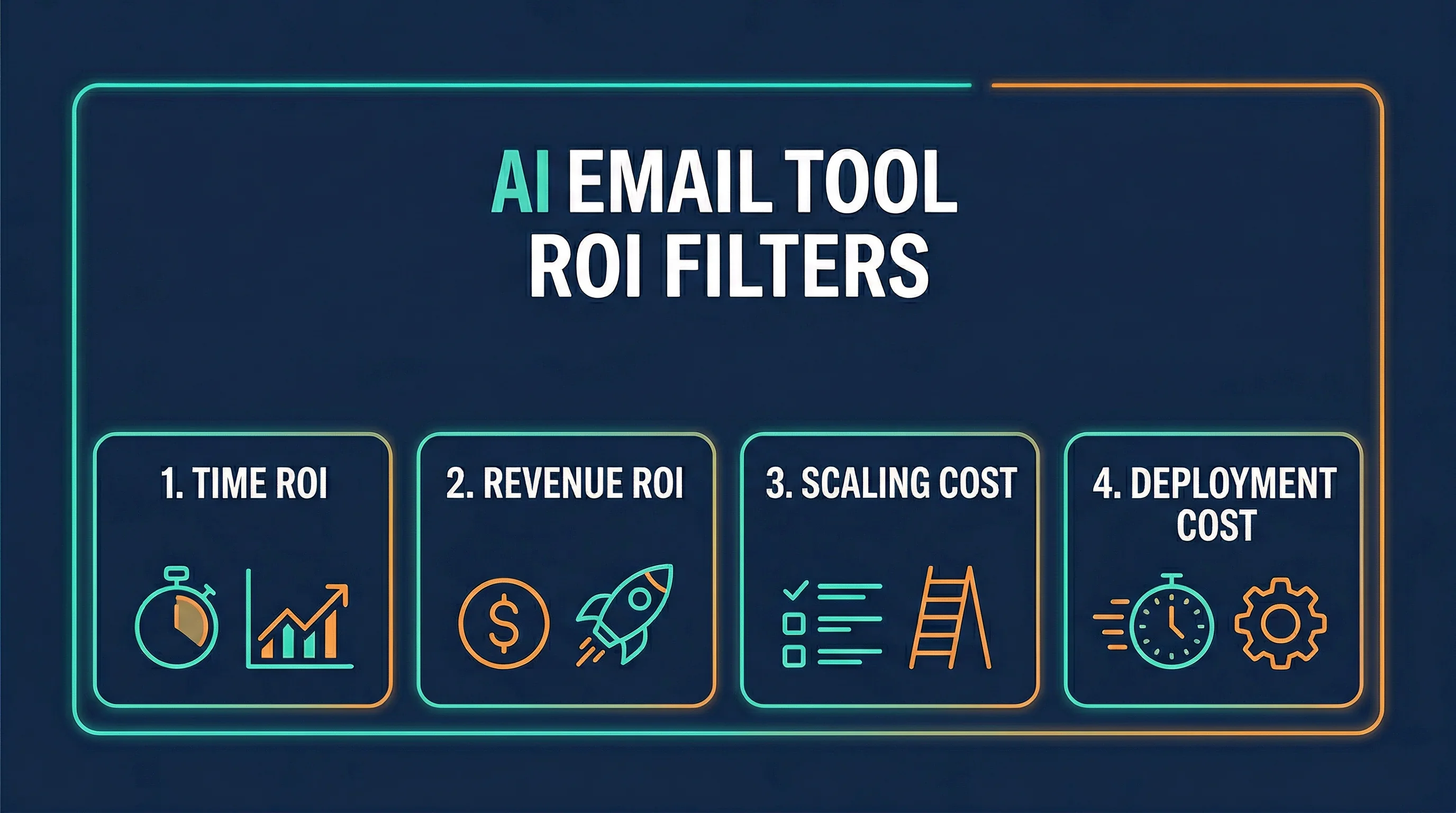
The four-stage ROI framework for evaluating AI email marketing software.
Top AI Email Marketing Tools for Small Businesses: Full Comparison (2026)
All tools reflect official starting plan pricing. Free tier availability and small business use cases are prioritized.
| Tool | Starting Price | Best For | Free Tier? | Key AI Feature |
|---|---|---|---|---|
| Mailchimp | $13/mo (Essentials) | Beginners + fast setup | ✅ Yes | Predictive segmentation + send-time AI |
| ActiveCampaign | $15/mo (Starter) | Automation + lead nurturing | Trial only | AI automation builder + behavioral targeting |
| HubSpot | $20/mo (Starter) | CRM + email integration | ✅ Full CRM | Predictive lead scoring + omnichannel AI |
| Klaviyo | $20/mo (Email) | E-commerce revenue | ✅ Limited | Predictive analytics + automated flows |
| Brevo | $25/mo (Starter) | Budget-friendly automation | ✅ Yes | AI email generation + SMS automation |
| GetResponse | $19/mo (Email Marketing) | Funnels + lead generation | ✅ Limited | AI email builder + funnel automation |
| Zoho Campaigns | $3/mo (Standard) | Zoho ecosystem users | ✅ Yes | CRM-based automation + workflow builder |
→ Not sure where to start? Use our AI Email Tool Selector to get a personalized platform recommendation in under 30 seconds.
Best AI Email Marketing Tools by Use Case
Beginners and Fast Setup
Mailchimp ($13/month) is the default starting point for most small businesses — and for good reason. Its AI-powered predictive segmentation automatically groups your audience based on purchase history and engagement behavior, so you're not manually tagging contacts from day one. The send-time optimization feature identifies when each subscriber is most likely to open, and the AI campaign assistant drafts subject lines and body copy based on your goals.
Pair it with ChatGPT Plus ($20/month) for deeper copy generation and Canva Pro ($15/month) for branded email visuals. This three-tool stack handles the full email creation and delivery workflow for under $50/month. Small businesses scaling beyond Mailchimp's contact pricing should explore Brevo ($25/month) — its pricing is based on email volume, not list size, which makes it significantly more cost-effective as your audience grows.
Automation and Lead Nurturing
ActiveCampaign ($15/month) is the strongest automation platform on this list. Its AI automation builder constructs multi-step sequences based on behavioral triggers — page visits, link clicks, purchase history, and inactivity windows — without requiring a developer to configure the logic. Predictive sending ensures each contact receives emails at their individual optimal time, not a one-size-fits-all broadcast window.
CRM and Omnichannel Integration
HubSpot ($20/month Starter) is built for businesses that want email marketing and CRM in a single system. Its predictive lead scoring assigns scores to contacts based on behavior — identifying who's ready to buy before your sales team reaches out. The AI chatbot handles inbound lead qualification, and omnichannel automation connects email sequences with SMS, ads, and live chat into a unified workflow.
For a detailed feature and pricing comparison across AI CRM platforms, see the Best AI CRM Software for Small Businesses (2026 Guide).
E-commerce Revenue Optimization
Klaviyo ($20/month) is purpose-built for e-commerce brands. Its predictive analytics engine forecasts each contact's next purchase date, lifetime value, and churn risk — then uses those predictions to trigger the right email at the right moment. Automated flows for cart abandonment, post-purchase follow-up, and win-back sequences run continuously in the background, generating revenue without manual input.
A practical example: a D2C brand running Klaviyo's cart abandonment flow on 500 monthly abandoned carts at a 15% recovery rate and $85 average order value recovers $6,375/month — at a $20/month tool cost. Klaviyo is less well-suited for non-e-commerce businesses, where ActiveCampaign or HubSpot will deliver stronger ROI.
Budget-Friendly Automation
Brevo ($25/month) is the strongest value option on this list for small businesses that need both email and SMS automation without paying for separate platforms. Its AI email generation drafts campaigns based on goal and audience inputs, and the free tier handles 300 emails per day before you spend anything — making it genuinely useful for pre-revenue and early-stage teams.
GetResponse ($19/month) adds funnel automation and webinar integration to the standard email toolkit, making it a strong fit for coaches, course creators, and service businesses that use lead magnets and webinars as acquisition channels.
Zoho Ecosystem Users
Zoho Campaigns ($3/month) delivers the best per-dollar value on this list for businesses already using Zoho CRM or Zoho One. CRM-based automation triggers email sequences directly from deal stage changes and contact activity — no manual sync required. The workflow builder handles standard nurture and re-engagement sequences effectively, though the interface is less polished than Mailchimp or ActiveCampaign. For Zoho users, it's the obvious starting point before evaluating external platforms.
Best AI Email Marketing Stacks Under $100/Month
| Business Type | Tools Included | Monthly Cost | Primary ROI Driver |
|---|---|---|---|
| Solo / Small Business | Mailchimp + Canva Pro + ChatGPT Plus | ~$48/mo | Fast setup + branded content at scale |
| Growing Business | ActiveCampaign + ChatGPT Plus | ~$35/mo | Deep automation + lead nurturing |
| E-commerce Brand | Klaviyo + ChatGPT Plus | ~$40/mo | Revenue-focused flows + cart recovery |
| Budget / Pre-Revenue | Brevo Free + ChatGPT Free + HubSpot CRM Free | $0–$20/mo | Validate sequences + build list |
| CRM-Integrated Team | HubSpot Starter + ChatGPT Plus | ~$40/mo | Pipeline acceleration + omnichannel nurture |
| Content-First Business | GetResponse + Canva Pro + ChatGPT Plus | ~$54/mo | Funnel automation + lead magnet delivery |
Start with the stack that matches your current stage, not your aspirational one. Overbuilding your email stack early is as damaging as underbuilding — every unused subscription is pure overhead.
What “Affordable” AI Email Marketing Tools Don’t Tell You About Scaling Costs
Email marketing tools often appear cost-effective at the entry level, but the pricing model becomes more complex as your audience, campaigns, and automation depth increase. The real cost is usually tied to how fast your marketing funnel grows, not just the plan you start with.
-
Subscriber-driven pricing jumps: Platforms like Mailchimp, HubSpot, and GetResponse scale pricing directly with list size. As your funnel grows from a few thousand to tens of thousands of contacts, costs increase significantly even if your campaign strategy remains unchanged.
-
Send frequency limitations: Lower-tier plans often restrict how many emails you can send per month. Businesses running weekly newsletters combined with onboarding or promotional sequences can quickly approach or exceed these limits.
-
AI feature usage thresholds: AI-driven tools such as subject line optimization, predictive send times, and content suggestions are often limited by credit systems. Once these internal quotas are used up, continued optimization requires plan upgrades.
-
Automation workflow constraints: Many platforms restrict the number of active automation paths on basic plans. As you build multi-step funnels (welcome, nurturing, re-engagement), these limits become a structural bottleneck.
-
Advanced testing feature barriers: Features like A/B testing at scale, multivariate testing, or advanced timing optimization are typically locked behind higher pricing tiers, making performance optimization more expensive as you grow.
-
Third-party integration overhead: While integrations with platforms like Shopify or Salesforce appear seamless, deeper functionality often depends on paid connectors or higher-tier plans, especially when syncing complex customer data flows.
Creating a Sustainable AI Email Marketing System
Establish a Strong Foundation Before Scaling
Successful email automation starts with a well-organized subscriber database and a platform that matches your business model. Whether you use Mailchimp, ActiveCampaign, or Klaviyo, proper audience segmentation and contact organization are more important than advanced automation features during the initial setup stage.
Prioritize Automated Customer Journeys
The highest-performing email programs rely on automated sequences rather than one-off campaigns. Welcome series, onboarding emails, and nurture workflows consistently generate stronger engagement because they deliver relevant messages at the right stage of the customer journey. Building these foundational automations creates long-term value without increasing ongoing workload.
Measure Performance With Reliable Tracking
Before optimizing campaigns, ensure every email interaction can be measured accurately. Configure Google Analytics 4, apply consistent UTM parameters, and establish baseline metrics for open rates, click-through rates, conversions, and revenue contribution. Reliable measurement is essential for evaluating the real impact of AI-assisted optimization.
Focus on Revenue Growth and Retention
Once core automations are operating smoothly, expand into higher-impact lifecycle campaigns. Cart recovery, customer re-engagement, lead nurturing, and retention workflows often generate the strongest return because they target contacts who have already demonstrated interest. AI can improve timing, personalization, and audience selection, but the strategy should remain centered on customer behavior and business objectives.
Continuously Evaluate Results and Improve Efficiency
Email marketing technology should be reviewed regularly against measurable outcomes. Monitor subscriber engagement, conversion performance, revenue attribution, and list health. Retain tools and workflows that consistently improve results, refine underperforming campaigns, and prioritize investments that strengthen customer retention and long-term lifetime value.
Designing a High-ROI AI Email Strategy
Before running the numbers, it's worth understanding the framework behind a winning AI email strategy. It's not just about which platform you choose — it's about sequencing the right message, to the right segment, at the right moment in the customer lifecycle.
ROI Modeling: What a $100/Month AI Email Stack Is Actually Worth
⚠️ Hypothetical estimates only. The figures in this section are illustrative examples based on industry averages and publicly available data. Actual results vary significantly by business size, industry, tool configuration, and team adoption. These numbers are not guarantees of return.
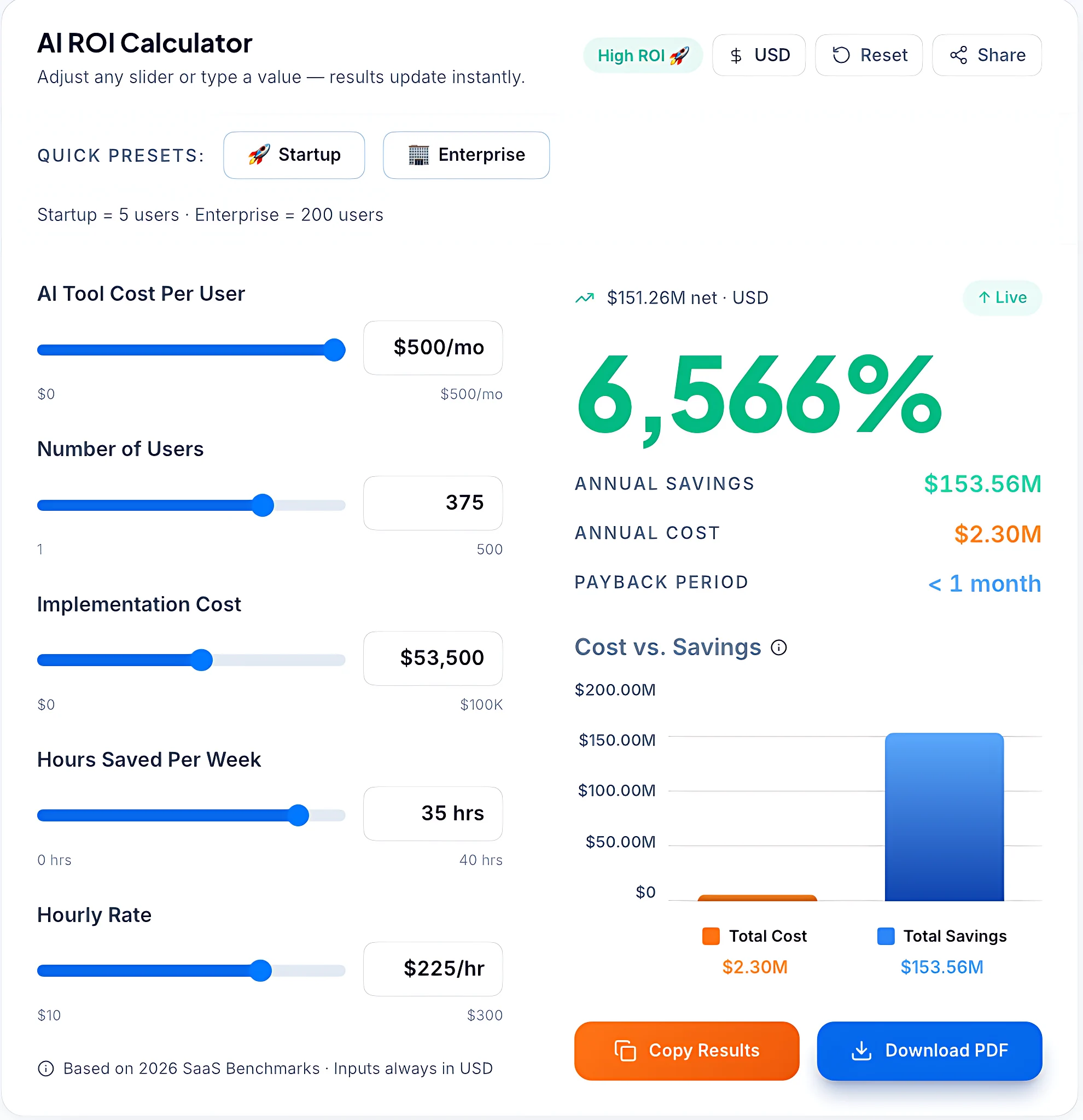
Real-time ROI modeling showing the significant revenue impact of automated AI email workflows.
Most small businesses underestimate email ROI because they track tool cost but not the value of recovered time, automated revenue, and prevented churn.
A practical illustration for a 3-person e-commerce brand running $25,000/month in revenue:
| ROI Driver | Calculation | Monthly Value |
|---|---|---|
| Cart abandonment recovery (Klaviyo: 15% on 400 carts) | 60 recovered × $85 AOV | $5,100 |
| Time saved on campaign creation (ChatGPT: 6 hrs/week) | 24 hrs × $30/hr | $720 |
| Re-engagement sequence (win-back: 8% on 500 lapsed) | 40 reactivated × $60 avg order | $2,400 |
| Open rate lift (AI send-time: +22% on 5,000 list) | Modeled 1% CTR improvement × $25 avg order | $125 |
| Total Monthly Return | $8,345 | |
| Total Stack Cost | Klaviyo + ChatGPT Plus + Canva Pro | ~$55/mo |
| ROI | ((8,345 − 55) / 55) × 100 | ~15,072% |
Conservative assumptions throughout. Actual returns depend on list quality, sequence design, and offer strength — not tool selection alone.
→ Want real numbers for your specific setup? Use the Email Marketing ROI Calculator to model your returns before investing.
Emerging Trends in AI Email Marketing (2026)
The tools available today are impressive. What's developing over the next 12–18 months is even more significant for small business marketers.
AI Runs the Entire Campaign Workflow
The shift in 2026 isn't just AI writing subject lines — it's AI managing entire campaign calendars. Tools are now capable of determining who to email, what to send, when to send it, and how to follow up based on individual response patterns. Small teams that previously needed a dedicated email strategist can now operate at the same sophistication level with a single platform and a clear goal.
Predictive Send-Time Optimization at the Individual Level
Early send-time optimization worked at the audience level — finding the best window for the majority. The current generation of AI operates at the individual subscriber level, identifying each contact's personal optimal send window based on months of behavioral data. The result is materially higher open rates with zero additional effort from the marketing team.
Agentic Lead Nurturing
The next frontier in AI email marketing is fully agentic nurture — where the AI system decides the next best action for each contact in real time, without waiting for a human to configure a new sequence. Instead of pre-built automation trees, agentic tools dynamically route contacts based on live behavioral signals. Several platforms are already in early deployment of this capability, and adoption will accelerate significantly through 2027.
Invest in ROI — Not Just Cheap Email Tools
The small businesses winning with AI email marketing in 2026 aren't the ones using the most tools or spending the most money. They're the ones who treat platform selection as a revenue decision — with the same discipline they apply to hiring, product development, and customer acquisition.
A $40–$100/month email stack, built against your actual conversion bottlenecks, can eliminate the need for a dedicated email marketing hire and outperform manual campaigns on every measurable metric. That's not a feature claim — it's arithmetic. Recovered revenue plus saved hours, minus the tool subscription, is the only calculation that matters.
The framework above gives you the structure to make those decisions well: evaluate on ROI, deploy in phases, measure before expanding, and cut fast when tools don't perform. Start with your biggest email problem — abandoned carts, inactive subscribers, or manual campaign creation. Solve that first. Then scale.
The best AI email marketing tools don't succeed because they're cheap. They succeed because the business owners using them are disciplined enough to measure, iterate, and double down on what works. That discipline — not the tools themselves — is the real competitive advantage.
The Bottom Line
AI email marketing tools are not about finding the cheapest platform — they're about building a stack that generates measurable revenue from day one.
A small business spending $40–$100/month on the right combination of AI email tools can match the output of a dedicated email marketing hire — and outperform manual campaigns on open rate, conversion, and revenue recovery across every automation type.
Start simple:
- Solve your biggest email problem first — cart abandonment, inactive list, or manual campaign creation
- Track open rate, CTR, and attributed revenue weekly for the first 60 days
- Remove tools that don't produce measurable results
Then scale only what works.
The small business owners winning with AI email in 2026 are not the ones with the largest lists or the most complex automations — they're the ones making disciplined, ROI-grounded decisions about what to build and what to cut.
Evaluate rigorously. Automate deliberately. Measure from day one.


