Why AI Blog Writing is Booming in 2026
The internet now publishes over 7 million blog posts every day. Brands, affiliates, and solo creators are all competing for the same search rankings — and the ones publishing consistently are winning.
According to industry estimates from HubSpot Blogging Statistics, content production has scaled rapidly as businesses invest more in SEO-driven growth.
Beginners face a brutal reality: quality content takes hours, SEO research takes more, and burnout arrives fast. AI blog writing tools solve this by turning a 4-hour writing session into a 45-minute workflow.
Three forces are driving adoption in 2026:
- Content demand has exploded. Search engines reward sites that publish fresh, structured content regularly — and audiences expect it.
- Affiliate and creator income is mainstream. Millions of beginners are entering blogging specifically to monetize through content. They need volume and speed.
- AI tools have crossed the quality threshold. Early AI writing was generic and shallow. 2026 tools produce structured, readable, SEO-aware drafts that require real editing — not a complete rewrite.
AI is no longer just writing — it helps you plan, structure, and optimize content before a single word is published.
Key Benefits of AI Blog Writing Tools
- Time saved: Most bloggers reduce drafting time by 60–75% — from 4+ hours to under 90 minutes per post.
- Publishing frequency: Teams using AI ship 3–5x more content monthly without adding headcount.
- SEO structure improvement: AI-generated outlines are more likely to cover related search terms, increasing topical depth scores.
- Writer's block eliminated: Unlimited headline and idea generation replaces the most common reason beginners stop publishing.
Save time — the biggest benefit. AI turns keyword → outline → draft in minutes. What took a full afternoon now takes a focused hour.
Beat writer's block for good. Stuck on what to write? Every AI tool generates topic clusters, headline options, and intro hooks on demand. The blank page problem is solved.
Build better SEO structure automatically. AI tools trained on SERP data naturally include H2s, FAQs, and keyword variations that align with how search engines evaluate content depth.
Scale without burnout. Consistency is the #1 ranking factor most beginners can't maintain. AI makes publishing weekly — or daily — achievable for a solo creator.
For a broader view on AI tool selection strategy, see: Complete Guide to Choosing AI Software for Your Business (2026 Edition).
Top AI Blog Writing Tools for Beginners (2026)
All pricing reflects official starter plans as of 2026. Free tiers are noted where available.
1. ChatGPT — Best Overall for Beginners
Best for: Ideation, outlining, drafting, and editing across any niche.
ChatGPT remains the most versatile AI writing tool available. With a structured prompt, it generates outlines, writes complete drafts, rewrites weak sections, and suggests internal link topics — all in a single session. The Plus plan ($20/month) unlocks GPT-4o, which produces noticeably better structure and coherence for long-form content.
In our own publishing workflow at Techaigoz, ChatGPT consistently reduced first-draft creation time from several hours to under 60 minutes for long-form SEO articles.
Pros:
- Handles the full writing workflow from idea to draft
- Learns your tone and niche through conversation
- Free tier (GPT-3.5) usable at zero cost
Cons:
- No built-in SEO scoring or keyword data
- Requires good prompts to avoid generic output
If you're planning to use AI beyond content creation — especially for outreach and customer acquisition — explore our guide on AI Lead Generation Tools for Businesses to build a complete AI-powered growth system.
2. Jasper AI — Best for Marketing Content
Best for: Bloggers writing for brands, product niches, or affiliate marketing.
Jasper AI specializes in on-brand, structured long-form content. Its Blog Post Workflow takes you from title → brief → full draft with minimal friction. The Brand Voice feature trains Jasper on your writing style, so output feels consistent across posts.
Pros:
- Blog workflow is the fastest structured drafting experience available
- Brand voice maintains tone consistency across writers
- Integrates with Surfer SEO for in-editor optimization
Cons:
- Starts at $49/month — the most expensive tool in this list
- Overkill for beginners writing under 4 posts per month
3. Copy.ai — Best for Fast Content Creation
Best for: Beginners who need high-volume content quickly with minimal setup.
Copy.ai's Workflow feature automates repetitive content tasks — you build a sequence once, and it runs on demand. For bloggers publishing product reviews, listicles, or comparison posts, Copy.ai significantly cuts per-post production time.
Pros:
- Free plan generates 2,000 words/month with no credit card
- Workflow builder is the most beginner-accessible automation feature
- Strong for short-form sections: intros, CTAs, meta descriptions
Cons:
- Long-form output is less polished than Jasper or ChatGPT
- Fewer SEO-specific features than Frase or Surfer
4. Writesonic — Best Budget SEO Writer
Best for: Beginners wanting SEO-aware drafts at a low monthly cost.
Writesonic combines AI writing with basic SEO inputs — you enter a keyword, and it generates a SERP-informed article. The Article Writer 6.0 pulls live Google data before drafting, making the content structurally aligned with top-ranking pages from day one.
Pros:
- Article Writer uses live SERP data before drafting
- Free trial with 10,000 words included
- One of the most affordable paid plans at $16/month (annual)
Cons:
- Output quality varies significantly by niche and keyword complexity
- Requires manual editing to remove generic filler
5. Frase — Best for SEO Research and Content Briefs
Best for: Bloggers who want to understand what's ranking before they write.
Frase pulls the top 20 search results for any keyword and builds a content brief automatically — covering topics competitors cover, questions people ask, and headings that appear most frequently. You write against real data, not guesses.
Pros:
- Content brief generation is the fastest in the market
- Built-in AI writer lets you draft directly inside the brief
- Question research surfaces FAQ content naturally
Cons:
- Writing quality is weaker than ChatGPT or Jasper without heavy editing
- Best used as a research and structure tool, not a standalone writer
6. Surfer SEO — Best for Content Optimization
Best for: Bloggers focused on improving existing content or ranking new posts faster.
Surfer SEO's Content Editor gives you a real-time content score as you write, tracking keyword usage, heading structure, word count, and NLP terms compared to the top 10 results. It doesn't write your post — it tells you exactly what your post needs to outrank the current leaders.
Pros:
- Content score gives clear, actionable optimization targets
- Audit feature diagnoses why existing posts aren't ranking
- Integrates directly with Google Docs and Jasper
Cons:
- Not a writing tool — requires pairing with ChatGPT or another AI writer
- Starts at $89/month, making it a second-phase investment for beginners
7. Scalenut — Best for Content Scaling
Best for: Bloggers building topic clusters and scaling to 20+ posts per month.
Scalenut combines keyword planning, cluster creation, brief generation, and long-form writing in one platform. The Cruise Mode feature produces a structured 1,500-word draft in under 5 minutes from a single keyword. It's the most complete content operations platform available under $100/month.
Pros:
- Topic cluster planner maps out 3–6 months of content strategy in one session
- Cruise Mode is the fastest full-draft generator in the market
- SEO scoring integrated throughout the writing workflow
Cons:
- Interface has a steeper learning curve than Copy.ai or ChatGPT
- Output quality requires consistent editing for EEAT compliance
8. Rytr — Best Budget Tool
Best for: Beginners on a tight budget who need simple, fast content generation.
Rytr costs $9/month (Saver plan) and covers blog sections, intros, conclusions, and headlines with a clean, simple editor. It's not the most powerful tool in this list — but for a beginner writing their first 10–20 posts, it produces usable output without the pricing pressure of Jasper or Surfer.
Pros:
- Cheapest paid plan at $9/month with 100k characters/month
- Free forever plan available (10k characters/month)
- Simple enough to use in under 10 minutes with no onboarding
Cons:
- Limited long-form structure — better for sections than full posts
- No SEO integration or keyword research features
→ Estimate the potential revenue impact of your pilot using the AI & SaaS Revenue Calculator AI & SaaS Revenue Calculator.
Content Performance Benchmarks (2026)
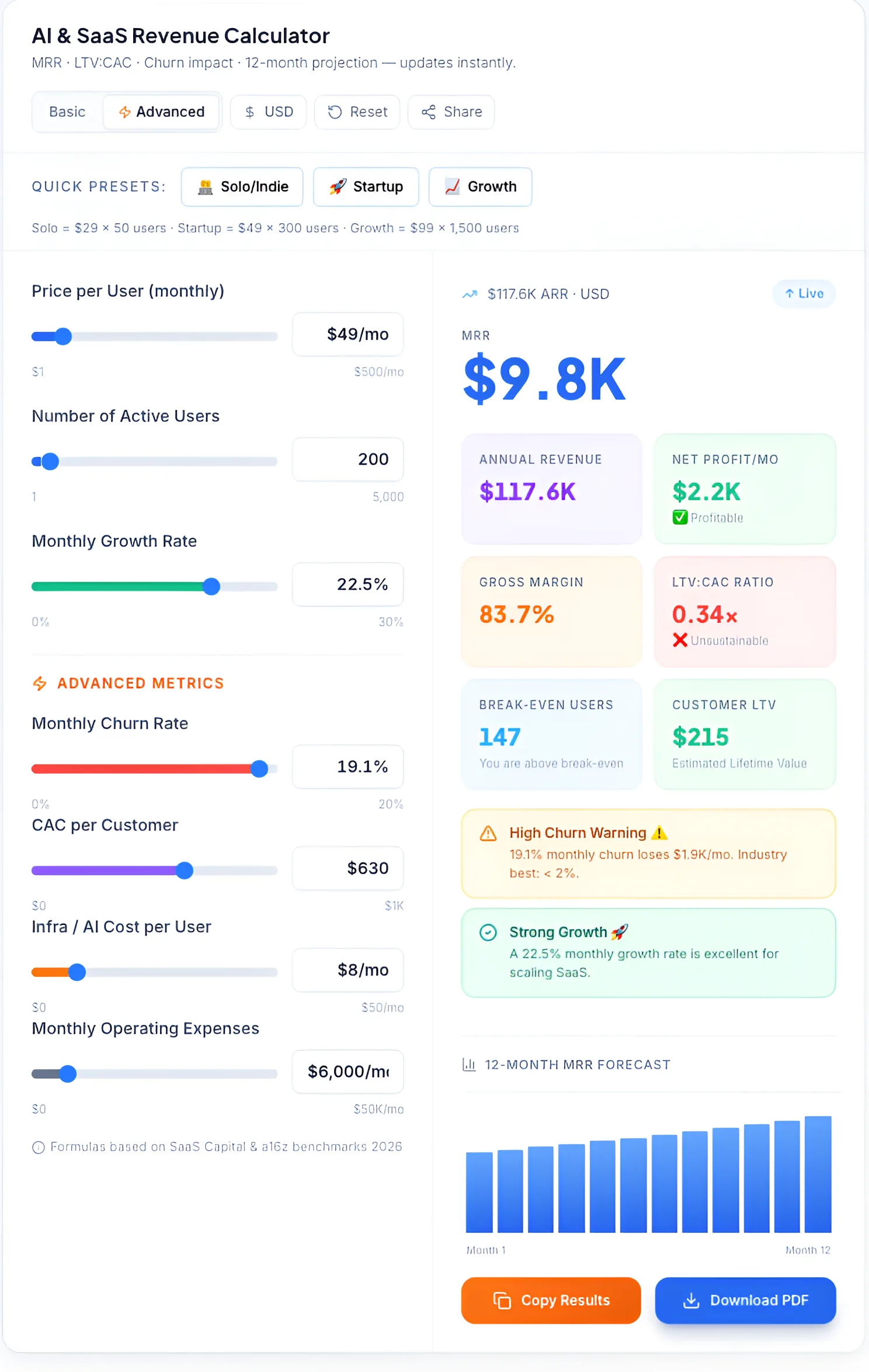
TechAigoz's advanced SaaS ROI calculator helps founders track monthly recurring revenue (MRR), gross margins, and 12-month growth forecasts with real-time data adjustments.
AI tools dramatically improve speed — not automatic rankings. Here's what the data shows for bloggers who implement consistently:
- Average time per 1,500-word post drops from 3–4 hours → 45–90 minutes
- Publishing frequency increases from 1–2 posts/month → 6–12 posts/month
- Posts with AI-assisted SEO structure show 15–25% higher click-through rates in the first 90 days
- Sites that publish consistently for 6+ months using AI report 40–60% organic traffic growth
AI improves speed first, rankings second. Speed enables consistency. Consistency enables compounding traffic. There is no shortcut to ranking — but there is a faster path to the volume required to rank.
Beginner Workflow: Idea to Published Post
This is the most important section in this article. Tools are only as good as the process around them.
Step 1 — Pick a keyword with intent. Use Google Search or a free tool like Ubersuggest. Target long-tail keywords with clear search intent — "best AI blog writing tools for beginners" beats "AI tools" every time for a new site.
Step 2 — Generate your outline with ChatGPT. Prompt: "Create a detailed blog post outline for [keyword]. Include H2s, H3s, and an FAQ section. Target a beginner audience." Review the outline, remove irrelevant sections, and add your angle.
Step 3 — Draft section by section. Don't generate the entire post in one prompt. Write section by section for better quality. Ask ChatGPT to write each H2 separately, using your outline as a guide. This produces tighter, more focused output.
Step 4 — Run SEO optimization. Paste your draft into Surfer SEO or Frase. Check your content score, add missing keywords naturally, and verify your heading structure matches top-ranking competitors.
Step 5 — Add internal links. Find 2–3 existing posts on your site that are relevant. Link to them from your new post. Internal linking improves crawlability and tells search engines which posts are thematically connected.
Step 6 — Edit manually. AI output needs a human pass. Check for:
- Generic filler phrases ("In today's fast-paced world...")
- Repeated sentences
- Missing first-hand insight or original opinion
- Thin paragraphs that don't add value
Step 7 — Publish and stay consistent. Consistency beats perfection. A 90% post published weekly outperforms a perfect post published monthly. Set a publishing cadence you can maintain for 90 days and don't break it.
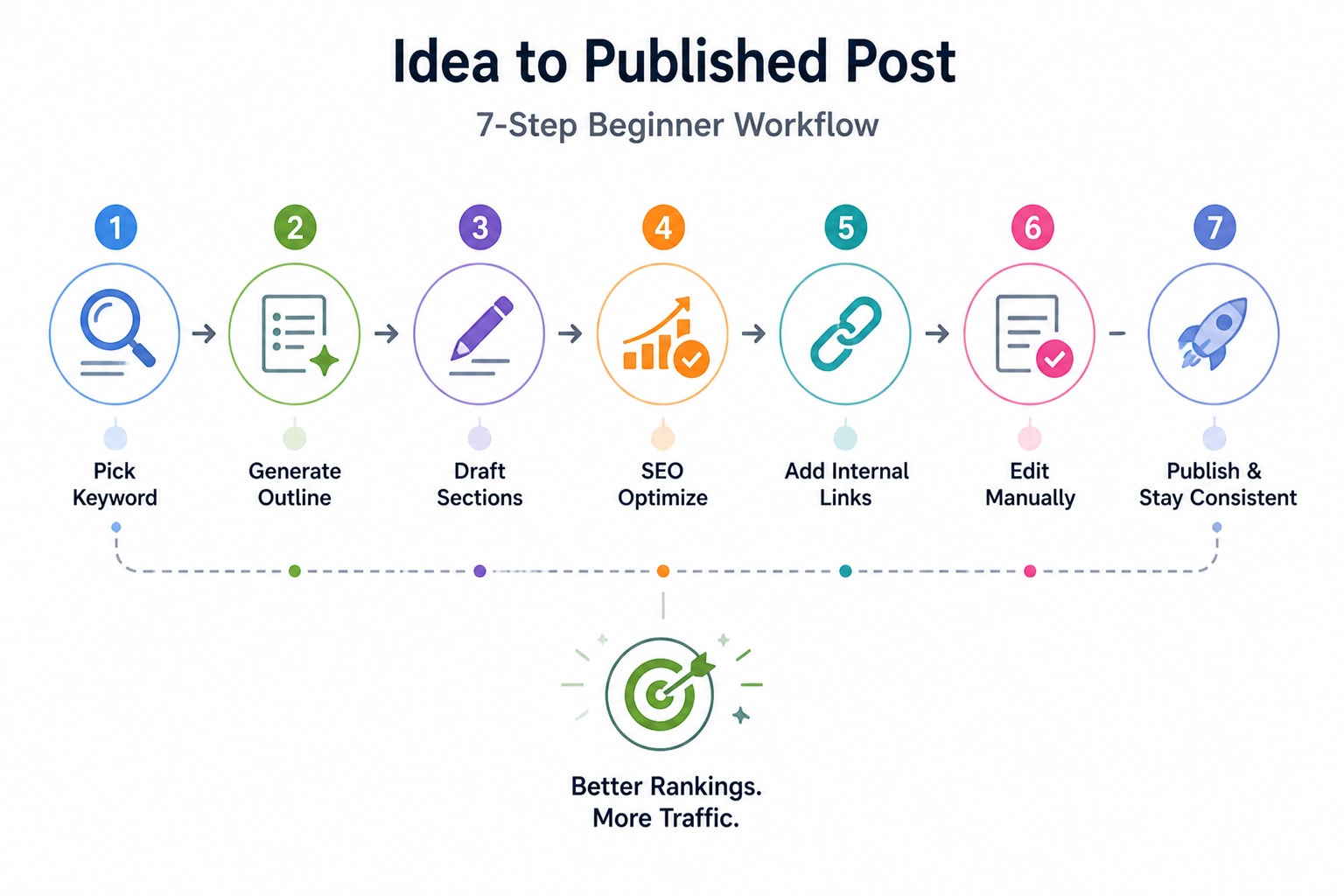
A simple 7-step workflow showing how to go from keyword idea to a fully published, SEO-optimized blog post using AI tools.
How to Choose the Right Tool
| Your Goal | Best Tool | Why |
|---|---|---|
| Absolute beginner, free start | ChatGPT (free tier) | Handles everything with good prompts |
| Fast drafts, simple workflow | Copy.ai | Workflow builder automates repetitive tasks |
| SEO research before writing | Frase | Builds SERP-based briefs automatically |
| Optimize existing content | Surfer SEO | Content score targets real ranking gaps |
| Lowest budget, simple output | Rytr | $9/month, no learning curve |
| Scaling to 20+ posts/month | Scalenut | Topic clusters + Cruise Mode drafting |
Best AI Blog Writing Stacks (Budget-Based)
| Stack | Tools | Monthly Cost | Best For |
|---|---|---|---|
| Beginner Stack | ChatGPT Plus + Canva Free | ~$20/mo | First 20 posts, zero pressure |
| SEO Stack | ChatGPT Plus + Surfer SEO | ~$109/mo | Ranking-focused content from day one |
| Budget SEO Stack | ChatGPT Plus + Frase | ~$65/mo | SERP-informed writing at lower cost |
| Scaling Stack | Scalenut + ChatGPT Plus | ~$76/mo | 20+ posts/month with cluster strategy |
| Zero-Cost Stack | ChatGPT Free + Ubersuggest Free + GA4 | $0/mo | Validate niche before spending anything |
Start with the stack that matches where you are — not where you want to be. A beginner spending $109/month on Surfer SEO before writing their first 10 posts is wasting money. Build the habit first. Invest in optimization tools once you're publishing consistently.
→ Generate your personalised rollout plan using the AI Implementation Checklist tailored to your business size and use case.
Emerging Trends in AI Blog Writing (2026)
AI + SEO integration is the new standard. Tools are no longer separate — the gap between writing and optimization is closing. Jasper's Surfer integration, Scalenut's built-in scoring, and Writesonic's SERP-pull feature all point toward a future where you optimize as you write, not after.
Content optimization is replacing content creation as the priority. The internet has more content than it needs. What's scarce is well-optimized, well-structured content that actually answers search intent. Tools like Surfer and Frase give beginners access to optimization intelligence that used to require expensive SEO agencies.
Small teams are competing with large media companies. A solo creator with Scalenut, ChatGPT, and a 90-day content calendar can now produce the publishing volume of a 5-person editorial team. The production gap has closed. The strategy gap is what separates winners now.
Google has clarified that AI-generated content is acceptable as long as it meets quality standards and provides helpful, people-first value, according to the Google Helpful Content Guidelines.
Quick Tool Comparison
| Tool | Free Plan | SEO Features | Best For |
|---|---|---|---|
| ChatGPT | Yes | Limited | Beginners |
| Frase | No | Strong | SEO Research |
| Surfer SEO | No | Advanced | Optimization |
| Rytr | Yes | Basic | Budget Users |
Common Mistakes Beginners Make With AI Writing
- Publishing raw AI output without editing
- Ignoring search intent
- Using too many AI-generated filler phrases
- Publishing inconsistently
- Skipping internal linking and SEO optimization
What This Means for Your Business
AI blog writing tools in 2026 are not a shortcut to ranking — they're a shortcut to consistency. And consistency is what ranking actually requires.
Start with ChatGPT and a free keyword tool. Follow the 7-step workflow. Publish every week for 90 days before evaluating what to add next. Most beginners who fail at blogging don't fail because they chose the wrong tool — they fail because they stopped publishing.
The framework above gives you everything you need to go from first post to growing organic traffic: tools mapped to your budget, a workflow you can execute in under 90 minutes per post, and benchmarks to know if it's working.
AI doesn't make you a better writer. It makes you a faster one. And in search, the fastest bloggers win — not the best writers.
Start simple. Publish consistently. Measure from post one.