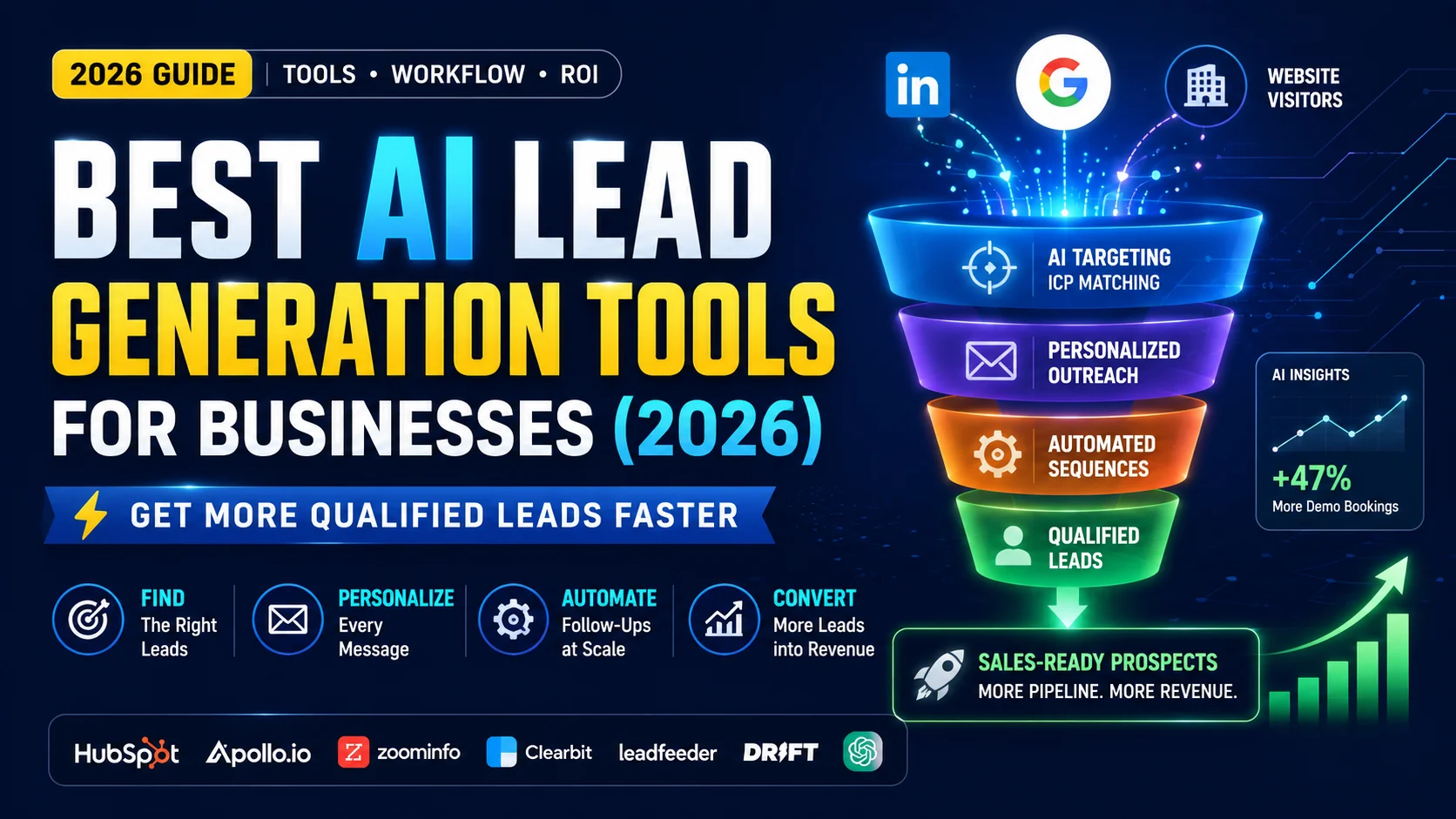
Why AI Lead Generation Is Booming in 2026
Manual prospecting is dying. Not gradually — quickly.
The average B2B sales rep spends 21% of their week on data entry and 17% on manual lead research, according to Salesforce's State of Sales report. That's nearly 40% of selling time consumed by tasks that AI tools now handle in minutes. Meanwhile, cost per lead has increased 20–30% across most B2B categories over the past two years as competition for the same buyer attention intensifies.
The shift isn't just about efficiency. The core problem with manual lead generation was never volume — it was quality.
- Lead quality: Businesses using AI-powered ICP targeting report 50% more sales-ready leads compared to manual prospecting at the same volume.
- Cost per lead: AI-assisted outreach reduces customer acquisition cost (CAC) by up to 60% through better targeting and automated follow-up sequences.
- Response rates: AI-personalized cold emails achieve 2–3x higher reply rates compared to generic template-based outreach.
- Time savings: AI lead generation workflows reduce manual prospecting time from 15–20 hours/week to 2–3 hours/week per sales rep.
The fundamental shift in 2026 is this: the goal is no longer more leads. It's better leads with higher conversion rates. AI tools make precision targeting and personalized outreach economically viable for teams of any size — not just enterprises with large SDR teams.
For a broader view of AI software selection strategy, see: Complete Guide to Choosing AI Software for Your Business (2026 Edition).
How to Evaluate AI Lead Generation Tools: An ROI Framework
Lead volume is the wrong starting metric. Before selecting any AI lead generation platform, run it through four filters:
-
Lead quality ROI: Does this tool help you find contacts that match your Ideal Customer Profile — not just contacts with email addresses? A tool that surfaces 50 ICP-matched leads per week is worth more than one that dumps 500 unqualified contacts into your CRM and calls it prospecting.
-
Conversion ROI: Does it improve the rate at which leads move from contacted to qualified to closed? Tools with lead scoring, behavioral tracking, and personalization features directly impact conversion at every funnel stage — not just top-of-funnel volume.
-
Scaling cost: Map per-contact, per-seat, and per-sequence pricing to your monthly outreach volume. Apollo.io's credit system works well at low volume but can become expensive at scale. ZoomInfo's enterprise pricing model is the opposite — expensive at low volume, cost-effective at high volume. Know which curve fits your current stage.
-
Deployment cost: A tool that requires a two-week CRM integration and a dedicated ops resource to configure has a real time cost before it generates a single lead. Prioritize platforms with pre-built integrations to your existing CRM and email tools, deployable within 48 hours.
Apply these four filters before every purchase decision. They eliminate lead generation tools that look impressive in demos but don't move pipeline in production.
Choose tools based on your funnel stage bottleneck — not feature count. If your problem is finding the right contacts, you need a data tool (Apollo, ZoomInfo). If your problem is converting visitors who are already on your site, you need a chat or enrichment tool (Drift, Leadfeeder). If your problem is follow-up consistency, you need automation (HubSpot sequences). Identifying the bottleneck first prevents buying tools that solve problems you don't have.
Top AI Lead Generation Tools: Full Comparison (2026)
All tools reflect official starting plan pricing. B2B use cases and ICP-targeting capabilities are prioritized.
| Tool | Starting Price | Best For | Free Tier? | Key AI Feature |
|---|---|---|---|---|
| HubSpot | $20/mo (Starter) | Inbound CRM + lead scoring | ✅ Full CRM | AI lead scoring + email sequences |
| Apollo.io | $59/mo (Basic) | Outbound prospecting + sequencing | ✅ Limited | AI contact search + personalized outreach |
| ZoomInfo | Custom pricing | Enterprise B2B data | Trial only | Intent data + AI ICP matching |
| Clearbit | Custom pricing | Lead enrichment + data append | Trial only | Real-time company + contact enrichment |
| Leadfeeder | $99/mo (Paid) | Website visitor identification | ✅ Limited | AI visitor-to-company matching |
| Drift | $2,500/mo (Premium) | Conversational AI lead capture | Trial only | AI chatbot + meeting booking automation |
| ChatGPT | $20/mo (Plus) | Personalization + outreach copy | ✅ Yes | AI-generated personalized email sequences |
→ Not sure which tool fits your current funnel stage? Use our AI Lead Gen Tool Selector to get a personalized recommendation based on your sales model and monthly lead target.
Deep Dive: Top AI Lead Generation Tools (2026)
HubSpot
Best for: All-in-one inbound lead generation and CRM pipeline management
HubSpot is the default starting point for most B2B businesses managing inbound leads. Its free CRM covers contact management, deal pipeline, email sequences, and basic lead scoring — making it genuinely useful before you spend anything. The AI-powered lead scoring feature assigns contact scores based on behavioral signals: page visits, email opens, content downloads, and form submissions. This means your sales team works the highest-intent leads first, not the most recent ones.
For SaaS companies and agencies running content-driven inbound funnels, HubSpot's integration between marketing automation and CRM eliminates the handoff friction that typically causes leads to fall through the gap between marketing and sales.
Key AI Features:
- Predictive lead scoring — ranks contacts by conversion probability based on behavioral data
- AI email sequence suggestions — recommends follow-up timing and content based on contact engagement
- Chatbot builder — qualifies inbound leads from website automatically
- Smart content — personalizes website and email content based on contact properties
Pricing: Free CRM (full features), $20/month (Starter), $890/month (Professional — full marketing automation)
Pros: Most complete inbound lead management system available. Free CRM is genuinely powerful before any paid upgrade. Strong integration ecosystem (Salesforce, Slack, Gmail, 1,000+ apps).
Cons: Full Marketing Hub automation requires the Professional plan at $890/month — a significant jump from Starter. Reporting depth on lower tiers is limited. Less useful for pure outbound prospecting — pair with Apollo.io for outbound workflows.
Apollo.io
Best for: Outbound B2B prospecting — finding and reaching ICP-matched contacts at scale
Apollo.io is the most complete outbound lead generation platform on this list. Its contact database covers 275+ million contacts with AI-powered ICP filtering: you define your ideal customer by industry, company size, job title, technology stack, funding stage, and growth signals — and Apollo returns a targeted list in seconds. The built-in sequencing tool automates multi-step outreach across email and LinkedIn without requiring a separate tool.
The AI personalization feature generates first-line personalizations for cold emails based on each contact's LinkedIn activity, recent company news, and role-specific context — which is the primary driver of the response rate improvements Apollo users report.
Key AI Features:
- AI contact search — ICP filtering across 275M+ contacts with 65+ data attributes
- AI-generated email personalizations — first-line personalization based on contact context
- Sequence automation — multi-step email + LinkedIn outreach with AI timing optimization
- Intent signals — surfaces contacts actively researching solutions in your category
Pricing: Free (limited credits), $59/month (Basic), $99/month (Professional — full sequencing)
Pros: Best outbound prospecting tool for B2B teams at any budget. Free tier is genuinely useful for validation. Strong contact data quality for US-based companies. Built-in sequencing eliminates the need for a separate outreach tool.
Cons: Credit-based contact export system can constrain high-volume prospecting on entry plans. Data quality varies by geography — strongest for North America, weaker internationally. Email deliverability depends on your domain reputation, not Apollo's infrastructure.
ZoomInfo
Best for: Enterprise-level B2B data — deepest contact and company intelligence available
ZoomInfo is the most data-rich B2B platform on this list. Where Apollo.io excels at outreach workflow, ZoomInfo leads on data depth: intent signals, technographic data, org chart mapping, and real-time job change alerts give enterprise sales teams a level of account intelligence that lower-cost tools can't match.
The Intent feature identifies companies actively researching topics related to your product — surfacing buying signals before a prospect fills out a form or responds to an email. For enterprise sales teams with longer cycles and higher deal values, this pre-intent identification can compress the discovery phase significantly.
Key AI Features:
- Intent data — identifies companies showing active research behavior in your category
- AI ICP matching — scores accounts against your defined ideal customer profile
- Org chart mapping — identifies decision-makers and reporting structures within target accounts
- Job change alerts — notifies when a contact you're tracking changes roles
Pricing: Custom pricing (typically $15,000–$40,000/year for team plans)
Pros: The deepest B2B data platform available. Intent signals are a genuine competitive advantage for enterprise teams with the budget to act on them. Strong CRM integrations with Salesforce and HubSpot.
Cons: Price point is inaccessible for SMBs and early-stage companies. Requires a dedicated ops resource to get full value from the platform. Apollo.io covers 80% of ZoomInfo's use cases for SMBs at 10% of the cost.
Clearbit
Best for: Lead enrichment — turning anonymous visitors and partial contacts into full profiles
Clearbit solves a specific problem that most B2B companies don't realize they have: they're already generating leads, but those leads arrive incomplete. A form submission with just a name and email address gives your sales team almost nothing to work with. Clearbit appends company name, size, industry, technology stack, LinkedIn URL, and role information to that contact record in real time — turning a partial lead into a qualified one before it reaches your CRM.
The Reveal feature identifies anonymous website visitors by company — showing you which businesses are browsing your pricing page or case studies without filling out a form. That's pipeline visibility most companies are currently blind to.
Key AI Features:
- Real-time lead enrichment — appends 100+ data attributes to new form submissions automatically
- Reveal — identifies anonymous website visitors by company and intent signal
- Prospector — generates target contact lists within enriched company profiles
- HubSpot and Salesforce native integration
Pricing: Custom pricing (contact Clearbit for current rates — acquired by HubSpot in 2023, pricing varies by plan tier)
Pros: Best-in-class lead enrichment quality. Reveal feature provides pipeline visibility no other tool on this list offers. Native HubSpot integration means enrichment happens inside your existing workflow.
Cons: Custom pricing creates friction for budget-conscious buyers. Less useful as a standalone tool — delivers maximum value when integrated with a CRM and lead scoring system.
Leadfeeder
Best for: Identifying high-intent website visitors who never fill out a form
Most B2B websites convert 1–3% of visitors into leads. Leadfeeder identifies the other 97% — matching IP addresses to company records and surfacing which businesses visited your site, which pages they viewed, and how long they spent there. For outbound sales teams, this is a warm lead list that requires no cold outreach — these companies are already aware of you.
The AI scoring feature prioritizes visitors by intent signals: companies that viewed your pricing page and case studies twice in 48 hours are scored higher than companies that bounced from the homepage. That prioritization is what separates Leadfeeder from raw analytics data.
Key AI Features:
- Visitor-to-company matching — identifies companies from anonymous IP traffic
- Intent scoring — ranks visitor companies by page behavior and visit frequency
- CRM integration — pushes identified companies to HubSpot or Salesforce as new leads
- Slack alerts — notifies sales reps in real time when target accounts visit key pages
Pricing: Free (5 leads/week, 7-day history), $99/month (Paid — unlimited leads and history)
Pros: Surfaces warm pipeline from traffic you're already generating. Intent scoring makes prioritization straightforward. Strong HubSpot and Salesforce integration.
Cons: Requires meaningful website traffic to be useful — less valuable for sites under 500 monthly visitors. Company matching accuracy varies (IP-based identification has inherent limitations). Doesn't provide individual contact details — pair with Apollo.io to find the right person at identified companies.
Drift
Best for: Conversational AI — capturing and qualifying high-intent leads from website traffic in real time
Drift's AI chatbot engages website visitors at the moment of highest intent — when they're actively on your pricing page, reading a case study, or considering a demo request. Instead of routing visitors to a form that creates a 24-hour response lag, Drift qualifies them conversationally and books meetings directly into your sales reps' calendars.
For SaaS companies and B2B businesses where demo booking rate is the primary pipeline metric, Drift's ability to compress the time between "interested visitor" and "scheduled meeting" to under 5 minutes is a measurable conversion improvement.
Key AI Features:
- Conversational AI chatbot — qualifies leads through natural conversation, not form fields
- AI meeting booking — schedules demos directly from chat without human rep involvement
- Account-based marketing routing — serves different chat experiences to target accounts versus general traffic
- Revenue acceleration — prioritizes live chat engagement for high-value target accounts
Pricing: $2,500/month (Premium) — significant investment relative to other tools on this list
Pros: Best tool for converting high-intent website traffic into booked meetings. Conversational qualification produces more complete lead data than form submissions. Meeting booking automation removes friction from the demo request process.
Cons: Price point is inaccessible for most SMBs. Full AI features require the Premium plan. Less useful for outbound prospecting — purely a conversion and capture tool for inbound traffic.
ChatGPT
Best for: Personalized outreach copy and AI-assisted prospecting research
ChatGPT is different from every other tool on this list — it's not a lead database or a CRM. It's a flexible AI system that dramatically improves the quality of your outreach at zero marginal cost per email. The core use case is personalization: feeding ChatGPT a prospect's LinkedIn profile, recent company news, and role context, then generating a cold email first line or entire sequence that feels genuinely researched rather than templated.
Used alongside Apollo.io for contact identification, ChatGPT completes the outbound workflow for under $80/month — the most cost-effective outbound stack on this list.
Key AI Features:
- Personalized cold email generation — first lines and full sequences from prospect context
- ICP definition assistance — helps refine your ideal customer profile with structured prompts
- Objection handling scripts — generates responses to common sales objections by persona
- Research summarization — condenses prospect company news into outreach-relevant talking points
Pricing: Free (GPT-4o limited), $20/month (Plus — full access)
Pros: Most flexible and cost-effective personalization tool available. Dramatically improves cold email quality without adding per-contact cost. Works alongside any existing lead generation stack.
Cons: Requires prompt skill to get consistently strong output — there's a learning curve. Not a lead database — can't identify prospects on its own. Output requires human review for accuracy and brand voice consistency.
Mini Case Study: How a SaaS Company Increased Demo Bookings by 47% Using Apollo + AI Personalization
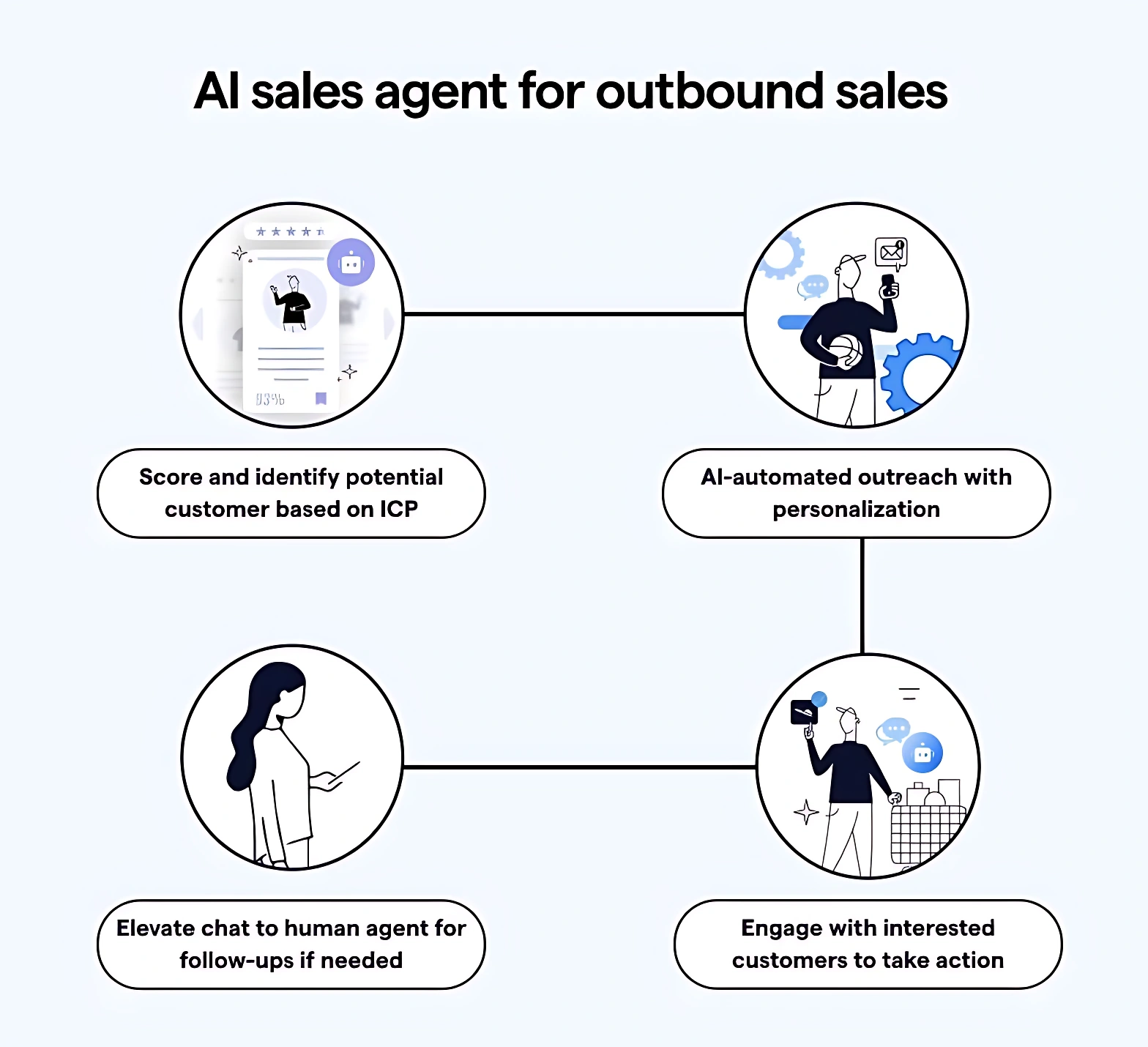
The AI Outbound Workflow: Leveraging AI agents to score potential customers based on Ideal Customer Profiles (ICP) and automate personalized engagement at scale.
What they changed:
The team had been using generic templates — the same email body sent to every contact with only the first name swapped. Apollo's AI personalization feature and ChatGPT together enabled a different approach.
For each outreach batch, the SDR pulled 30 ICP-matched contacts from Apollo and used the following ChatGPT prompt for each:
"Write a 3-sentence cold email opening for a SaaS outreach to [Name], [Title] at [Company]. They recently [relevant company news or LinkedIn activity]. Our product helps operations teams reduce project handoff delays. Make it specific to their context, not generic."
Before AI personalization:
Subject: Improve your team's project management

Hi [First Name],

I wanted to reach out because we help operations teams like yours
reduce project delays and improve cross-team visibility.

Would you be open to a 20-minute call to see if we might be a fit?

Best,
[SDR Name]
After AI personalization (ChatGPT + Apollo context):
Subject: Saw your post about the Q1 rollout challenges

Hi Sarah,

Noticed your LinkedIn post last week about the communication gaps
during your Q1 product rollout — that's exactly the kind of
cross-team handoff problem our platform was built to eliminate.

Companies like Notion and Loom used the same approach you're
describing before switching to a structured handoff system —
and cut their average project delay from 11 days to 3.

Worth a 20-minute look?

[SDR Name]
Results after 60 days:
- Reply rate: 1.8% → 5.3% (+194% relative improvement)
- Demo bookings: 9/month → 15/month (+67%)
- Cost per booked demo: $340 → $148 (−56%)
- Total stack cost increase: $119/month
The key insight: The personalization didn't require more time — it required a different workflow. Each personalized email took 4 minutes instead of 30 seconds. But at a 3x higher reply rate, the time investment per booked demo dropped significantly. The AI didn't replace the SDR; it gave the SDR enough context to send emails that felt like they came from a person who had done their homework.
How AI Lead Generation Tools Work: The 5-Step System
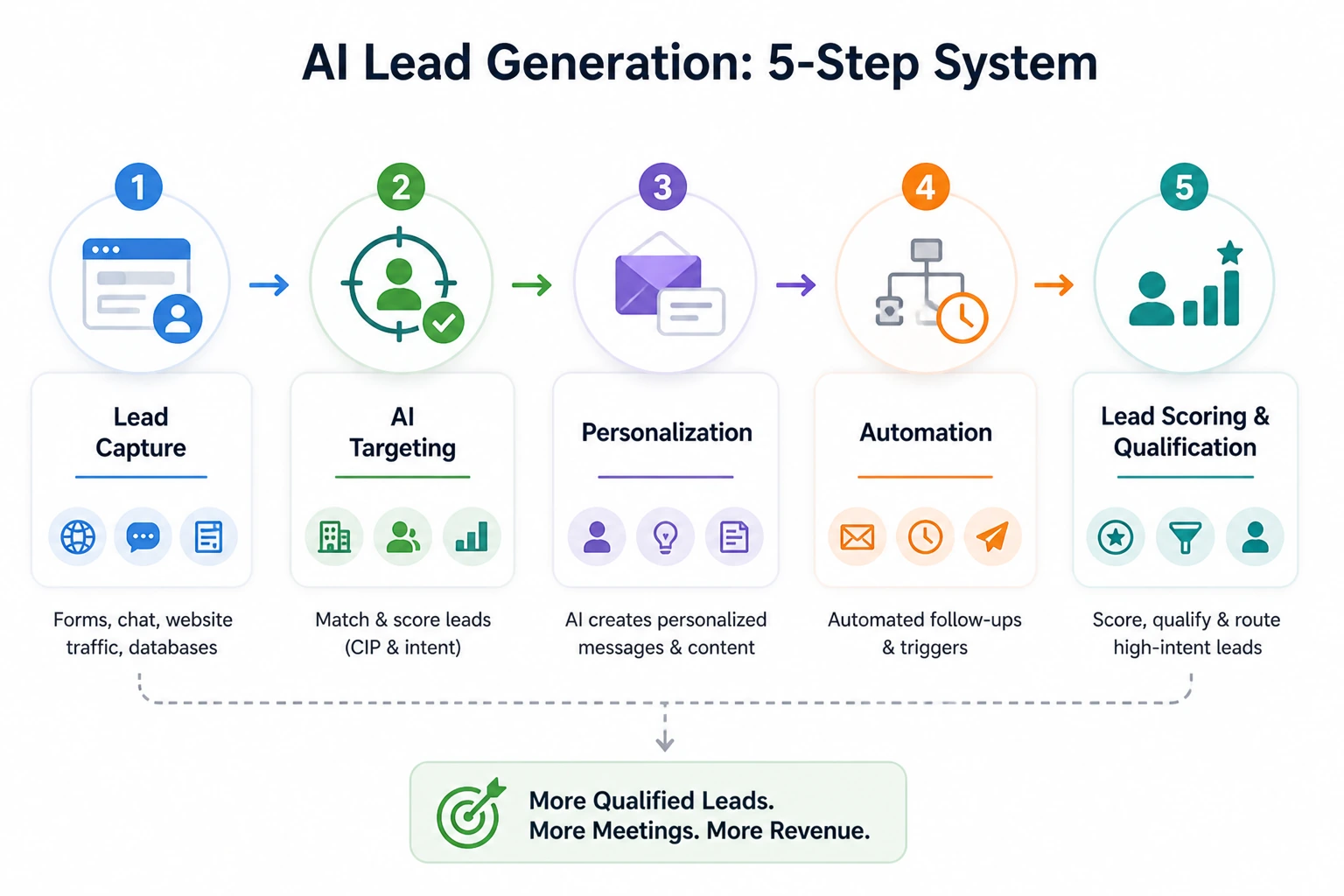
The 5-step AI lead generation system showing how businesses capture, qualify, and convert leads using automation and personalization.
Understanding the mechanics behind AI lead generation helps you deploy tools at the right funnel stage — and avoid the common mistake of buying tools that duplicate each other's function.
Step 1: Lead Capture Leads enter your funnel through forms, website traffic, database search, or conversational chat. Tools: Drift (chat), Leadfeeder (anonymous visitors), HubSpot (forms), Apollo (database).
Step 2: AI Targeting (ICP Matching) Raw leads are filtered against your Ideal Customer Profile. AI tools score each contact by industry, company size, job title, technology usage, intent signals, and behavioral data. Tools: Apollo, ZoomInfo, HubSpot predictive scoring.
Step 3: Personalization Matched leads receive outreach personalized to their specific context — company news, role challenges, recent activity. Generic templates are replaced with AI-generated first lines and sequences. Tools: ChatGPT, Apollo AI personalization, HubSpot smart content.
Step 4: Automation Follow-up sequences run automatically based on engagement triggers — opened email, clicked link, visited pricing page. Leads that don't respond receive timed follow-ups without manual SDR input. Tools: Apollo sequences, HubSpot workflows, Drift conversation automation.
Step 5: Lead Scoring and Qualification Leads are scored by engagement behavior and purchase intent. High-score leads are routed to direct sales rep outreach. Low-score leads continue in automated nurture. Tools: HubSpot predictive scoring, Clearbit enrichment, Leadfeeder intent signals.
Funnel-Based Lead Generation Framework (Full Workflow)
This is the complete AI lead generation workflow for a B2B or SaaS business — from anonymous website visitor and cold prospect to qualified demo booking. Each stage maps to a specific tool and a specific outcome.
Stage 1 → Lead Capture Tools: Drift + Leadfeeder
Leadfeeder identifies companies visiting your website and routes high-intent visitors (pricing page, case studies, repeated visits) to a Slack notification for your sales team. Drift engages those same high-intent visitors in real time with a conversational chatbot — qualifying them and booking meetings without form friction. Together, these two tools capture pipeline from the 97% of website visitors who never fill out a form.
Stage 2 → Lead Enrichment Tools: Clearbit + ZoomInfo
Captured leads — whether from Leadfeeder identification or Drift conversations — are enriched automatically. Clearbit appends company size, industry, technology stack, and decision-maker contact details to every new lead record before it reaches your CRM. ZoomInfo adds intent signal data and org chart context for enterprise-tier accounts. Your sales team receives complete, actionable lead profiles rather than partial contact records.
Stage 3 → Lead Scoring Tool: HubSpot
Enriched leads are scored in HubSpot using predictive lead scoring — which weights behavioral signals (page visits, email engagement, content downloads) alongside firmographic fit (company size, industry, job title). Leads scoring above your qualification threshold are routed to direct SDR outreach. Leads below threshold enter automated nurture sequences. This routing decision — which is usually made manually and inconsistently — becomes systematic and data-driven.
Stage 4 → Outreach Tools: Apollo.io + ChatGPT
Qualified leads enter Apollo outreach sequences. Each sequence is built around a 4–5 step cadence: personalized first email → follow-up → LinkedIn touch → final email. ChatGPT generates the first-line personalization for each contact using company news, LinkedIn activity, and role context. The result is outreach that feels researched rather than automated — which is the primary driver of response rate improvement.
Stage 5 → Follow-Up and Qualification Tool: HubSpot Workflows + Apollo Sequences
Contacts who don't respond to initial outreach enter automated follow-up sequences with time-based triggers. Contacts who engage (open emails, click links, revisit the website) are flagged for priority SDR follow-up based on Leadfeeder alerts and HubSpot activity scoring. Contacts who book meetings through Drift or Apollo's calendar integration are automatically moved to the demo stage in HubSpot.
Full workflow output: A system that captures warm pipeline from existing traffic, enriches and scores every lead automatically, routes qualified prospects to personalized outreach, and follows up without manual SDR involvement — generating booked demos without a proportional increase in headcount.
How to Choose the Right AI Lead Generation Tool: Decision Framework
Use this framework — based on your current funnel bottleneck, not your feature wishlist:
If your bottleneck is "we don't have enough contacts to reach": → Apollo.io ($59–$99/month) for ICP-matched contact discovery, or ZoomInfo for enterprise-level data depth.
If your bottleneck is "we have traffic but low form conversion": → Drift for conversational lead capture, or Leadfeeder to identify and prioritize anonymous visitors.
If your bottleneck is "leads come in but we don't know which ones to prioritize": → HubSpot predictive lead scoring + Clearbit enrichment to complete partial lead profiles.
If your bottleneck is "we send outreach but get low reply rates": → ChatGPT Plus ($20/month) combined with Apollo's AI personalization. This is the highest-ROI upgrade for most B2B outbound teams.
If your bottleneck is "follow-up is inconsistent and leads fall through": → HubSpot Starter ($20/month) for automated sequence management and CRM pipeline visibility.
Quick recommendations by business type:
| Business Type | Primary Tool | Supporting Tool | Monthly Cost |
|---|---|---|---|
| Solo B2B / Consultant | Apollo.io Basic + ChatGPT Plus | HubSpot Free CRM | ~$79/mo |
| SMB (5–20 employees) | HubSpot Starter + Apollo Pro | ChatGPT Plus | ~$139/mo |
| SaaS (inbound focus) | HubSpot Pro + Leadfeeder | Clearbit | ~$989/mo |
| Agency (multi-client) | Apollo Pro + HubSpot Starter | ChatGPT Plus | ~$139/mo |
| Enterprise | ZoomInfo + HubSpot Pro | Clearbit | Custom |
Best AI Lead Generation Stacks Under $150/Month
| Team Type | Tools Included | Monthly Cost | Primary ROI Driver |
|---|---|---|---|
| Solo / Consultant | Apollo Basic + ChatGPT Plus + HubSpot Free | ~$79/mo | ICP prospecting + personalized outreach |
| SMB Outbound | Apollo Pro + ChatGPT Plus + HubSpot Starter | ~$139/mo | Sequencing + lead scoring + CRM pipeline |
| SMB Inbound | HubSpot Starter + Leadfeeder Free + ChatGPT Plus | ~$119/mo | Visitor identification + lead scoring |
| Agency | Apollo Pro + HubSpot Starter + ChatGPT Plus | ~$139/mo | Multi-client outbound + pipeline management |
| Budget / Pre-Revenue | Apollo Free + ChatGPT Plus + HubSpot Free | ~$20/mo | Manual-assisted prospecting at minimum cost |
| Content-First SaaS | HubSpot Free + Leadfeeder Free + ChatGPT Plus | ~$20/mo | Inbound capture + visitor identification |
Start with the stack that matches your current funnel stage. Buying Drift at $2,500/month when you're generating 500 website visits per month is poor ROI. Buying Apollo Pro at $99/month when your primary problem is low website conversion is solving the wrong problem. Match the tool to the bottleneck.
→ Calculate your exact pipeline impact before committing: Use our AI CRM & Sales ROI Calculator to model monthly pipeline value by outreach volume, lead quality, and conversion rates..
The Costs That Often Get Overlooked in AI Lead Generation Platforms
Lead generation software is usually marketed around the size of its database or the number of prospects you can reach. However, the actual cost of running a successful lead generation system extends far beyond the subscription fee. As outreach volume grows, additional expenses often emerge across data, infrastructure, and workflow management.
-
Prospect consumption limits: Platforms such as Apollo.io and ZoomInfo typically operate on credit-based systems where contact access, exports, or enrichment actions consume monthly allowances. High-volume prospecting teams can burn through these allocations much faster than anticipated.
-
Scaling beyond entry-level plans: Many tools offer attractive starter pricing but reserve advanced automation, reporting, and workflow capabilities for significantly more expensive tiers. What works for a solo operator may become financially impractical once sales processes mature.
-
Outreach infrastructure expenses: Generating leads is only one part of the process. Maintaining strong email deliverability often requires additional investments in domain management, inbox monitoring, warming services, and outreach optimization tools.
-
Dependency on external systems: Lead enrichment and prospect intelligence platforms frequently deliver their greatest value when connected to a CRM. Businesses using basic CRM plans may discover that key workflows require upgrades across multiple platforms rather than just one.
-
Data quality maintenance challenges: Contact databases naturally lose accuracy as people change jobs, companies, or responsibilities. The effectiveness of a lead generation tool depends heavily on how frequently its data is refreshed and validated.
-
Variable usage charges: Credit-based and consumption-driven pricing models can create unpredictable monthly costs. Teams that increase outreach activity during campaigns or seasonal promotions may encounter unexpected overage charges if safeguards are not in place.
Lead Generation Tool Rollout Framework
Phase 1: Prospect Data Quality
Before sending a single outreach email, verify that your contact data matches your ideal customer profile.
Focus on:
- Industry relevance
- Company size
- Decision-maker identification
- Email deliverability
Poor prospect quality creates low reply rates regardless of tool quality.
Phase 2: Outreach System Setup
Build your outreach workflow using a CRM, prospecting platform, and email sequencing tool.
Recommended workflow:
Apollo → Email Sequence → HubSpot CRM → Follow-up Process
Track:
- Open rate
- Reply rate
- Positive reply rate
- Meeting booking rate
Phase 3: Optimization
After collecting enough data, identify:
- Best performing subject lines
- Highest converting buyer personas
- Strongest personalization angles
Scale only after achieving consistent positive reply rates.
Phase 4: Pipeline Expansion
Increase volume gradually while maintaining list quality.
Businesses that scale prospect quality before volume typically achieve stronger long-term results than businesses focused only on outreach quantity.
ROI Modeling: What a $100/Month AI Lead Generation Stack Is Actually Worth
⚠️ Hypothetical estimates only. The figures in this section are illustrative examples based on industry averages and publicly available data. Actual results vary significantly by business size, industry, tool configuration, and team adoption. These numbers are not guarantees of return.
Most B2B teams underestimate lead generation tool ROI because they measure tool cost against time saved — and miss the much larger impact of improved conversion rates on pipeline economics.
The highest AI returns tend to be concentrated in sales and lead generation functions — where conversion rate improvements directly compound into revenue rather than cost savings.
A practical illustration for a B2B SaaS company with a $5,000 average contract value:
| ROI Driver | Calculation | Monthly Value |
|---|---|---|
| Demo bookings via AI personalization (reply rate: 1.8% → 5.3%) | 3 additional demos × 25% close rate × $5,000 ACV | $3,750 |
| Time saved on prospecting (15 hrs/week → 3 hrs/week per SDR) | 48 hrs × $40/hr equivalent | $1,920 |
| Cost per lead reduction (AI ICP targeting vs. manual) | 60% CAC reduction on $2,000/month base spend | $1,200 |
| Pipeline from website visitors (Leadfeeder: 8 identified companies/month) | 2 conversions × 20% close × $5,000 ACV | $2,000 |
| Total Monthly Return | $8,870 | |
| Total Stack Cost | Apollo Pro + ChatGPT Plus + HubSpot Starter + Leadfeeder Free | ~$139/mo |
| ROI | ((8,870 − 139) / 139) × 100 | ~6,281% |
Conservative assumptions throughout. Actual returns depend on ICP definition quality, sequence execution, and close rate — not tool selection alone.
→ Want real numbers for your specific pipeline? Use the Lead Generation ROI Calculator to model your returns before investing.
Common Lead Generation Mistakes (And How AI Tools Fix Them)
Most B2B lead generation failures aren't caused by insufficient budget or weak products. They're caused by five consistent strategic mistakes that AI tools specifically address.
1. Focusing on quantity over quality Sending 500 cold emails per week to poorly matched contacts produces lower total pipeline than sending 100 emails to precisely ICP-matched contacts with personalized outreach. Apollo's ICP filtering and ZoomInfo's intent data exist specifically to solve the quality problem — not to help you send more emails faster.
2. Weak ICP definition "Companies with 50–500 employees in the US" is not an ICP. An ICP includes: industry vertical, tech stack, growth stage, org structure, the specific pain point your product solves, and the job title of the person who feels that pain most acutely. Without a precise ICP, every lead generation tool on this list produces low-quality output — garbage in, garbage out.
3. No follow-up system Studies consistently show that 80% of sales require 5+ follow-up touches. Most manual outreach programs abandon after 2. Apollo sequences and HubSpot workflows automate follow-up at the right intervals without requiring SDR memory or discipline — which is why systematic follow-up is one of the highest-ROI changes any B2B team can make.
4. Poor personalization "I wanted to reach out because we help companies like yours" is not personalization — it's a template with the word "personalization" in the strategy doc. Real personalization references something specific to the individual prospect: their company's recent news, a post they published, a challenge specific to their industry stage. ChatGPT makes genuine personalization scalable at a cost per email that's economically viable.
5. Over-automation without strategy Setting up an Apollo sequence and running it without monitoring reply rates, adjusting copy based on feedback, or defining what a "qualified reply" looks like produces activity metrics — not pipeline. Automation amplifies your strategy. If the strategy is weak, automation produces weak results at higher volume.
Emerging Trends in AI Lead Generation (2026)
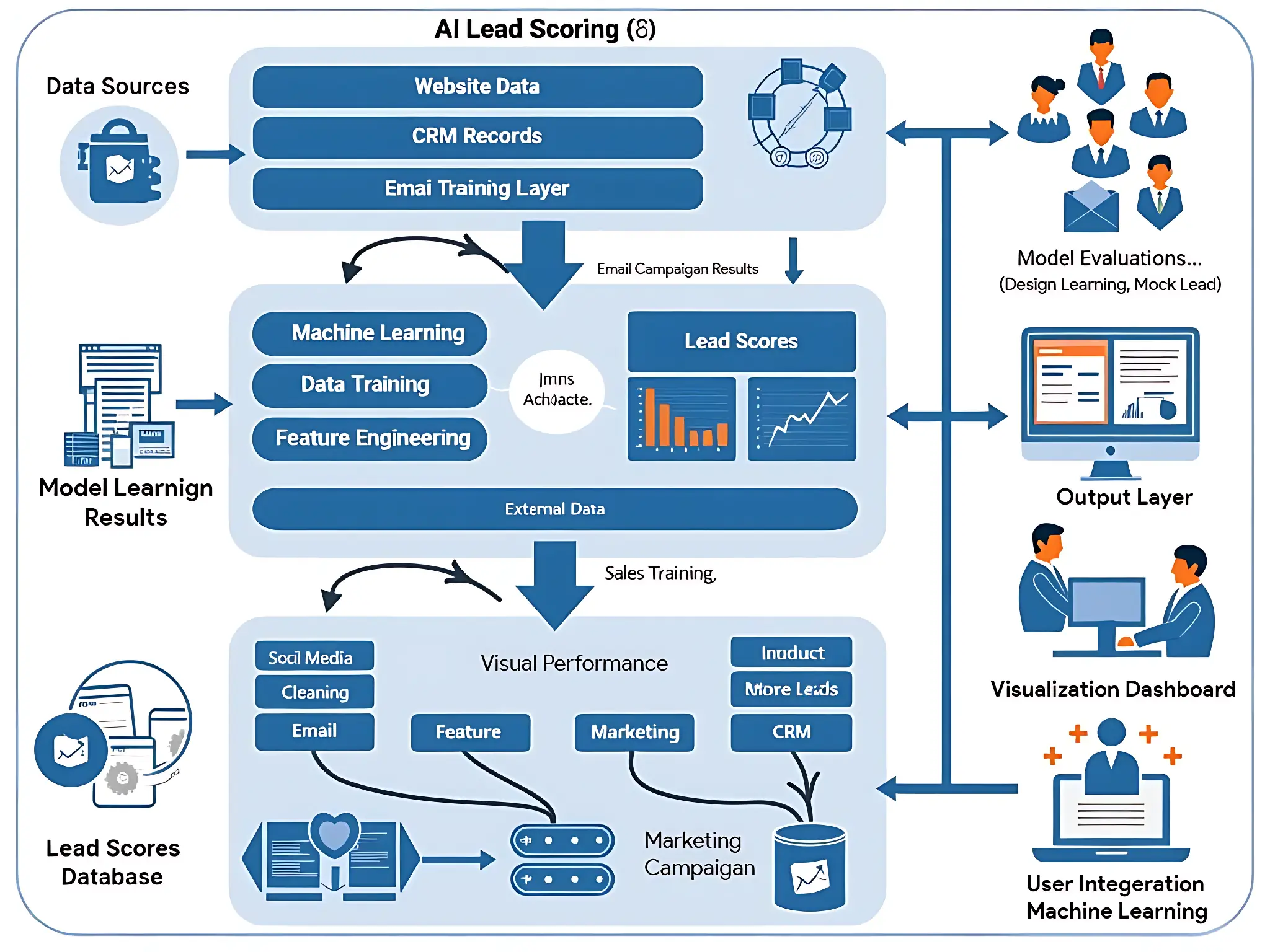
The AI Lead Scoring Engine: How machine learning models process CRM and website data to predict lead quality and automate marketing campaign prioritization.
The current generation of tools represents the baseline. The direction the category is moving over the next 12–18 months shifts the advantage further toward teams that build systematic lead generation workflows now.
AI-Driven Lead Scoring Becomes Predictive, Not Retrospective
Current lead scoring assigns scores based on past behavior. Emerging AI scoring systems predict future behavior — identifying which contacts are likely to convert based on patterns across thousands of similar sales cycles, before they've shown explicit buying signals. This compresses the qualification timeline and improves resource allocation for sales teams.
Conversational AI Becomes the Primary Lead Capture Channel
Drift's chat-first approach is the early version of a larger trend: AI-powered conversations replacing static forms as the primary inbound lead capture mechanism. The next generation of conversational AI handles full discovery conversations, qualifies leads against ICP criteria, and books meetings — all within a single chat thread. Expect this capability to become standard across B2B websites within 18 months.
Hyper-Personalized Outreach at Scale
The convergence of contact data (Apollo, ZoomInfo), AI writing (ChatGPT, Claude), and behavioral signals (Leadfeeder, intent data) makes genuinely personalized outreach at scale achievable for the first time. The next frontier is AI systems that generate fully personalized sequences — not just first-line personalizations — based on each prospect's complete digital footprint.
Fully Automated Sales Pipelines
The emerging category is AI that manages the full top-of-funnel pipeline autonomously: identifying ICP-matched companies, finding decision-maker contacts, generating personalized outreach, executing sequences, following up on engaged prospects, and routing qualified leads to human reps at the moment of highest intent. Several platforms are in early deployment of this capability in 2026, with broader adoption expected through 2027.
Invest in Lead Quality — Not Just Lead Volume
The B2B teams winning with AI lead generation in 2026 aren't the ones sending the most emails or maintaining the largest contact databases. They're the ones who defined their ICP precisely, built a systematic funnel workflow, and used AI to execute that workflow consistently at a quality level no manual team can sustain.
A $80–$140/month AI lead generation stack, built specifically around your current funnel bottleneck — whether that's contact discovery, personalization, scoring, or follow-up consistency — compounds pipeline over time in a way that raw outreach volume never will.
The framework above gives you the structure to execute: define your ICP, capture and enrich leads at every funnel stage, score and route qualified prospects, personalize outreach with AI, automate follow-up, and measure conversion at each stage transition. Run that system for 60 days with discipline and measure against a pre-AI baseline.
The best AI lead generation tools don't succeed because they have large databases or impressive demos. They succeed because the teams using them are disciplined enough to define what a qualified lead actually looks like, systematic enough to measure what moves pipeline, and patient enough to optimize the funnel rather than chasing volume.
Organizations that formalize their AI tool evaluation process...consistently outperform those deploying tools reactively without a structured review process.
Final Verdict
AI lead generation tools are not a volume solution — they're a quality and efficiency solution that compounds pipeline over time when applied to a well-defined ICP and a systematic funnel workflow.
A B2B team spending $80–$140/month on the right combination of AI lead generation tools can generate more qualified pipeline per SDR hour than teams spending 10x more on headcount-based prospecting. But the advantage doesn't come from the tools — it comes from the discipline of the workflow they enable.
Start simple:
- Define your ICP precisely before configuring any tool
- Solve your biggest funnel bottleneck first — contact discovery, personalization, scoring, or follow-up
- Measure cost per qualified lead and cost per booked meeting weekly for the first 60 days
Then scale only what produces qualified pipeline.
The B2B teams winning with AI in 2026 are not the ones with the most sophisticated tech stacks or the largest databases — they're the ones who built the workflow habit, measured what moved pipeline, and doubled down on what converted.
Define your ICP. Build the funnel. Measure conversion. Scale what works.