Introduction
Good copy prints money. Bad copy burns ad budget.
That's not a metaphor — it's the most expensive lesson most marketers learn the hard way. You can have the best product, the right audience, and a well-structured funnel. But if the words on your page don't connect, don't compel, and don't convert — none of it matters.
Here's what's changed in 2026: AI copywriting tools have made high-quality sales copy accessible to anyone willing to learn how to use them properly.
We're not talking about generic blog posts or filler content. We're talking about sales page headlines that stop the scroll. Ad copy that drives a 38% boost in click-through rates. Email sequences that move leads through a funnel without feeling like a sequence at all. Real, conversion-focused copy — produced faster, tested more aggressively, and refined based on actual performance data.
The marketers winning with AI right now aren't the ones replacing their copywriting instincts. They're the ones using AI to test more, iterate faster, and let data pick the winner.
This guide breaks down the best AI copywriting tools for sales pages and funnels in 2026 — what they actually deliver, where they fall short, and exactly which tool fits your situation.
If you're building out your full AI marketing stack, check out our Complete Guide to Choosing AI Software for Your Business (2026 Edition).
AI Copywriting Market Growth (2026)
The shift from human-only copywriting to AI-assisted copy isn't coming — it's already happened.
- Market growth: The AI copywriting market is projected to surpass $2.6 billion in 2026, growing at a CAGR of over 19%
- Adoption rate: 85–90% of marketers are now using AI in some part of their content and copy workflow
- Time savings: Teams using AI copywriting tools report an average 40% reduction in copy production time
- Revenue impact: Businesses using AI-optimized copy report 10–20% improvement in conversion rates
- For deeper insights into what actually improves conversions, refer to this guide on conversion rate optimization best practices, which breaks down how high-performing funnels are structured and tested.
- Ad performance: AI-generated and tested ad copy has delivered 38% higher CTR and 32% lower CPC in controlled campaigns
- Funnel efficiency: Email sequences written with AI assistance show up to 25% higher open rates when personalized at scale
These aren't marketing industry projections made in a vacuum. They reflect what happens when teams move from writing one version of copy and hoping it works — to generating ten versions and letting performance data pick the winner.
That's the real shift. Not AI writing for you. AI helping you test your way to what converts.
Why AI Copywriting is Powerful for Sales Funnels
Most people think AI copywriting is about speed. And yes — speed matters. But the deeper advantage is what speed makes possible.
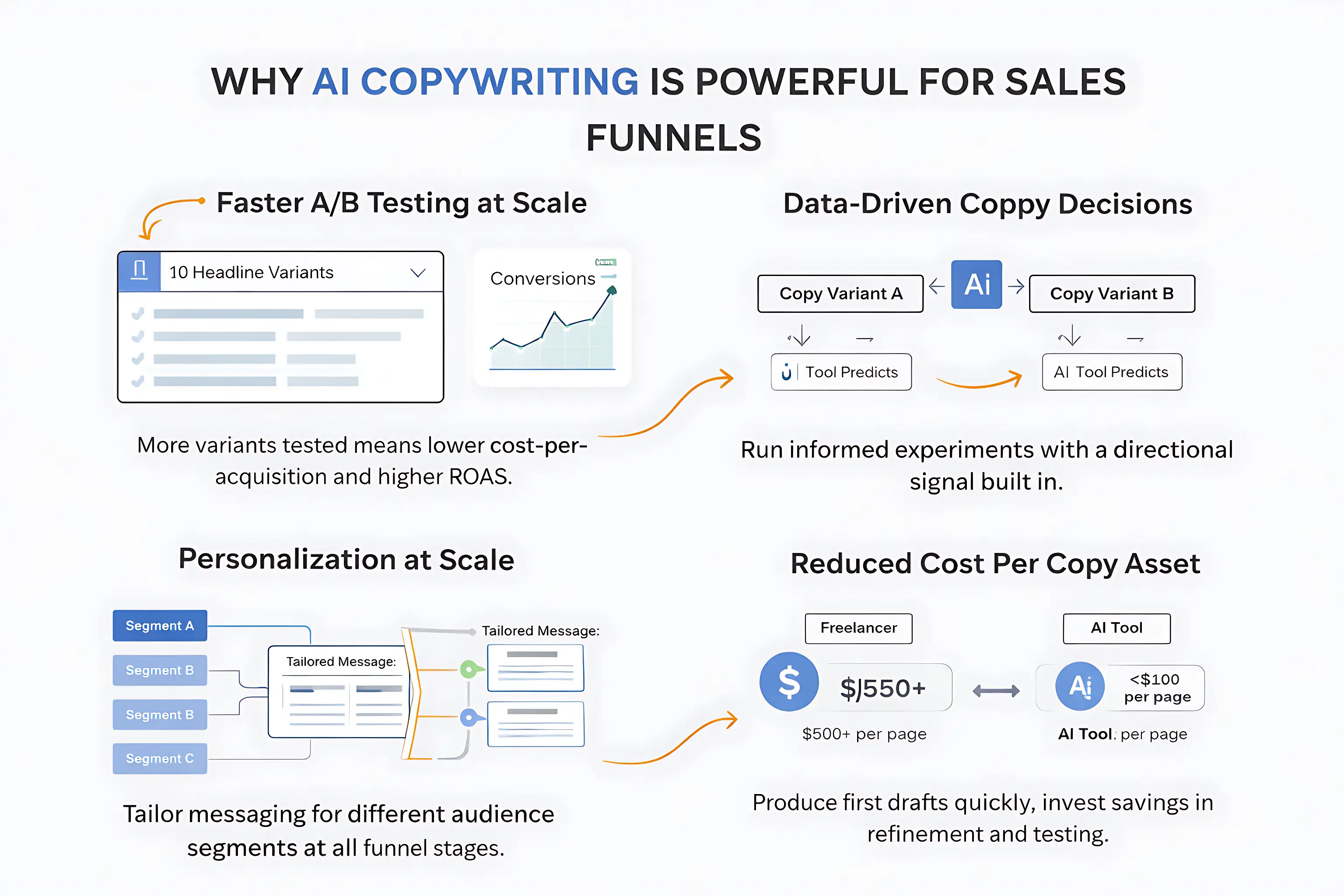
Strategic Leverage of AI in Funnels: By shifting from manual drafting to AI-assisted generation, businesses can achieve higher ROAS through rapid testing and hyper-personalization.
Faster A/B testing at scale. A traditional copywriter produces one headline variant per hour. An AI tool produces ten in ten minutes. For sales pages and paid ads, that's not a convenience — it's a competitive edge. More variants tested means faster identification of what converts, which means lower cost-per-acquisition and higher ROAS.
Data-driven copy decisions. Tools like Anyword score copy variants based on predicted conversion performance before you publish. You're not guessing anymore. You're running informed experiments with a directional signal built in.
Personalization at scale. Generic funnel copy loses leads at every stage. AI tools let you adapt messaging to different audience segments — different pain points, different objections, different buying stages — without rewriting your entire funnel from scratch each time.
Reduced cost per copy asset. A freelance direct response copywriter charges $500–$3,000 for a single sales page. AI tools let you produce that first draft in under an hour, then invest your budget in refinement and testing rather than base production.
Use Cases of AI Copywriting in Sales Funnels
Landing Pages — Headlines and Hero Sections
The headline is responsible for whether anyone reads the rest of the page. Research consistently shows that 8 out of 10 people read the headline — and only 2 out of 10 read the body copy.
AI tools excel at generating headline variations fast. Give them your offer, your audience's core pain point, and your desired outcome — and they produce 10–20 headline options in minutes. Some will be mediocre. A few will be genuinely strong. And occasionally one will be better than anything you would have written alone.
The process: generate broadly, shortlist 3–5 candidates, run a split test, let the data decide.
Ad Copy — Facebook and Google Ads
Ad copy has the shortest feedback loop in marketing. Within 48–72 hours of launch, you know whether a hook is working. AI tools make it practical to enter that feedback loop with 5–10 creative variants instead of 1 — and the performance difference is measurable.
For Facebook ads specifically, the hook (first line or opening visual text) determines 80% of whether someone stops scrolling. AI tools are excellent at generating hooks across emotional registers — curiosity, fear of loss, social proof, aspiration — so you can test which angle your audience responds to.
Email Funnels — Welcome to Sales
A well-structured email funnel moves leads from awareness to purchase without ever feeling pushy. The mechanics are: warm up with value, build trust with specificity, introduce the offer when the reader is ready.
AI tools handle the production volume that makes this possible. Writing a 7-email nurture sequence from scratch takes days. With AI, you're generating drafts in hours and spending your time on the strategic decisions — sequence structure, offer positioning, objection handling — rather than blank-page writing.
Product Descriptions — E-commerce
Generic product descriptions don't convert. "High-quality material" and "premium design" say nothing that moves a purchase decision forward.
AI tools, when prompted correctly, generate benefit-focused product descriptions that speak to the buyer's actual desire — not the product's specs. The difference between "400-thread-count cotton" and "the kind of sheets you'll look forward to coming home to" is the difference between a bounce and an add-to-cart.
Upsell and Downsell Pages
These are the highest-leverage pages in any funnel — and the most consistently neglected. A well-written upsell page can add 20–40% to average order value with zero additional acquisition cost.
AI tools are particularly useful here because upsell copy follows predictable frameworks: acknowledge the purchase, reframe the upgrade as a natural next step, make the incremental benefit crystal clear. Generate 5–6 variants, test on a small segment first, and scale what converts.
Best AI Copywriting Tools for Sales Pages and Funnels (2026)
All pricing reflects official starter plans as of April 2026. Free tiers are noted where available.
Jasper AI — Best Overall for Sales Copy
Jasper is the most purpose-built AI copywriting tool for marketers who need conversion-focused output — not just well-written text. Its template library includes AIDA (Attention, Interest, Desire, Action), PAS (Problem, Agitate, Solution), and direct response frameworks built specifically for sales pages, landing pages, and ad copy.
What separates Jasper from general AI writing tools is its understanding of marketing context. It doesn't just write — it writes with persuasion structure baked in.
Key Features:
- 50+ marketing-specific templates including AIDA, PAS, sales emails, and landing pages
- Brand Voice feature — trains on your existing content to maintain consistent tone
- SEO mode with SurferSEO integration for content that ranks and converts
- Team collaboration tools for agencies and in-house marketing teams
Pricing: From $49/month (Creator), $125/month (Pro)
Pros:
- The strongest out-of-the-box conversion framework library
- Brand Voice consistency is excellent for teams managing multiple campaigns
- Produces polished first drafts faster than any comparable tool
Cons:
- Higher price point — the value is clear at volume, less obvious for occasional use
- Outputs still need human review for emotional depth and brand nuance
- No built-in A/B testing or performance prediction
Best For: Marketing teams, agencies, and growth marketers producing consistent volumes of sales copy who need output that's already structured for conversion.
Copy.ai — Best for Ads and Outreach
Copy.ai is the fastest tool in this list for producing ad copy and sales outreach at scale. Its Workflows feature lets you automate repetitive copy tasks — generating 50 ad variants from a single brief, personalizing outreach emails by segment, or adapting one piece of copy across multiple platforms.
For performance marketers running paid social and email outreach simultaneously, Copy.ai removes the production bottleneck entirely.
Key Features:
- Workflows: automated copy pipelines for ads, email sequences, and social posts
- 90+ templates covering every major sales and marketing format
- Brand voice training for consistent tone across outputs
- Team workspace for collaborative copy production
Pricing: Free plan available; paid from $49/month (Starter)
Pros:
- Best-in-class for ad copy volume — generates multiple variants faster than any other tool
- Workflows feature eliminates repetitive manual copy tasks
- Generous free plan for testing before committing
Cons:
- Quality of individual outputs can be uneven — volume is the strength, not precision
- Less suitable for long-form sales page copy
- Brand voice training is less refined than Jasper's
Best For: Performance marketers, media buyers, and outreach teams who need high volumes of ad copy and personalized email variants fast.
Writesonic — Best for Budget Teams
Writesonic delivers strong conversion-focused copy at a price point that makes it accessible to bootstrapped teams and solo founders. Its landing page and sales email templates are genuinely good — not just functional but structured around persuasion principles that actually work.
If you're early-stage and you need quality sales copy without a $100/month tool subscription, Writesonic is where to start.
Key Features:
- Landing page and sales page templates with conversion-focused structure
- AI Article Writer for blog and SEO content alongside sales copy
- Chatsonic: a ChatGPT-style interface with real-time web data access
- Available in 30+ languages — useful for teams in non-English markets
Pricing: Free trial available; from $20/month (Individual)
Pros:
- Best price-to-output ratio in this category
- Broad template library covers both sales copy and content marketing
- Chatsonic integration adds research capability to the copy workflow
Cons:
- Output quality for complex sales pages requires more editing than Jasper
- Less specialized for high-stakes conversion copy (upsells, long-form VSLs)
- Brand voice consistency is limited compared to premium tools
Best For: Solopreneurs, early-stage startups, and small business owners who need capable sales copy without a high monthly tool cost.
Anyword — Best for Performance Marketers
Anyword does something none of the other tools in this list do: it predicts conversion performance before you publish. Every piece of copy receives a Predictive Performance Score — an AI-generated probability estimate of how well it will convert based on historical data from millions of ad campaigns.
For marketers running paid traffic where every click costs money, this is a meaningful advantage. You're not testing blind.
Key Features:
- Predictive Performance Score for every copy variant generated
- Ad copy optimization for Facebook, Google, LinkedIn, and TikTok
- Data-driven copy improvement suggestions based on performance signals
- Custom scoring models trained on your own historical campaign data
Pricing: From $49/month (Starter)
Pros:
- The only tool that quantifies conversion potential before publishing
- Excellent for ad copy optimization across multiple paid platforms
- Custom scoring models improve accuracy with your own campaign data
Cons:
- Performance scores are directional signals, not guarantees — still test in market
- Less suitable for long-form copy (sales pages, email sequences)
- Higher value for teams with existing campaign data to train the model on
Best For: Performance marketers, paid media teams, and growth hackers who need data-informed copy decisions and want to reduce wasted ad spend.
→ Want real numbers for your specific setup? Use the AI ROI Calculator to model your returns before investing.
ChatGPT — Best for Flexibility
ChatGPT isn't purpose-built for sales copy — but in the hands of someone who knows how to prompt it, it's the most flexible tool in this list. You can apply any copywriting framework, work through objections conversationally, ask it to rewrite in a specific voice, or use it to pressure-test your copy logic before publishing.
The limitation is that you need to bring the framework. ChatGPT doesn't know you want AIDA structure unless you tell it. That's a meaningful gap for marketers without copywriting knowledge — and a non-issue for those with it.
Key Features:
- Conversational copy iteration — refine through dialogue, not prompt rewrites
- Apply any framework on demand (AIDA, PAS, 4Ps, storytelling)
- Custom GPTs for repeatable sales copy tasks
- Broad capability: copy, strategy, research, and objection mapping in one tool
Pricing: Free plan available; ChatGPT Plus from $20/month
Pros:
- The most flexible AI tool available at any price point
- Excellent for complex copy problems that require back-and-forth refinement
- Strong for objection mapping, positioning strategy, and copy logic testing
Cons:
- No built-in marketing templates — requires strong prompt skills
- Outputs need more structural editing for direct sales copy use
- No performance prediction or A/B testing capability
Best For: Experienced marketers and copywriters who want maximum flexibility and already understand conversion frameworks.
ClosersCopy — Best for Direct Response
ClosersCopy is purpose-built for one thing: copy that closes. It's the most specialized direct response tool in this list — built around long-form sales letter frameworks, VSL scripts, email sequences, and the persuasion architecture that drives high-ticket sales.
If you're writing sales letters, webinar scripts, or complex multi-step funnels, ClosersCopy handles formats that other tools weren't designed for.
Key Features:
- Direct response frameworks: long-form sales letters, VSL scripts, webinar copy
- 700+ copywriting frameworks covering every major direct response format
- Tone analyzer to match copy voice to audience expectations
- Lifetime deal available — no recurring monthly cost
Pricing: From $49.99/month; lifetime deal available
Pros:
- The deepest direct response framework library in this category
- Purpose-built for long-form sales copy — sales letters, VSLs, launch sequences
- Lifetime deal makes it cost-effective for committed users
Cons:
- Interface is less polished than Jasper or Copy.ai
- Steeper learning curve — best suited for marketers with DR copywriting knowledge
- Less useful for short-form ad copy or content marketing
Best For: Direct response marketers, funnel builders, and course creators writing high-ticket sales copy, VSL scripts, and launch sequences.
Comparison Table
| Tool | Best For | Starting Price | Templates | A/B Testing | Ease of Use | Conversion Focus |
|---|---|---|---|---|---|---|
| Jasper AI | Overall sales copy | $49/month | ⭐⭐⭐⭐⭐ | ❌ | Easy | ⭐⭐⭐⭐⭐ |
| Copy.ai | Ads & outreach | Free / $49/month | ⭐⭐⭐⭐⭐ | ❌ | Very Easy | ⭐⭐⭐⭐ |
| Writesonic | Budget teams | $20/month | ⭐⭐⭐⭐ | ❌ | Easy | ⭐⭐⭐⭐ |
| Anyword | Performance marketers | $49/month | ⭐⭐⭐⭐ | ✅ Built-in | Moderate | ⭐⭐⭐⭐⭐ |
| ChatGPT | Flexibility | Free / $20/month | ❌ (prompt-based) | ❌ | Moderate | ⭐⭐⭐ |
| ClosersCopy | Direct response | $49.99/month | ⭐⭐⭐⭐⭐ | ❌ | Advanced | ⭐⭐⭐⭐⭐ |
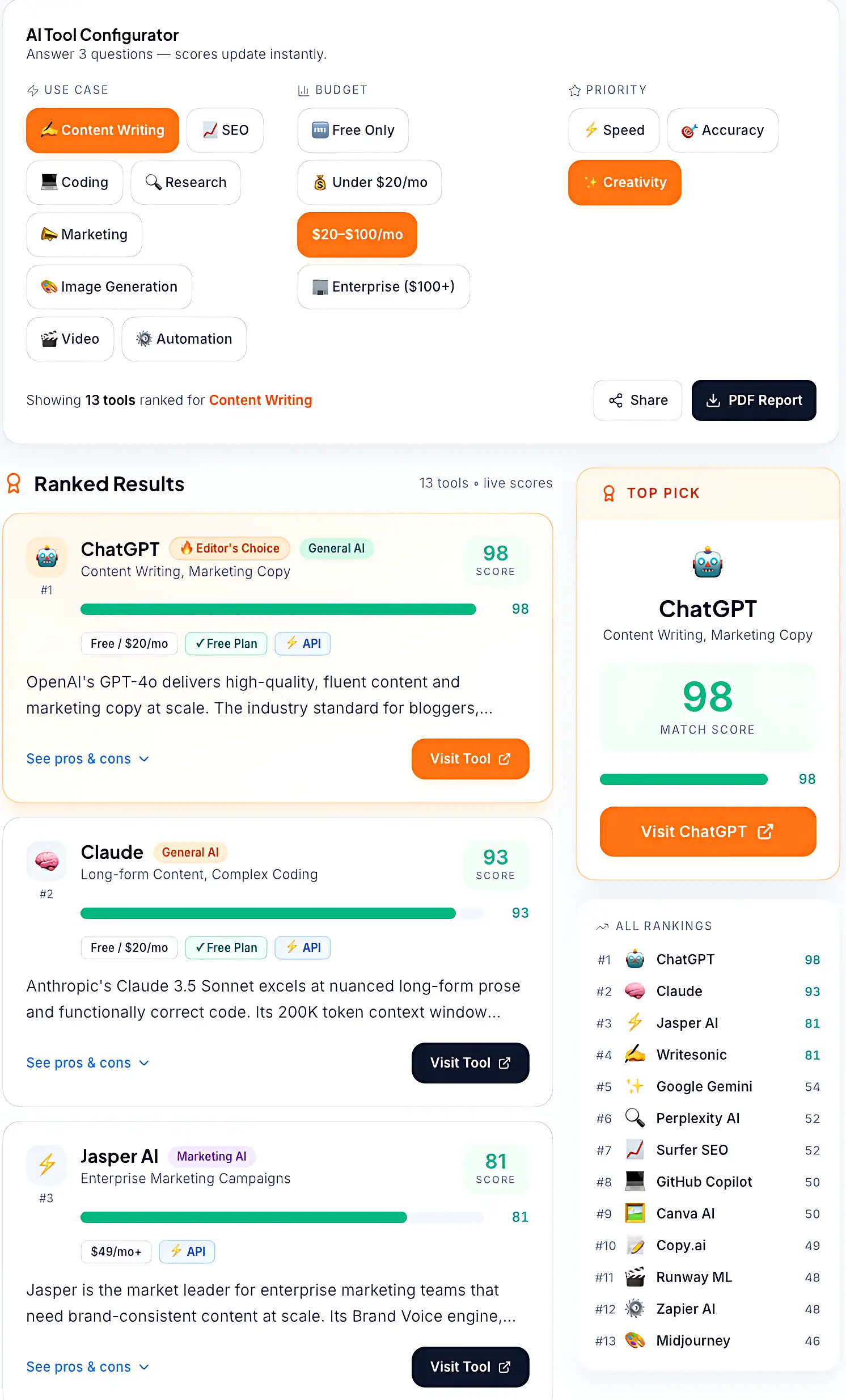
Smart Tool Selection: Our proprietary AI Tool Configurator helps marketers cut through the noise by ranking the best copywriting software based on real-world performance scores and specific business constraints.
How to Choose the Right AI Copywriting Tool
The wrong tool doesn't just waste money — it slows you down and produces copy you don't trust. Here's how to make the right call quickly.
Start with budget. Under $25/month, Writesonic handles most standard sales copy needs. At $49/month, Jasper or Anyword depending on whether you prioritize output quality or performance prediction. If you have technical copywriting knowledge, ChatGPT at $20/month delivers more flexibility than any tool twice its price.
Match the tool to your funnel complexity:
- Simple landing page + a few ad sets → Copy.ai or Writesonic
- Full funnel with email sequences and multiple offer pages → Jasper AI
- High-ticket sales letters, VSLs, or launch sequences → ClosersCopy
- Paid media optimization with performance scoring → Anyword
Consider your skill level. If you don't know what AIDA or PAS means, start with Jasper — the templates teach you the frameworks as you use them. If you already think in direct response terms, ClosersCopy or ChatGPT will feel natural quickly.
Think about A/B testing capability. If you're running paid traffic and you need copy performance data, Anyword's built-in scoring is the only tool in this category that gives you a signal before you spend. Everything else requires external testing infrastructure.
If you're building a complete marketing stack, don't focus only on visuals. Your copy plays an equal role in conversions. Here's a breakdown of the best AI image Genaration Tools to complete your funnel.
How to Use AI to Write High-Converting Sales Copy
This is where most marketers go wrong. They open a tool, type a vague prompt, get mediocre output, and conclude that AI copywriting "doesn't work."
It works. But it requires a process — and the process is what this section is about.
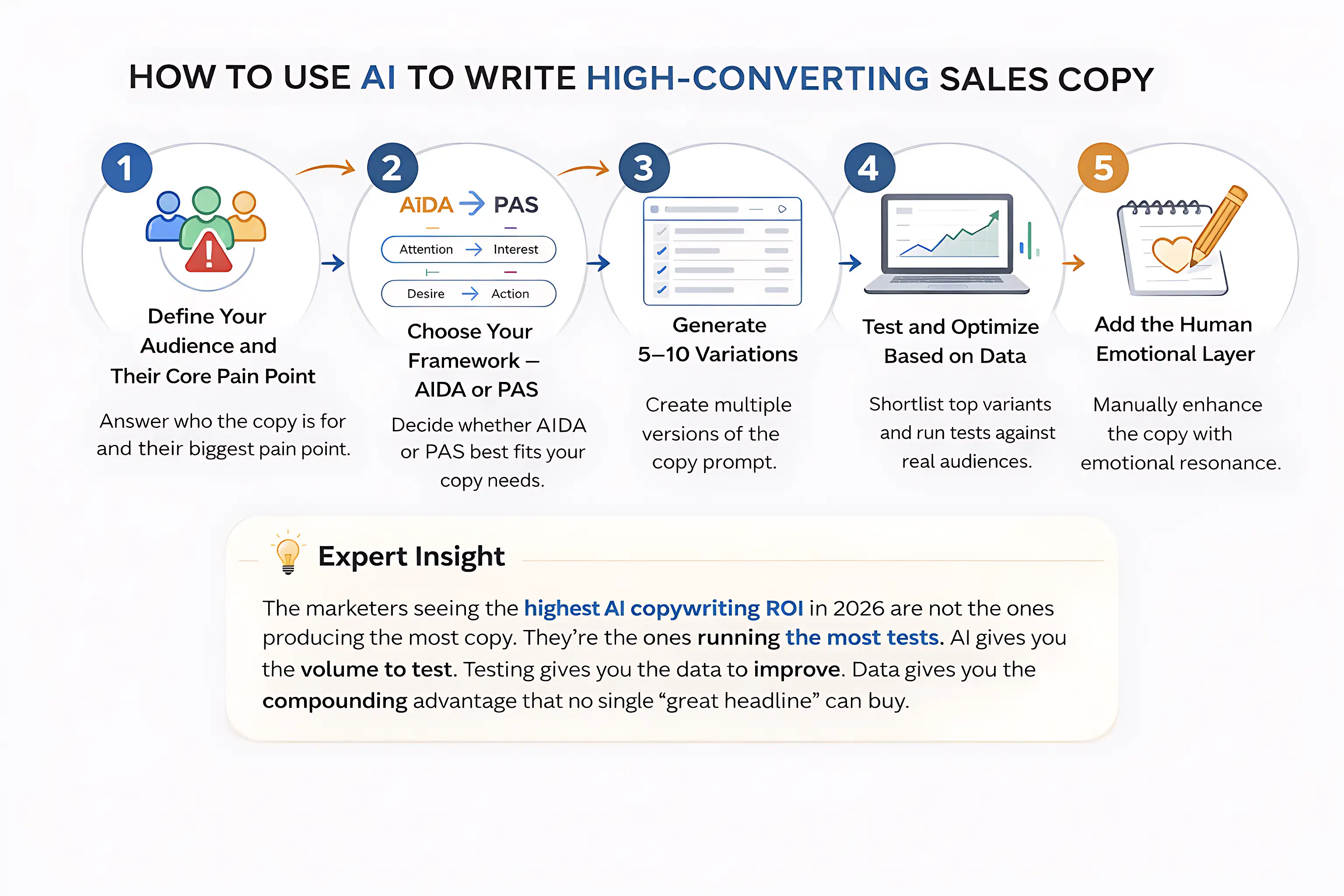
The Human-in-the-Loop Workflow: A structured 5-step process to ensure AI-generated sales copy remains emotionally resonant while maximizing data-driven conversion performance.
Step 1: Define Your Audience and Their Core Pain Point
AI tools produce generic copy when they receive generic inputs. The quality of your output is directly proportional to the specificity of your brief.
Before you write a single prompt, answer these three questions:
- Who is this copy for, specifically? (Not "small business owners" — "e-commerce founders running their first paid ad campaign")
- What is their biggest pain point right now?
- What does success look like for them after using your product?
Feed these answers into your prompt. Every time.
Step 2: Choose Your Framework — AIDA or PAS
Two frameworks handle 80% of sales copy situations.
AIDA (Attention → Interest → Desire → Action) is best for landing pages, sales emails, and ad copy where you're leading a cold prospect through a decision. Start by grabbing attention with a specific headline, build interest with relevant context, create desire with benefit-focused proof, and close with a clear action.
PAS (Problem → Agitate → Solution) works better for pain-driven audiences. Open by naming the problem they recognize. Agitate it — make the cost of not solving it visceral. Then introduce your solution as the relief. It's one of the most reliable frameworks in direct response for a reason.
Tell your AI tool which framework you want. Don't assume it will choose the right one.
Step 3: Generate 5–10 Variations
Never use the first output. Generate at least five to ten variations before shortlisting.
This is the highest-leverage part of the process. Most AI tools produce one genuinely strong variant in every five to ten generated — and you won't know which one it is until you have the full set to compare. Generating broadly is the only way to find the outlier that outperforms your default thinking.
Step 4: Test and Optimize Based on Data
Shortlist your top three variants and test them. For ad copy, run each against the same audience with identical budgets for 72 hours. For landing page headlines, run a proper split test with statistical significance in mind.
The data tells you things your instincts can't. Headlines you were confident about will underperform. Lines you almost discarded will outperform everything. This is why testing volume is the real advantage AI provides — not just faster writing.
Step 5: Add the Human Emotional Layer
This is the step most AI workflows skip — and it's why so much AI copy feels functional but flat.
After your AI draft, go through it manually and ask: where does this copy feel cold? Where is it explaining when it should be feeling? Where does it say "high-quality" when it should say "the kind of product you stop thinking about because it just works"?
AI produces the structure and the substance. The emotional resonance — the specificity that makes a reader think "they're talking about me" — still requires a human to add. Budget 20–30 minutes of human editing into every major copy asset. The conversion difference is measurable.
If you're new to structured persuasion frameworks, this breakdown of the AIDA copywriting framework explained shows how attention, interest, desire, and action work together in high-converting sales copy.
Challenges and Limitations
AI copywriting tools are genuinely powerful — but treating them as plug-and-play conversion machines is how teams end up with high-volume, low-performing content.
Generic copy is the primary risk. AI tools trained on broad datasets default to safe, average outputs. If your prompts are vague, your copy will be vague. Specificity in your brief is the single most important variable you control.
Lack of deep persuasion structure. Most AI tools can produce copy that reads well. Fewer produce copy that converts systematically. The gap is in understanding buyer psychology — objections, buying triggers, emotional drivers — which requires human input to translate into effective prompts.
Over-reliance risk. Teams that automate copy entirely, without human strategic oversight, tend to produce high volumes of mediocre content rather than lower volumes of high-performing copy. AI scales execution. It doesn't replace the judgment that makes execution worth scaling.
SEO thin content risk. AI-generated copy that isn't reviewed and enriched with genuine experience, specific proof points, and original insight can trigger content quality issues in search. For sales pages that depend on organic traffic, human editing and EEAT-focused enrichment aren't optional.
Future of AI Copywriting (2026 and Beyond)
The capabilities coming online in the next 12–18 months will make today's AI copy tools look like first drafts.
AI plus dynamic personalization is the next major unlock. Rather than writing one landing page for your entire audience, you'll deploy pages that adapt copy in real time to each visitor — based on their traffic source, browsing behavior, and purchase intent signals. The technology exists; the accessible tooling is arriving now.
Real-time funnel optimization will shift from a manual testing discipline to an automated system. AI tools will monitor funnel performance, identify drop-off patterns, generate copy hypotheses, run micro-tests autonomously, and deploy winners — with a human reviewing the strategic direction rather than executing every step.
AI landing page auto-testing will compress the feedback loop from weeks to days. Early versions are already in beta at several funnel platforms. Within 18 months, it will be a standard feature in most mid-market marketing stacks.
Human copywriters are becoming strategists. The most in-demand copy professionals in 2026 aren't the fastest writers — AI handles speed. They're the ones who understand buyer psychology deeply enough to brief AI tools with precision, evaluate outputs critically, and make the strategic creative decisions that separate good funnels from great ones.
→ Not sure which AI tool fits your funnel? Use our AI Tool Selector to get a personalized recommendation in under 30 seconds.
Final Thoughts
The cost of bad copy has always been high. The barrier to great copy just got much lower.
AI copywriting tools don't replace the need to understand your audience, your offer, and what drives purchase decisions. What they do is remove the production bottleneck — so you can spend your time testing, refining, and optimizing instead of staring at a blank page.
Here's the quick summary by user type:
- Jasper AI — best overall for structured, conversion-ready sales copy
- Copy.ai — best for ad copy and outreach at high volume
- Writesonic — best for budget-conscious teams that still need quality
- Anyword — best for performance marketers who want data before they publish
- ChatGPT — best for experienced marketers who know their frameworks
- ClosersCopy — best for direct response funnels and long-form sales copy
Pick one tool that matches your current biggest bottleneck. Use it for 30 days — not casually, but with a real process: specific briefs, multiple variants, and a commitment to testing what you generate.
The difference between AI copy that underperforms and AI copy that converts isn't the tool. It's the process around it.
Build the process. The results follow.
Evaluate performance. Test consistently. Measure from day one.