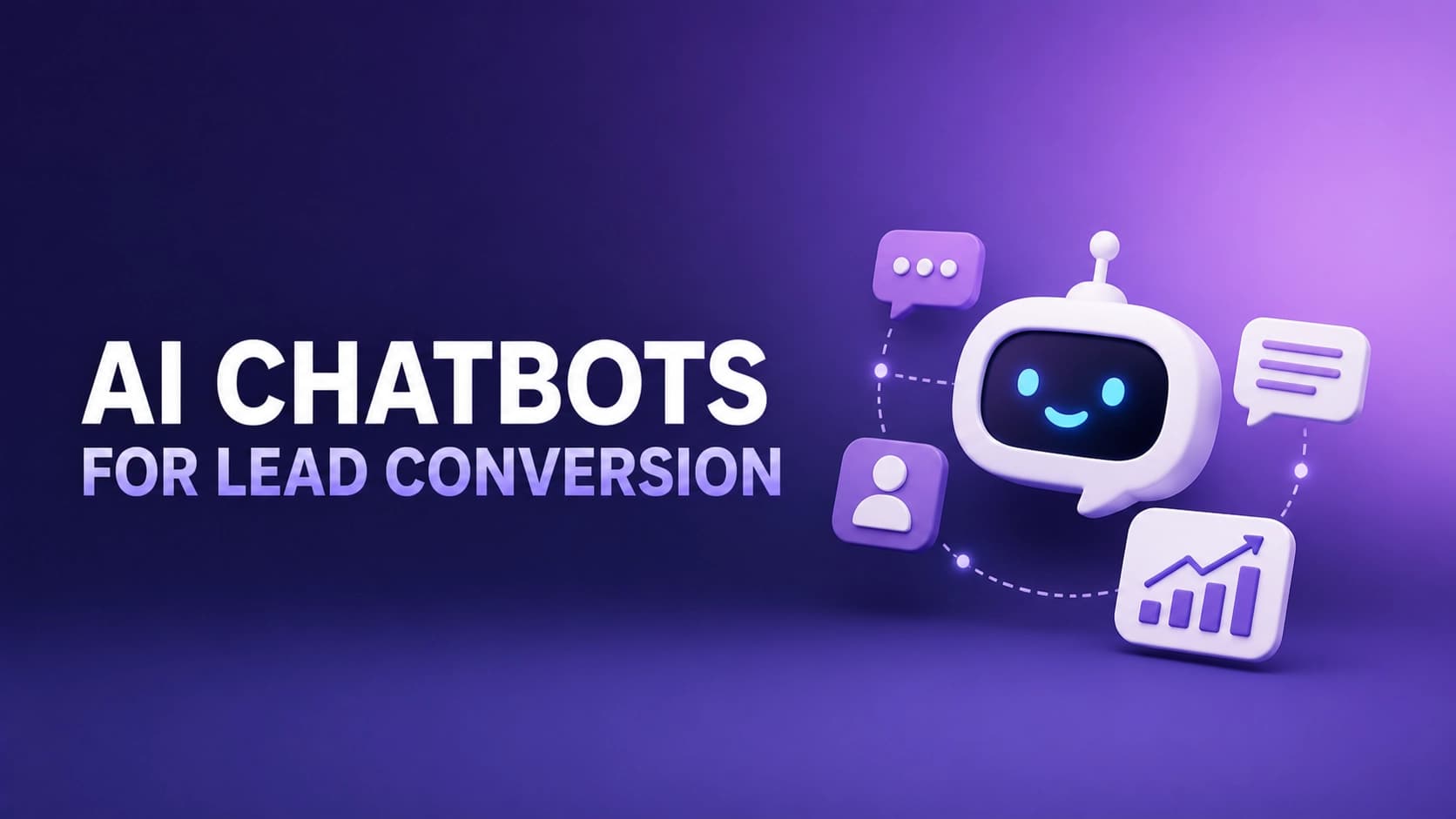
What Are AI Chatbots for Lead Conversion?
An AI chatbot for lead conversion is software that engages your website visitors automatically — asking the right questions, capturing contact details, qualifying interest, and booking meetings — without any human involvement.
Think of it as a sales rep available 24/7 who never gets tired, never misses a follow-up, and can handle ten conversations simultaneously.
Here's what this looks like in practice:
- Instant engagement: A visitor lands on your pricing page at 9 PM. Instead of leaving, they get a message: "Have questions about pricing? I can help." The conversation starts — and the lead is captured.
- Qualification without a form: The bot asks smart questions (company size, use case, timeline) and scores the lead before it ever reaches your inbox.
- Automatic meeting booking: Qualified prospects pick a time from the bot. No email chains. No SDR required.
- 24/7 coverage: Your chatbot works nights, weekends, and holidays — every visitor gets a response, not a form that sits unread until Monday.
For a small business without a dedicated sales team, this is the difference between capturing a lead and losing one to a competitor who responded faster.
To understand how chatbots fit into your overall AI stack, read our guide on Complete Guide to Choosing AI Software for Your Business (2026 Edition).
Why Small Businesses Are Betting on AI Chatbots
Speed is the biggest driver. Research shows that responding to a lead within five minutes makes you 9x more likely to convert them — yet most small businesses take hours, sometimes days. An AI chatbot eliminates that gap entirely.
The broader data makes an equally strong case:
- 38% of consumers prefer chatbot conversations over waiting for a human agent.
- Businesses using AI chatbots report 67% higher lead capture rates than static forms alone.
- A well-configured chatbot can qualify and route leads 10x faster than a manual intake process.
- US small businesses that deployed chatbots in 2025 reported an average 30% reduction in cost per lead.
The businesses still relying only on contact forms aren't just slower — they're losing leads to competitors who respond before the visitor even thinks about leaving.
- 38% of US consumers prefer chatbot interactions over waiting for a live agent
- 67% higher lead capture rates reported by businesses using AI chat vs. forms only
- 9x more likely to convert a lead if you respond within 5 minutes — chatbots do it instantly
- 30% average reduction in cost-per-lead after chatbot deployment
- 3x–5x ROI within the first 90 days when chatbots are properly configured
According to research from McKinsey, AI-driven customer interaction tools like chatbots are becoming a standard part of modern business operations, especially for small and mid-sized companies.
Best AI Chatbots by Use Case (Quick Comparison)
| Use Case | Best Tool |
|---|---|
| Beginners | Tidio |
| B2B Lead Qualification | Intercom Fin AI |
| Social Media Leads | ManyChat |
| HubSpot Users | HubSpot Chatbot |
8 Best AI Chatbots to Capture and Qualify Leads 24/7 (2026)
All pricing reflects current starter plan costs in USD. Free tier availability is noted where applicable.
1. Tidio
Tidio is the most beginner-friendly AI chatbot on this list — and one of the most capable at its price point. Its built-in AI agent, Lyro, handles conversations naturally, answers product questions, qualifies visitors, and books meetings without any scripting required. For small businesses, this means your website starts capturing leads the same day you install it.
Setup takes a few hours. You don't need a developer. And Lyro handles the majority of common questions without constant updates.
Key Features:
- Lyro AI chatbot for automated visitor qualification
- Pre-built playbooks for sales, support, and lead capture flows
- Live chat fallback when human follow-up is needed
- Email and Messenger integration
- Conversation analytics and performance reporting
Pricing (USD):
- Free: 50 Lyro conversations/month
- Starter: $29/month
- Growth: $59/month
- Tidio+: Custom pricing
Pros:
- Fastest setup of any tool on this list — live in hours
- Genuinely capable AI, not just keyword-triggered responses
- Strong free tier to test before committing
Cons:
- Lyro conversation limits apply on lower plans
- Customization options are more limited on the Starter plan
Best For: Small businesses and e-commerce stores that want to start capturing and qualifying leads from their website immediately — without any technical setup.
2. Intercom Fin AI
Intercom's Fin is an AI agent that sits at the front of your inbound funnel. It reads your product documentation, your FAQs, and your help content — then uses that to answer customer questions instantly and accurately. Complex or sales-ready leads get routed to a human. Routine questions get resolved automatically.
For small businesses managing high inbound volume, Fin meaningfully reduces how much time your team spends answering the same questions over and over.
Key Features:
- AI agent trained on your own product documentation
- Smart handoff to human reps for complex or high-value conversations
- Multi-channel support: chat, email, WhatsApp
- Conversation analytics and resolution reporting
- Full integration with the Intercom platform
Pricing (USD):
- Essential: $39/month per seat
- Advanced: $99/month per seat
- Fin AI agent: $0.99 per resolved conversation
Pros:
- Handles a high volume of routine questions automatically
- Easy to train using content you already have
- Reduces support burden while keeping qualified leads moving
Cons:
- Per-resolution pricing adds up at scale
- Full value requires the broader Intercom suite
Best For: Small businesses with consistent inbound inquiry volume where a large portion of questions are repetitive enough for AI to handle reliably.
3. Drift
Drift is purpose-built for B2B pipeline acceleration. It identifies high-intent visitors using firmographic data, routes them to the right rep, and books meetings inside the chat window — without a form in sight. For SaaS companies and B2B service businesses where deal size is meaningful, Drift speeds up the entire top-of-funnel process.
Key Features:
- AI-powered visitor identification and intent scoring
- Real-time alerts when target accounts land on your site
- Meeting booking directly inside the chat window
- ABM integrations with Salesforce and HubSpot
Pricing (USD):
- Premium: Starts at ~$2,500/month (billed annually)
- Enterprise: Custom pricing
Pros:
- Best-in-class for B2B pipeline acceleration
- Identifies and prioritizes high-value accounts in real time
- Deep CRM integrations
Cons:
- Expensive — not suited for early-stage or solo businesses
- Overkill for simple or transactional sales cycles
Best For: B2B SaaS companies and agencies with an established pipeline where deal value justifies the investment.
4. ManyChat
ManyChat operates where many of your customers already are: Instagram DMs, Facebook Messenger, WhatsApp, and SMS. If your business runs social media campaigns or drives traffic through paid ads, ManyChat turns those interactions into automated lead qualification sequences — instantly, before anyone reaches your website.
Key Features:
- Automated DM flows on Instagram, Facebook, and WhatsApp
- SMS and email follow-up sequences
- Lead capture without a website
- Keyword-triggered conversation starters
- E-commerce integrations (Shopify, WooCommerce)
Pricing (USD):
- Free: Up to 1,000 contacts
- Pro: $15/month (scales with contact count)
- Elite: Custom pricing
Pros:
- One of the lowest entry prices on this list
- Captures leads where your social audience already is
- No technical knowledge required
Cons:
- Limited to messaging channels — not website-first
- Conversation logic gets complex at scale
Best For: Small businesses and e-commerce brands driving leads through Instagram, Facebook ads, or WhatsApp campaigns.
5. Freshchat
Freshchat is the messaging and chatbot layer inside the Freshworks ecosystem. It pairs AI-powered bot automation with a unified inbox for chat, email, and social messages — making it one of the most complete budget-friendly options on this list. If you're already using Freshdesk or Freshsales, it's a natural add-on that keeps everything connected.
Key Features:
- AI chatbot for lead qualification and FAQ resolution
- Unified inbox across chat, email, and social
- Proactive messaging triggered by visitor behavior
- CRM sync with Freshsales and Zapier integrations
- Multilingual support for global teams
Pricing (USD):
- Free: Up to 10 agents
- Growth: $19/month per agent
- Pro: $49/month per agent
Pros:
- Generous free plan with real usability
- Strong multilingual support for non-US audiences
- Works well as part of the Freshworks stack
Cons:
- AI less advanced than Tidio or Intercom at lower tiers
- Can feel dense for first-time users
Best For: Small businesses in the Freshworks ecosystem, or teams needing a solid multi-channel inbox without enterprise pricing.
6. HubSpot Chatbot Builder
If you're already on HubSpot CRM, the HubSpot Chatbot Builder is your fastest path to a live chatbot. It's included in the free CRM, it syncs directly to your contact database, and every conversation automatically enriches existing records. No integration setup. No extra subscription. It just works with what you already have.
Key Features:
- Native HubSpot CRM integration (contacts sync automatically)
- Visual drag-and-drop flow builder — no coding
- Meeting scheduling linked to HubSpot Calendar
- Lead routing to the right rep
Pricing (USD):
- Free CRM includes basic chatbot: $0
- Marketing Hub Starter (advanced features): $20/month
- Professional: $890/month
Pros:
- Free if you're already on HubSpot
- Every chatbot conversation updates your CRM instantly
- Seamless meeting booking with HubSpot Meetings
Cons:
- AI capabilities more limited than dedicated tools
- Advanced automation requires paid Marketing Hub plans
Best For: Small businesses already using HubSpot CRM who want chatbot functionality without adding another tool to manage.
7. Landbot
Landbot builds conversational landing pages — full-screen interactive flows that feel like a real conversation rather than a static form. Conversion rates on Landbot flows consistently outperform equivalent landing page forms, which makes it particularly valuable for lead generation campaigns and product demos.
Key Features:
- No-code visual builder for conversational flows
- Embeddable as a chat widget, full-page, or pop-up
- Conditional logic for branching paths
- Native integrations with HubSpot, Salesforce, and Zapier
- WhatsApp bot support
Pricing (USD):
- Sandbox: Free (limited features)
- Starter: $45/month
- Pro: $110/month
Pros:
- Higher engagement than standard lead forms
- No developer required
- Flexible: website, pop-up, or WhatsApp
Cons:
- Higher starting price than simpler options
- More than most businesses need for basic chat
Best For: Small businesses where contact forms are underperforming and you want a more engaging, conversational alternative for lead capture campaigns.
8. Chatfuel
Chatfuel is built for e-commerce brands that sell through Facebook, Instagram, and WhatsApp. It automates product recommendations, abandoned cart recovery, and post-purchase follow-ups — and added website chat in 2025. If your customers live on social channels and you're leaving DMs unattended, Chatfuel fixes that at a low monthly cost.
Key Features:
- AI chatbot for Messenger, Instagram, and website chat
- Abandoned cart recovery via automated messaging
- Product recommendation flows for e-commerce
- Shopify and WooCommerce integrations
Pricing (USD):
- Business: $19.99/month (up to 1,000 conversations)
- Enterprise: Custom pricing
Pros:
- Very affordable for social e-commerce use cases
- Easy setup — no technical skills needed
- Strong abandoned cart recovery
Cons:
- Less suited for complex B2B qualification
- Website chat is newer and less polished
Best For: E-commerce small businesses wanting to automate lead follow-up and product engagement on social messaging channels.
Industry research from Gartner shows that 85% of customer service leaders are already exploring or piloting conversational AI solutions, highlighting how quickly chatbots are becoming a primary channel for customer engagement and lead generation.
At a Glance: Best AI Chatbots for Lead Conversion (2026)
| Tool | Starting Price | Best For | Key Feature | Ease of Use |
|---|---|---|---|---|
| Tidio | Free / $29/mo | All-around lead capture | Lyro AI conversation agent | ⭐⭐⭐⭐⭐ |
| Intercom Fin AI | $39/mo + $0.99/resolution | Inbound qualification at scale | Trained on your own docs | ⭐⭐⭐⭐ |
| Drift | ~$2,500/mo | B2B pipeline acceleration | Real-time account identification | ⭐⭐⭐ |
| ManyChat | Free / $15/mo | Social media lead capture | Instagram & WhatsApp automation | ⭐⭐⭐⭐⭐ |
| Freshchat | Free / $19/mo | Budget multi-channel chat | Unified inbox + AI bot | ⭐⭐⭐⭐ |
| HubSpot Chatbot | Free / $20/mo | HubSpot CRM users | Native CRM integration | ⭐⭐⭐⭐⭐ |
| Landbot | Free / $45/mo | Lead gen campaigns | Conversational landing pages | ⭐⭐⭐⭐ |
| Chatfuel | $19.99/mo | E-commerce social chat | Abandoned cart + product recs | ⭐⭐⭐⭐ |
How to Choose the Right AI Chatbot for Lead Conversion
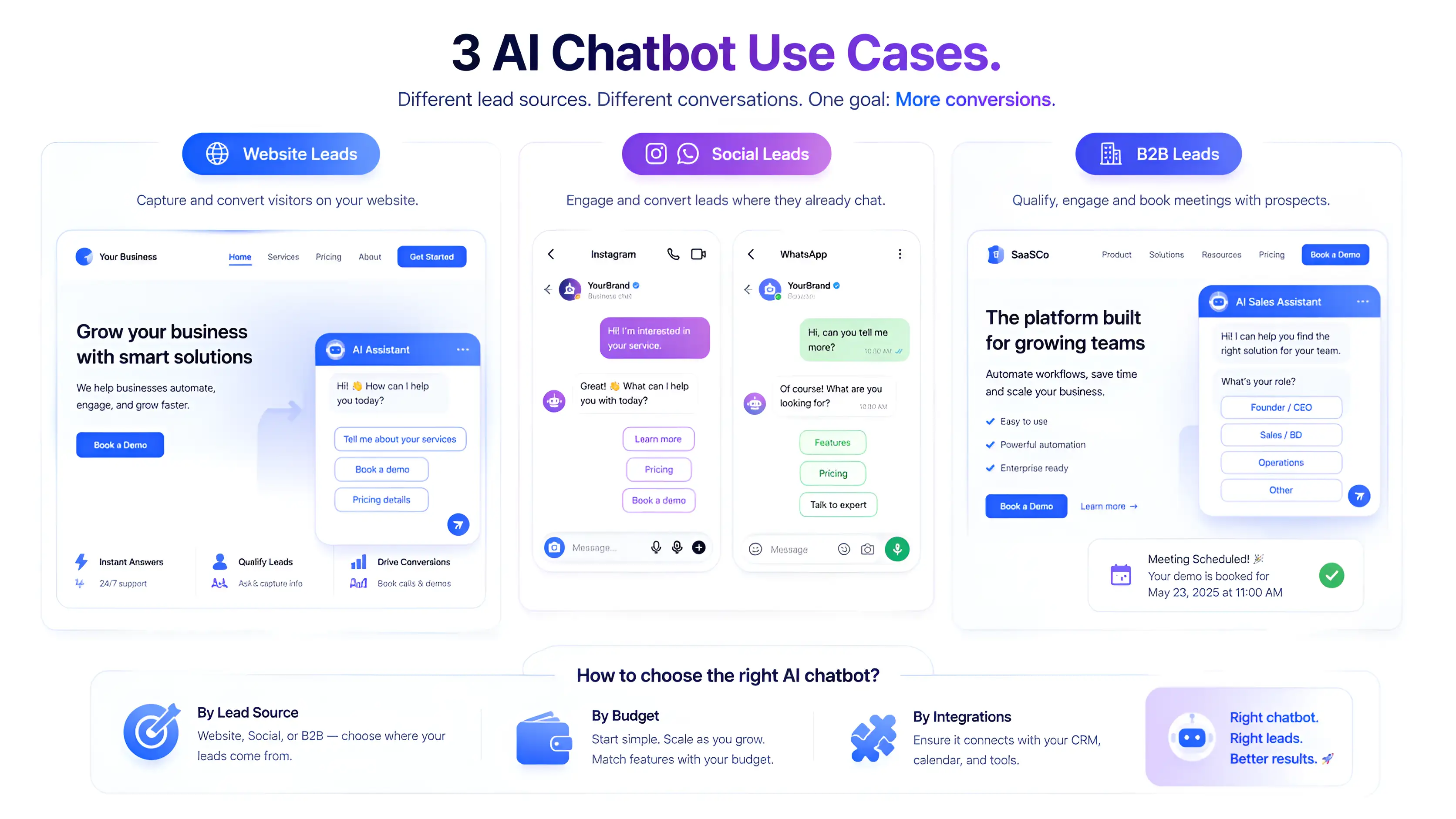
1. Where do your leads come from?
This is the most important question. Website-first businesses should look at Tidio, Freshchat, or HubSpot Chatbot. Instagram and WhatsApp-driven businesses will get more from ManyChat or Chatfuel. B2B teams with an inbound content strategy should evaluate Drift or Intercom Fin.
2. What's your budget?
You can get started for $0 with HubSpot's free chatbot, Tidio's free tier, or Freshchat's free plan. For most small businesses, a $30–$60/month budget covers everything they need. Drift is the only tool here that requires significant upfront investment — suited for teams where deal value justifies the spend.
Before choosing a paid chatbot, estimate expected returns using our AI ROI Calculator.
3. How much setup time do you have?
Tidio, ManyChat, and HubSpot Chatbot go live in under two hours with zero coding. Landbot takes longer to build out flows but still requires no developer. Intercom Fin and Drift need more onboarding but come with dedicated support.
4. Does it need to connect to your CRM?
HubSpot users: the native chatbot builder is the cleanest fit. Salesforce users: Drift and Intercom integrate tightly. Everyone else: Tidio and Landbot connect via Zapier or built-in integrations.
If you're integrating chatbot leads into your CRM, you can estimate total software costs using our CRM Cost Calculator.
Start with the channel where most of your leads already arrive — your website, Instagram, or email — and pick the tool built for that. A chatbot on the right channel outperforms a better chatbot on the wrong one, every time.
Use Cases: How Small Businesses Are Using AI Chatbots for Lead Conversion
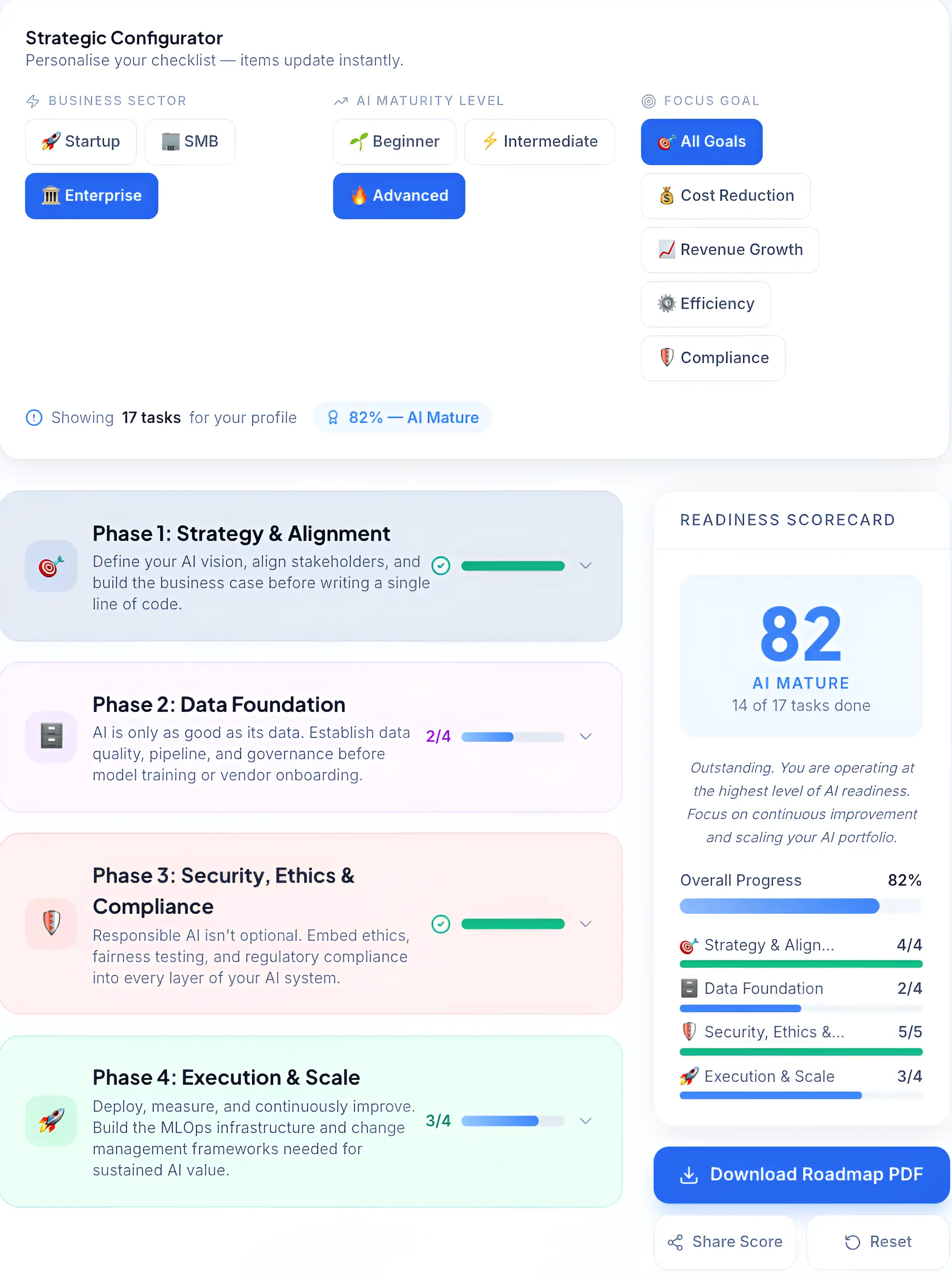
TechAiGoz Strategic Configurator: Tailor your AI adoption journey with our 4-phase readiness scorecard to ensure compliance and scalability.
Capturing Website Visitors Before They Leave
Most visitors leave without filling out a form. An AI chatbot changes that by initiating a conversation based on the page a visitor is viewing and how long they've been there — capturing intent before it disappears. Instead of waiting on a "Contact Us" click, you're already in a conversation.
If you're building a full sales system around these workflows, also see our guide on AI Sales Automation Tools for Small Businesses (2026 Guide).
Qualifying Leads Without an SDR
Rather than routing every inquiry to a human first, chatbots ask the qualifying questions (budget, timeline, use case) and sort responses automatically. Only leads that meet your criteria reach a salesperson's inbox — saving your team time and improving the buyer experience at the same time.
Booking Demos While You Sleep
High-intent visitors get walked through a short qualification flow and presented your calendar directly inside the chat. By the time you start your day, the meeting is already confirmed. No email chains. No scheduling friction.
If you're optimizing your scheduling flow beyond chat, explore our guide on AI Appointment Booking Tools for Businesses (2026 Guide).
Social Commerce and DM Follow-Up
For businesses running Instagram or Facebook ads, tools like ManyChat auto-respond to comments or DMs with a lead capture sequence. A user replies "interested" — and within seconds, they're in a conversation that qualifies them and stores their contact information automatically.
Businesses that combine chatbot qualification + instant booking see up to 2–3x higher meeting conversion rates compared to forms alone.
Pros and Cons of AI Chatbots for Lead Conversion
Pros
- Capture and qualify leads 24/7 — including nights, weekends, and holidays
- Respond to visitors instantly, dramatically improving conversion rates
- Reduce the time your team spends on early-stage, unqualified inquiries
- Work as a scalable alternative to hiring an SDR for initial outreach
Cons
- Poorly configured bots can feel impersonal and drive visitors away
- Free plans have conversation or contact limits that may require upgrades quickly
- Some tools have a learning curve when building advanced qualification flows
- Over-automating can hurt conversions if the handoff to human reps isn't smooth