Introduction
Somewhere around 2024, a lot of small business owners started doing the math on their SaaS subscriptions — and didn't like what they saw. $29 here, $49 there, $99 for that tool you use twice a month. Add it up and you're easily spending $600–$900/month on software before you've paid anyone to actually do work.
That math is what drove the lifetime deal (LTD) market into serious territory. It's not just AppSumo impulse buyers anymore. Founders, lean teams, and operators are actively building permanent software stacks with one-time purchases — tools they own rather than rent.
The challenge in 2026 is that the LTD market is noisier than ever. Hundreds of AI tools launch with lifetime pricing every quarter, and not all of them survive. Knowing which ones to trust — and which ones to skip — is where most people get it wrong.
This guide covers the best AI tools currently available with lifetime deals, what each one actually does well, and the honest framework for deciding when an LTD makes sense versus when it's just a cheap distraction.
If you're also evaluating monthly AI tools alongside lifetime options, read our Complete Guide to Choosing AI Software for Your Business (2026 Edition) before committing to any stack.
Why Lifetime Deals Are Getting More Popular in 2026
According to Gartner’s SaaS market research, the average small business now uses multiple SaaS tools across operations,with adoption increasing rapidly over the past few years.
AI tools accelerated this. Every new productivity category — content writing, video, outreach, analytics, automation — spawned its own set of $30–$99/month tools. For a bootstrapped team, keeping up stopped making financial sense.
The shift happening now is what some operators call "stack ownership" — buying software the way you'd buy equipment. Pay once, use long-term, own the asset. It mirrors how hardware works, applied to software.
- Subscription fatigue: The average SMB pays for 12–15 SaaS tools monthly — up from 6–8 in 2021
- LTD growth: The AppSumo marketplace grew its active buyer base by 41% in 2025, driven primarily by AI tool launches
- Cost savings: Replacing 3 monthly tools with LTD equivalents saves the average team $180–$340/month in recurring spend
- Retention: LTD tools with active development teams show 68% user retention after 18 months — comparable to funded SaaS products
- Risk factor: Roughly 22% of LTD tools launched in 2023 either shut down or significantly limited features within 24 months
That last stat matters. The LTD market isn't risk-free, and we'll cover exactly how to protect yourself before you spend a dollar.
The Reality of AI Lifetime Deals (Read This Before You Buy Anything)
Here's the part most LTD guides skip because it's uncomfortable.
Why LTDs Work When They Work
A lifetime deal makes financial sense in one specific scenario: you have a clear, repeatable workflow — something you'll use weekly — and the tool covers it completely. Under those conditions, even a $99 LTD pays for itself in 2–3 months compared to a monthly subscription.
Early-stage businesses especially benefit. Before you're generating consistent revenue, one-time software costs are far easier to manage than recurring obligations. They also give you breathing room to test workflows without worrying about monthly burn.
The Hidden Risks Most Buyers Ignore
The most common failure mode isn't that the tool is bad. It's that the business behind it changes.
Tool shutdowns are real. A product built on OpenAI's API can go from functional to broken the moment API pricing changes or access policies shift. This happened to dozens of AI writing tools in 2023–2024 when GPT-4 pricing fluctuated.
"Lifetime" has a legal asterisk. Some tools define "lifetime" as the lifetime of the product, not your account. Read the terms before purchasing. The better LTD platforms (AppSumo, Dealify) have buyer protection policies, but they don't guarantee tool continuity.
Feature drift is real. A tool's $69 LTD tier might start with full access and quietly get reduced to a capped feature set after 12 months as the company pushes users toward annual subscriptions.
The checklist before any LTD purchase: active product changelog (updated in last 60 days), responsive founder or support team, clear API/infrastructure disclosure, and at least 50 verified reviews on the platform.
Best AI Tools with Lifetime Deals (2026)
All pricing reflects current one-time purchase rates. Always verify at checkout — LTD pricing can change without notice.
1. Mootion — Best for Social Media Videos ($79 one-time)
Mootion does one thing well: it turns text prompts and static images into short-form videos that actually look like they were made intentionally. Not Hollywood — but polished enough for Instagram, LinkedIn, and short ad formats.
For social media managers and founders who can't afford a video production workflow but need consistent visual content, Mootion hits the right trade-off. The output isn't cinematic, but it's clean, on-brand, and fast.
What works: Text-to-video pipeline is genuinely usable without editing experience. Image-based video creation is a strong differentiator — upload a product photo and it builds motion around it.
What doesn't: If you need professional editing controls, timeline precision, or complex scene transitions, Mootion isn't it. This is a "create and publish" tool, not a production suite.
Best for: Founders, social media managers, and small teams who need consistent video content without a production budget.
2. Teable — Best for Internal Tools and AI-Native CRM ($69 one-time)
Teable is what happens when someone builds Airtable from scratch with AI in mind rather than bolting it on. It functions as an AI-native database with custom workflow logic — useful for building lightweight CRMs, client trackers, content pipelines, and internal ops tools.
The setup requirement is real. Unlike a drag-and-drop CRM, Teable expects you to define your data model. But if you're willing to spend 3–4 hours setting it up properly, the result is a flexible, owned system that doesn't charge you per row or per workspace.
What works: Custom workflows, relational data, and AI field logic that can auto-categorize, summarize, or route records without additional tooling.
What doesn't: Out-of-box usability is lower than Notion or Airtable. Budget setup time.
Best for: Operators and small teams building internal tools, custom CRMs, or structured workflows without a developer.
3. Sendpilot — Best for B2B LinkedIn Outreach ($69 one-time)
Sendpilot automates LinkedIn outreach with AI-personalized messaging — it pulls context from a prospect's profile and generates a first message that doesn't read like a template. For B2B sales teams doing 30–50 outreach touches per week, that personalization layer matters.
The platform dependency is the honest caveat. LinkedIn's automation policies are aggressive, and any tool in this category operates in a gray zone. Sendpilot is built conservatively — delays, human-like behavior patterns — but no outreach tool is immune to account restrictions if volume gets too high.
What works: AI personalization on cold outreach meaningfully improves reply rates compared to generic templates.
What doesn't: You're dependent on LinkedIn's platform rules. Use conservatively.
Best for: B2B founders and sales reps doing consistent LinkedIn prospecting.
4. Robinize — Best for SEO Content Optimization ($69 one-time)
Robinize is a SERP analysis and content scoring tool — it analyzes the top-ranking pages for any keyword and tells you exactly what your content needs to compete: topic coverage, semantic terms, heading structure, and content length benchmarks.
What it won't do is write the content for you. Robinize is a strategist's tool, not a writer's tool. You still do the writing — it just tells you what the content needs to contain to have a legitimate shot at ranking.
For anyone managing SEO content regularly, the LTD pricing here is remarkable. Comparable monthly tools (Surfer SEO, Clearscope) run $89–$149/month. At $69 one-time, Robinize pays for itself inside the first two articles.
What works: SERP-based content scoring is accurate and actionable. The keyword gap analysis is particularly useful.
What doesn't: No AI writing generation — you need to bring your own writing.
Best for: Content marketers, SEO consultants, and bloggers optimizing articles for search.
5. Lebesgue — Best for Shopify Ad Analytics ($59 one-time)
Lebesgue connects to your Shopify store and advertising accounts (Facebook, Google) and shows you exactly where your ad spend is working and where it isn't — with benchmarks from similar stores in your category for comparison.
It's a niche tool. If you're not running a Shopify store with active paid advertising, this isn't relevant. But for e-commerce operators who are, the category benchmarking alone is worth the $59. Knowing your ROAS is 1.8x is useless without knowing that similar stores are averaging 2.4x.
What works: Benchmark comparisons and cohort-based ad ROI tracking give context that native ad dashboards don't provide.
What doesn't: Zero utility outside e-commerce/Shopify context.
Best for: Shopify store owners running paid ads on Facebook or Google.
Best AI Tools with Lifetime Deals — Comparison
If you just want a quick side-by-side breakdown, here’s how these tools compare at a glance:
| Tool | Price (One-Time) | Best For | Key Limitation |
|---|---|---|---|
| Mootion | $79 | Social video creation | Not for professional editing |
| Teable | $69 | Internal tools / CRM | Requires setup time |
| Sendpilot | $69 | B2B LinkedIn outreach | LinkedIn platform dependency |
| Robinize | $69 | SEO content optimization | Manual writing required |
| Lebesgue | $59 | Shopify ad analytics | E-commerce only |
Real Use Cases: What You Actually Get from LTD Tools
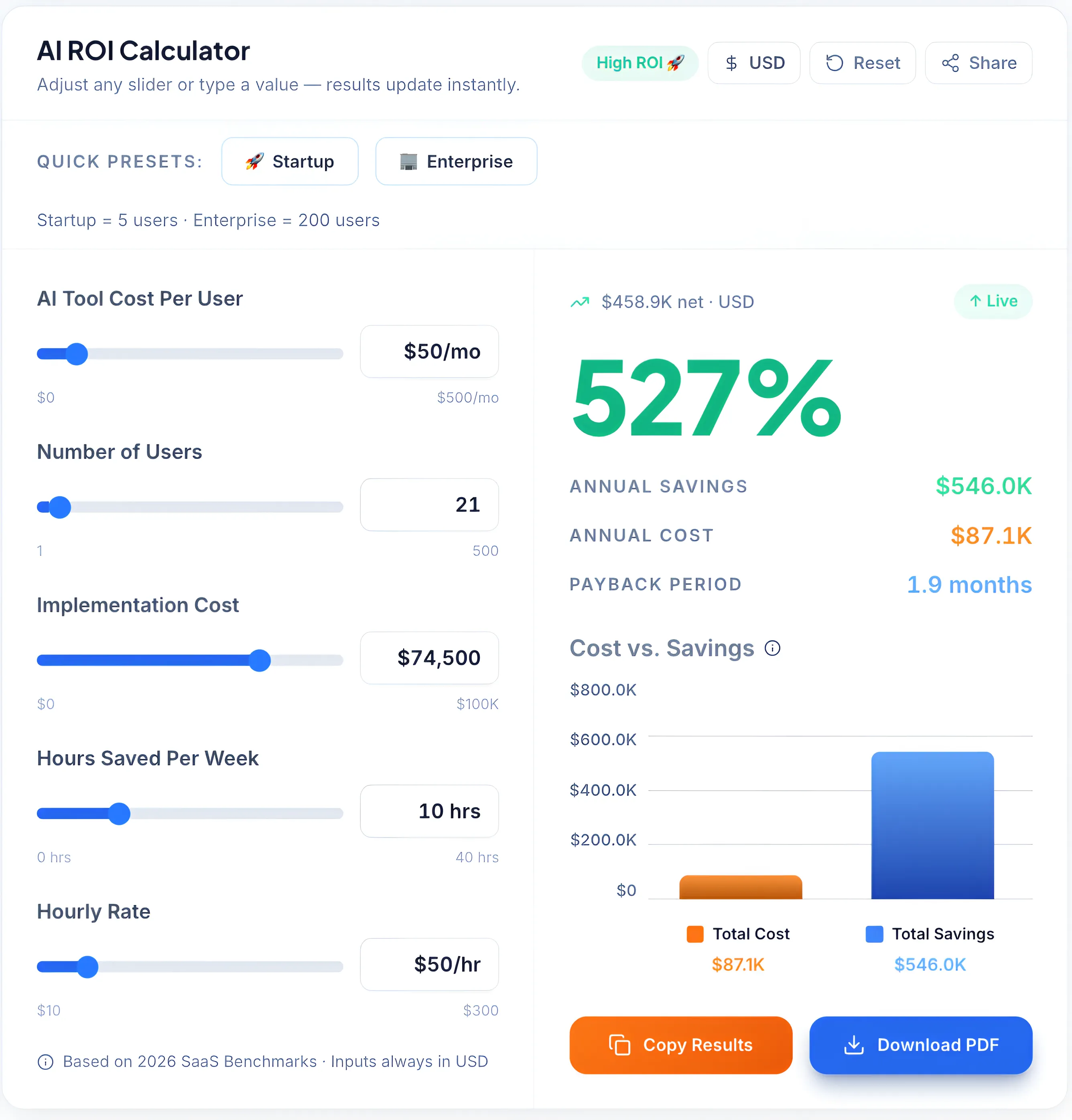
TechAigGo's Interactive AI ROI Calculator: A practical tool for founders to estimate annual savings and payback periods when implementing AI software in 2026.
The real value of a lifetime deal isn’t the price — it’s removing the monthly decision entirely — whether to keep paying, whether it's worth it this month, whether to cancel and restart.
A team using Robinize for weekly content optimization doesn't rethink the tool every billing cycle. It's just part of the workflow. That psychological shift matters more than most people admit — it's the difference between tools you use and tools you "subscribe to."
For lean teams (2–8 people), a well-chosen LTD stack can replace $300–$500/month in recurring subscriptions. Not by compromising on functionality — by making smarter one-time bets on tools that fit specific workflow slots.
The pattern that works: one LTD per workflow category (video, SEO, outreach, analytics). Not five tools per category because they were all cheap.
Based on current LTD market trends and platform data (AppSumo, Dealify)
Most buyers lose money on lifetime deals not because the tools are bad — but because they don’t map them to a real workflow. One well-used LTD tool delivers more ROI than five unused “cheap” purchases.
→ Curious how much you can actually save with lifetime deals? Use our AI ROI Calculator to compare one-time vs monthly tool costs instantly.
Best Lifetime Deal Stack by Use Case
| Use Case | Recommended LTD Stack | Monthly Cost Replaced |
|---|---|---|
| Content + SEO | Robinize + Pictory LTD (if available) | ~$150–$200/month |
| Social media | Mootion + scheduling tool LTD | ~$80–$120/month |
| B2B sales | Sendpilot + Teable (as CRM) | ~$120–$180/month |
| E-commerce | Lebesgue + Mootion (for ad creative) | ~$100–$150/month |
| Agency/freelancer | Robinize + Teable + Mootion | ~$200–$280/month |
According to data from platforms like AppSumo, the growth of lifetime deals has been driven by early-stage SaaS products looking to acquire users without traditional ad spend.
When Should You Buy a Lifetime Deal?
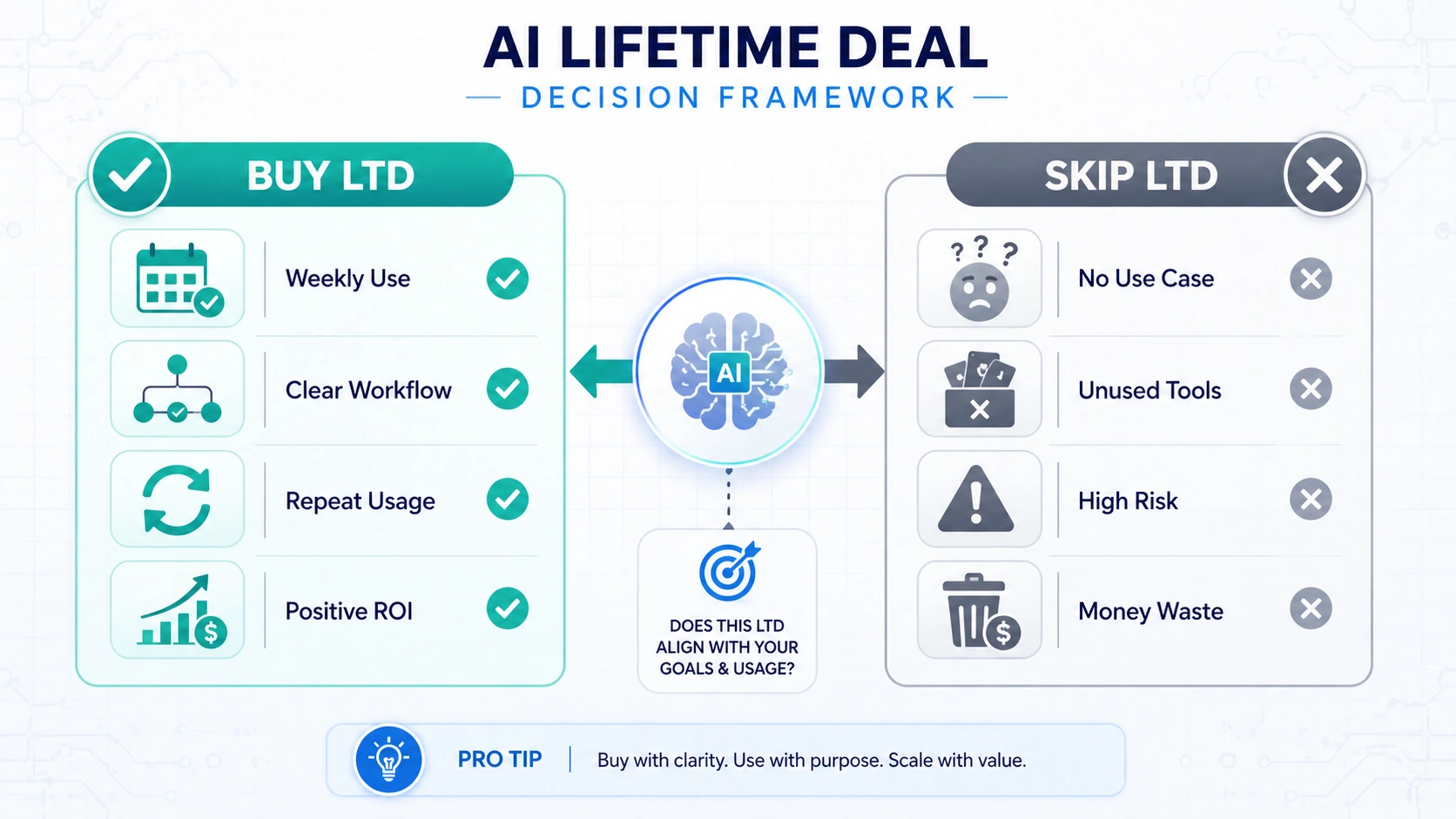
The AI Lifetime Deal (LTD) Decision Framework: Use this checklist to determine if a software deal aligns with your long-term business goals or if it's a potential waste of resources.
Buy when:
- The tool solves a specific workflow you run at least weekly
- The product has an active changelog and reachable founders
- You've tested the free trial or lowest tier and confirmed it delivers
- The company isn't exclusively API-dependent on a single provider
Skip it when:
- You're buying because it's cheap and might come in handy someday
- The tool is freshly launched with no reviews and no track record
- You have no immediate use case — "I'll figure out how to use it later" is how you build a graveyard of unused tools
- The LTD tier is meaningfully capped compared to paid plans
The discipline is the hard part. A $59 tool feels low-risk. But 12 of those is $708 and a stack you don't actually use.
If you're working with a tighter budget, check our breakdown of Top AI SaaS Tools Under $50/Month (2026) to build a lean, cost-efficient stack.
Common Mistakes with LTD Tools
AppSumo addiction. The platform is designed to make buying feel urgent and cheap. It's easy to buy 6 tools in a month because they were all under $100. The result is a cluttered stack where nothing gets used properly. Buy slow, use everything you buy.
Not checking the team. Before any LTD purchase, find the founders on LinkedIn or Twitter. Check if they're responsive. Look for a public roadmap or Discord. An unreachable team at launch is usually unreachable when something breaks.
Ignoring API dependencies. Any AI tool built purely on OpenAI or another external API carries structural risk. If that API changes pricing or access, the tool changes with it — and you can't renegotiate a lifetime deal.
Expecting SaaS-level support. LTD pricing is usually below what funded SaaS companies charge for a month. The support experience reflects that. If enterprise-grade support is a requirement, subscription tools are often the better fit.
→ Want to understand how tool costs impact your long-term SaaS revenue and growth? Try our AI & SaaS Revenue Calculator to model your projections.